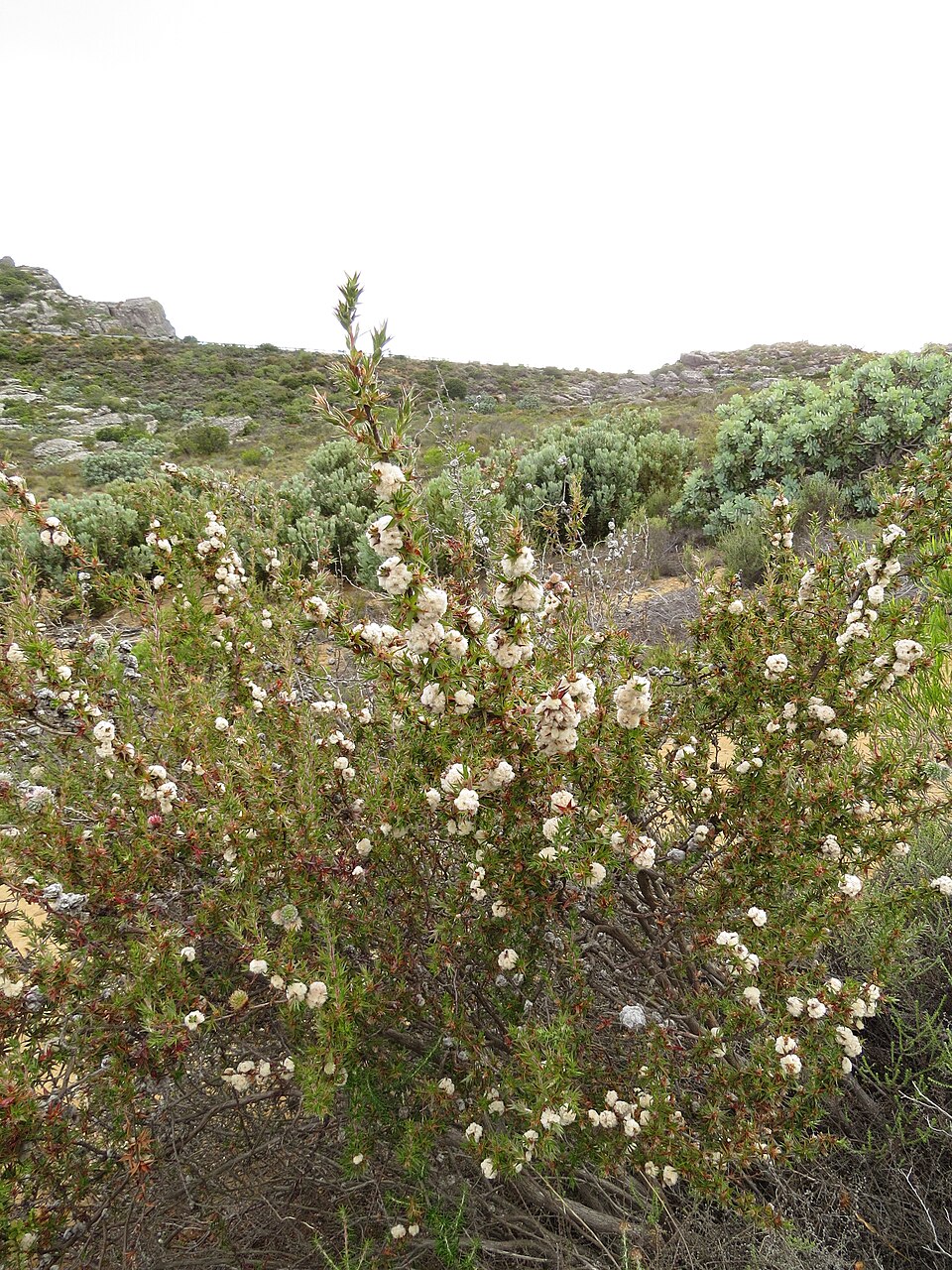
Cliffortia, Genus, spp., Multiple species,
- Genus
- Multiple species
Caperoses
Southern Africa (Cape Floristic Region)
Overview
Cliffortia is a large genus of about 130 evergreen shrubs in the rose family, Rosaceae, found almost entirely in southern Africa and concentrated in the Cape fynbos. Most species are wiry, heath-like shrubs 1.5–6 ft (0.5–1.8 m) tall, though some scramble or reach small-tree size. The leaves are small and tough, ranging from needle-like to three-pointed or rounded, and are often crowded along the stems or reduced to spines. Plants are dioecious, with separate male and female individuals, and the flowers are small, greenish or brownish, and without petals, since the genus is wind-pollinated rather than insect-pollinated. Male flowers shed pollen from dangling stamens, while female flowers form dry, sometimes winged fruits. Cliffortia grows on nutrient-poor, acidic, sandy soils in winter-rainfall and montane parts of the Cape, where many species resprout or seed after fire. The small leaves, spiny stems, and petal-less flowers give the genus little garden show, and its main use is in fynbos restoration and habitat planting. Most species are frost-tender.
Native Range
Cliffortia is native to southern Africa, with the great majority of species endemic to the Cape Floristic Region of South Africa and a few extending into tropical African mountains. It grows in fynbos, on rocky sandstone slopes, and along streams on acidic, sandy soils.Suggested Uses
Cliffortia is used mainly in fynbos restoration, habitat gardens, and water-wise plantings in Mediterranean and mild climates. Denser species serve as low informal screens or groundcover on sandy slopes, spaced 24–36 inches (60–90 cm) apart. Its small leaves and inconspicuous flowers place it among foliage and habitat plants more than flowering ornamentals.How to Identify
Appearance
Size & Dimensions
Height1'6" - 6'
Width/Spread1'6" - 5'
Colors
Bloom Information
Cliffortia flowers mainly in spring and early summer in its native range, roughly September to December in the southern hemisphere, though the petal-less flowers are easy to miss. Male plants release pollen in dry, breezy weather. Some species flower briefly after fire or over an extended period in mild sites.
Detailed Descriptions
Flower Description
greenish to brownFoliage Description
green to grey-greenGrowing Conditions
Sun Requirements
Requires 6-12 hours of direct sunlight daily
• Full Sun: 6+ hours of direct sunlight
• Partial Shade: 3-6 hours of direct sunlight
• Full Shade: Less than 3 hours of direct sunlight
Care & Maintenance
Care Guide
Cliffortia grows in full sun and sharp-draining, acidic, sandy soil with a pH of 4.5–6.0, matching the low-nutrient fynbos it comes from. Established plants tolerate summer drought and wind but resent rich feeding and waterlogged ground, which cause rapid decline. Most species are frost-tender and need a frost-free or lightly frosted site above about 28°F (−2°C). Light, infrequent watering suits container plants, and fertilizers high in phosphorus can harm this fynbos genus. Propagation is by seed, often aided by smoke treatment, or by cuttings, which can be slow to root. Few pests trouble it in a suitable open site.Pruning
Cliffortia needs little pruning beyond a light trim to shape young plants and remove dead wood. Like many fynbos shrubs, it regrows poorly from old leafless wood, so cutting hard into bare stems is avoided. Trimming after flowering keeps a denser habit in the more compact species.Container Growing
Suitable for container growing