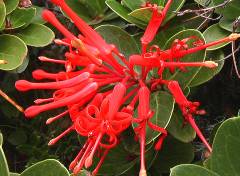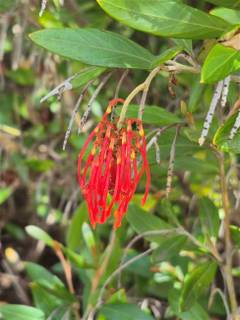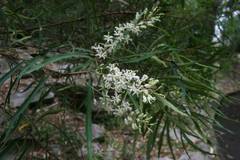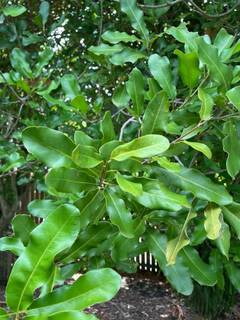
Image 1 of 10
1 / 10
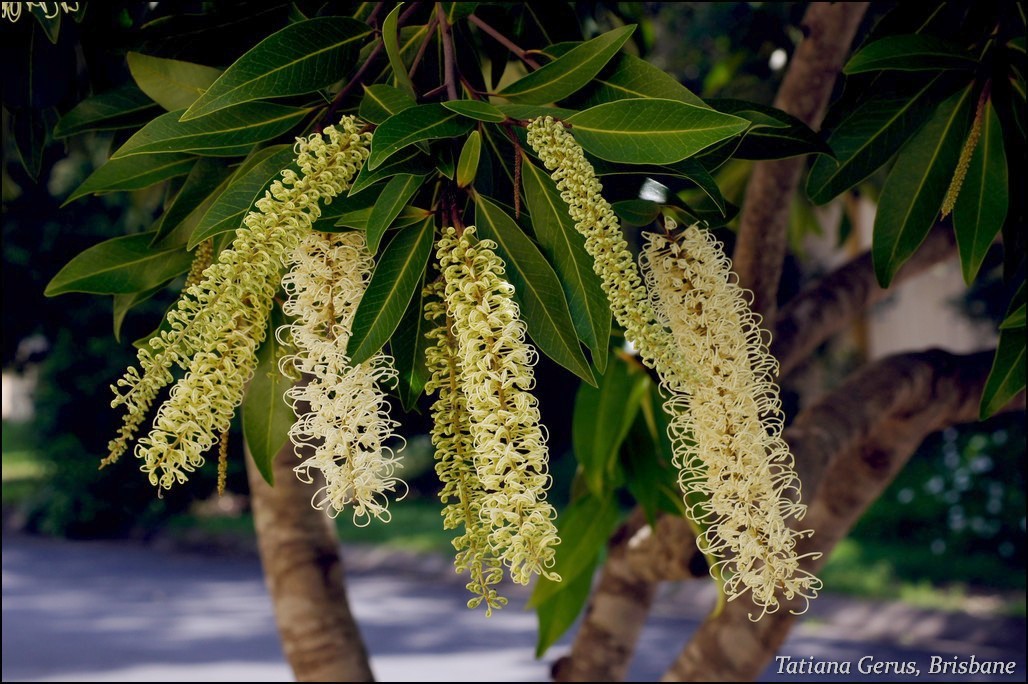
© Tatiana Gerus from Brisbane, Australia, some rights reserved (CC-BY-SA) · Wikimedia Commons
Buckinghamia, Genus, celsissima, Species,
- Genus & species
Ivory curl tree
Wet Tropics of north-eastern Queensland, Australia
Overview
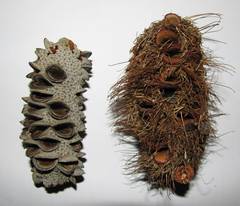
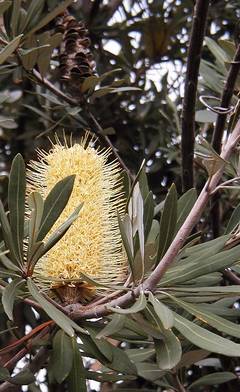
Buckinghamia celsissima is an evergreen tree in the Proteaceae reaching 100 feet (30 m) in rainforest and 16-30 feet (5-9 m) in cultivation, with a dense rounded to conical crown 10-20 feet (3-6 m) across. Bark is grey-brown and shallowly fissured. Adult leaves are alternate, simple, elliptic to oblong, 3-7 inches (8-18 cm) long and 1.2-2.8 inches (3-7 cm) wide, glossy dark green above and paler beneath; juvenile leaves on young plants and coppice shoots are deeply lobed with 3-7 divisions. New growth emerges bronze to copper-pink before hardening green. Flowers are cream to ivory, individually 0.4-0.6 inches (10-15 mm) long with a style that curls back on opening, packed into dense cylindrical racemes 4-8 inches (10-20 cm) long that arch or hang from the branch tips between December and April. The flowers carry a honey scent and produce nectar taken by honeyeaters, native bees and beetles. Fruit are woody follicles 0.6-1 inch (15-25 mm) long holding two winged seeds. Growth runs 12-20 inches (30-50 cm) per year. Foliage is damaged below 32F (0C), roots are injured by soil phosphorus above 15 ppm, and raceme counts fall where summer rainfall drops under 24 inches (600 mm).
Native Range
Buckinghamia celsissima is endemic to north-eastern Queensland, Australia, occurring in the Wet Tropics between Cooktown and Ingham, including the Atherton Tableland. It grows in upland and lowland rainforest and along rainforest margins from 300 to 3,900 feet (100-1,200 m) on basaltic and granitic soils. The genus holds two species, both confined to this region.Suggested Uses
Planted as a street and park tree across coastal Queensland and northern New South Wales, spaced 16-26 feet (5-8 m) apart, with the shallow root system allowed for near paving. Used as a screening and shade tree in subtropical gardens and grown in containers of 20 gallons (76 litres) or larger on frost-free patios. Flowering trees are worked by commercial apiaries during the January to March flush.How to Identify
Appearance
Size & Dimensions
Height16' - 100'
Width/Spread10' - 20'
Bloom Information
Flowering runs from December to April in eastern Australia, with the heaviest flush from January to March. Racemes take 6-8 weeks from first visible bud to full opening, and each raceme holds colour for 2-3 weeks as individual flowers open in sequence from the base upward. Trees in full sun carry three to five times the raceme count of those in part shade. Flowering begins on plants 4-6 years old from seed and 2-3 years from cutting-grown stock.
Detailed Descriptions
Flower Description
Cream to ivoryFoliage Description
Glossy dark green, new growth bronze to copper-pinkGrowing Conditions
Sun Requirements
Requires 5-10 hours of direct sunlight daily
• Full Sun: 6+ hours of direct sunlight
• Partial Shade: 3-6 hours of direct sunlight
• Full Shade: Less than 3 hours of direct sunlight
Care & Maintenance
Care Guide
Buckinghamia celsissima grows in full sun to light shade with 5-10 hours of direct exposure, and raceme counts thin markedly under 5 hours. It roots on free-draining loam, sandy loam and light clay at pH 5.0-6.5, and shows interveinal leaf yellowing on alkaline soils above pH 7.5. Young trees take 8-13 gallons (30-50 litres) weekly through dry spells in the first two summers; established trees carry through 6-8 weeks without rain, then shed flower buds under longer stress. As a member of the Proteaceae it is injured by soil phosphorus above 15 ppm, so a low-phosphorus native formulation at 1.75 oz per square yard (50 g per square metre) in early spring meets its annual demand. Growth stops below 50F (10C) and foliage is damaged at 32F (0C), holding outdoor culture to USDA zones 10-11. The root system is shallow and surface roots lift adjacent paving within 10 feet (3 m).Pruning
Pruning is carried out in late autumn once flowering finishes, since racemes form on growth made during the preceding spring and summer. Tip pruning of 4-8 inches (10-20 cm) on plants under 5 years old builds a branched framework and raises raceme counts. The species reshoots from bare wood and trees cut back hard regenerate from epicormic buds along the trunk, though the lobed juvenile leaf form returns on that regrowth for 2-3 years. Cuts over 2 inches (50 mm) across close slowly in humid tropical conditions.Pruning Schedule
Prune: April–May
fall
Container Growing
Suitable for container growing
Minimum container size: 20 gallons