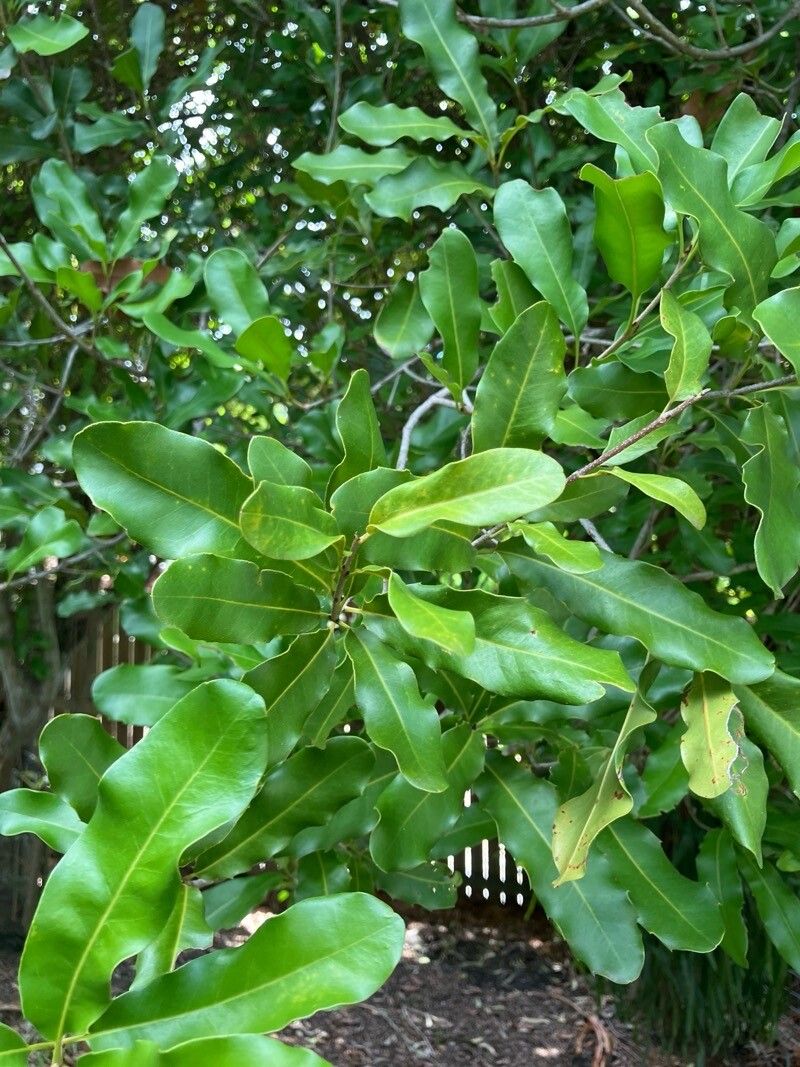
Macadamia, Genus, integrifolia, Species,
- Genus & species
macadamia nut
Coastal southeastern Queensland, Australia
Overview
Macadamia integrifolia is an evergreen subtropical nut tree native to coastal southeastern Queensland, Australia, growing 360-600 inches (9-15 m) tall and 240-360 inches (6-9 m) wide as a mature tree, with a dense rounded crown. Round to slightly oblong nuts 0.75-1.25 inches (2-3 cm) develop in pendulous racemes 4-12 inches (10-30 cm) long, ripening over 6-8 months from late summer through winter. Each nut consists of a smooth woody shell 2-3 mm thick enclosing a single creamy-white kernel — the kernel is approximately 78% oil and is harvested as nuts drop naturally to the ground. Long pendulous racemes of 100-300 small creamy-white to pale pink flowers 0.4-0.5 inch (10-12 mm) appear in late winter to early spring; flowers are mildly fragrant and attract bees. Self-fertile but cross-pollination with a second cultivar increases nut set 30-50 percent. Glossy dark green leathery oblong-elliptic leaves 4-12 inches (10-30 cm) long with smooth (rarely toothed) margins, arranged in whorls of three. Hardy to USDA zone 9 (20°F / -7°C); foliage damaged below 25°F (-4°C), branches damaged below 20°F (-7°C). Frost-free coastal subtropical climates are required for commercial production. Susceptible to phytophthora root rot (Phytophthora cinnamomi) in poorly drained soils and to macadamia felted coccid in some regions. Bears within 4-7 years of planting. Lifespan 80-100 years in cultivation. Zones 9-11.
Native Range
M. integrifolia is native to coastal southeastern Queensland, Australia, in subtropical rainforests at 0-600 m elevation. Commercial cultivation began in Australia in the late 19th century and expanded to Hawaii in the early 20th century, with Hawaii becoming the dominant producer until the late 20th century.Suggested Uses
Grown in commercial and home orchards in zones 9-11 with spacing of 240-360 inches (6-9 m) between trees. Frost-free coastal subtropical climates are required for reliable production. A second cultivar within 100 feet (30 m) increases nut set 30-50 percent. Ground harvest under tree canopy is the typical commercial practice — bare soil or short turf simplifies collection. Not commonly grown in containers due to mature size, though small specimens can be maintained in 25+ gallon (95+ L) containers in zone 8 with winter protection.How to Identify
Appearance
Size & Dimensions
Height30' - 50'
Width/Spread20' - 30'
Bloom Information
Long pendulous racemes 4-12 inches (10-30 cm) of 100-300 creamy-white to pale pink flowers appear in late winter to early spring (July-September in southern hemisphere; February-April in northern hemisphere). Flowers are mildly fragrant and attract honey bees. Bloom duration 3-5 weeks per raceme; total bloom 8-12 weeks across the canopy.
Detailed Descriptions
Flower Description
Creamy white to pale pinkFoliage Description
Glossy dark green, leathery, oblong-elliptic, smooth marginsGrowing Conditions
Sun Requirements
Requires 6-10 hours of direct sunlight daily
• Full Sun: 6+ hours of direct sunlight
• Partial Shade: 3-6 hours of direct sunlight
• Full Shade: Less than 3 hours of direct sunlight
Care & Maintenance
Care Guide
Full sun (6+ hours) for fruit production; tolerates light afternoon shade. Well-drained loam or sandy loam, pH 5.0-6.5; phytophthora root rot occurs in poorly drained soils. Water deeply 2-3 times weekly during establishment and during nut fill (late summer); established trees tolerate moderate drought but yield drops sharply. Hardy to USDA zone 9 (20°F / -7°C); foliage damage below 25°F (-4°C). A second cultivar within 100 feet (30 m) increases nut set 30-50 percent. Lifespan 80-100 years in cultivation.Pruning
Prune in late winter after the main harvest to remove dead, diseased, and crossing branches and to maintain a 240-360 inch (6-9 m) canopy. Heading cuts on bearing wood reduce yield for 1-2 years. Pendulous racemes form on second-year wood; preserve current-season growth.Pruning Schedule
Prune: February–March
winter
Container Growing
Minimum container size: 25 gallons