Image 1 of 12
1 / 12
Plant Reference
Grevillea, Genus, victoriae, Species,
- Genus & species
royal grevillea
Southeastern Australia — New South Wales and Victoria; alpine and subalpine zones at 4,000-6,500 feet (1,200-2,000 m) in rocky slopes and open eucalyptus woodland
Overview
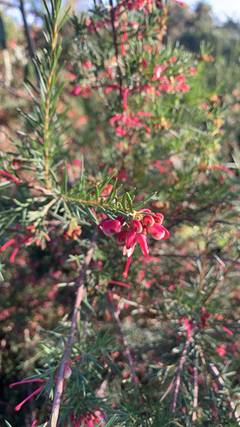
Grevillea victoriae is an upright broadleaf evergreen shrub in the protea family Proteaceae growing 72–96 inches (180–240 cm / 6–8 feet) tall and 60–96 inches (150–240 cm / 5–8 feet) wide from a woody base that produces arching spreading branches. The family Proteaceae is a Southern Hemisphere family that includes Banksia, Hakea, Protea, Leucadendron, and the commercially cultivated macadamia nut (Macadamia integrifolia and M. tetraphylla), and the family is characterized by proteoid (cluster) roots — dense clusters of slender rootlets that form seasonally on the root system and that are highly efficient at phosphorus uptake from phosphorus-poor soils. The cluster root adaptation is a response to the ancient phosphorus-depleted soils of Australia and southern Africa where the family evolved, and the consequence for garden cultivation is that standard phosphorus-containing fertilizers burn the cluster roots and can kill the plant — only low-phosphorus or phosphorus-free fertilizers are suitable for Grevillea and for other Proteaceae in cultivation. Leaves are gray-green to olive-green, oval, 3–6 inches (7–15 cm) long, with a slightly leathery texture and silvery undersides from a covering of short soft hairs. Pendant red to rust-orange spider-like flower clusters (racemes) 3–5 inches (7–13 cm) long open from May through July across a 6–8 week main bloom period, and the individual flowers carry long curved styles that extend beyond the floral tube after the flower opens — the curved protruding styles are the basis for the spider-flower common name applied to the genus. The flowers are nectar-rich and are a significant nectar source for hummingbirds in regions where Anna's hummingbird and other overwintering hummingbird species are present, and for honeyeaters in the species' native Australian range. The species is the hardiest of the commonly cultivated Grevillea species — tolerating brief periods to approximately 10 °F (−12 °C) and with foliage damage beginning at extended temperatures below 15 °F (−9 °C) — because the native range is the alpine and subalpine zones of southeastern Australia at 4,000–6,500 feet (1,200–2,000 m) elevation in New South Wales and Victoria where hard winter frosts are a regular feature of the climate. Limitation: sharp drainage is non-negotiable because the species develops root rot in heavy wet soil, and the combination of the phosphorus sensitivity and the drainage requirement limits the species' performance in gardens with routine phosphorus fertilization or with heavy clay soils. Native to southeastern Australia. Drought-tolerant once established. Non-toxic. Deer-resistant.
Native Range
Native to southeastern Australia — New South Wales and Victoria — growing in the alpine and subalpine zones at 4,000–6,500 feet (1,200–2,000 m) elevation on rocky slopes and in open eucalyptus woodland. The high-elevation native range is the basis for the species' cold hardiness within the genus Grevillea — the species tolerates brief periods to approximately 10 °F (−12 °C) and is the hardiest of the commonly cultivated members of the genus, supporting garden cultivation across USDA zones 8 and 9 where most other Grevillea species cannot be grown outdoors.Suggested Uses
Used in mixed shrub borders, as a flowering specimen shrub, in Mediterranean-climate dry gardens, in hummingbird-focused plantings, and in containers of at least 10 gallons (38 L) with sharp-drained potting mix at 60–96 inch (150–240 cm) spacing between plants in USDA zones 8 through 9. The long spring-through-summer bloom window, the hummingbird-drawing nectar-rich spider flowers, and the gray-green silvery-backed evergreen foliage combine for a year-round ornamental shrub in positions with sharp drainage and no phosphorus fertilization. Heavy clay gardens without substantial drainage amendment, positions with routine phosphorus fertilizer application, and cold-exposed sites in USDA zones colder than zone 8 are unsuitable because of the drainage requirement, the phosphorus sensitivity of the proteoid cluster roots, and the cold damage threshold of the species. Companion plantings with other Mediterranean and Australian native-climate plants — Leucadendron, Callistemon, Westringia, and Rosmarinus — build the low-phosphorus dry-garden palette that suits the species' cultural requirements.How to Identify
Appearance
Size & Dimensions
Height6' - 8'
Width/Spread5' - 8'
Bloom Information
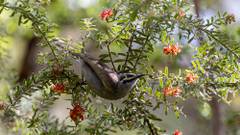
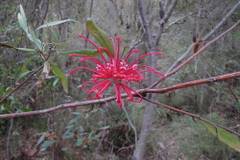
Pendant red to rust-orange spider-like flower clusters (racemes) 3–5 inches (7–13 cm) long open from May through July across a 6–8 week main bloom period. The individual flowers carry long curved styles that extend beyond the floral tube, giving the spider-flower appearance. The flowers are nectar-rich and are a significant nectar source for hummingbirds in regions where Anna's hummingbird and other overwintering hummingbird species are present. Sporadic rebloom through late summer and fall follows light deadheading after the main flush.
Detailed Descriptions
Flower Description
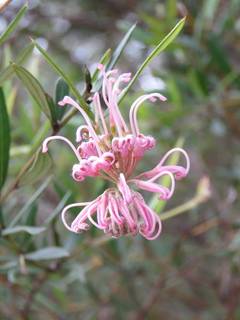
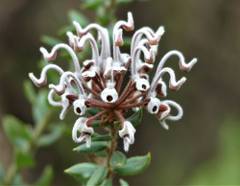
pendant red to rust-orange spider-like flower clusters (racemes) 3-5 inches (7-13 cm) long carrying 20-40 individual flowers each; the individual flowers have long curved styles that extend beyond the floral tube after the flower opens, and the curved protruding styles are the basis for the spider-flower common name applied to the genus GrevilleaFoliage Description
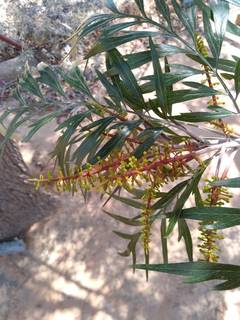
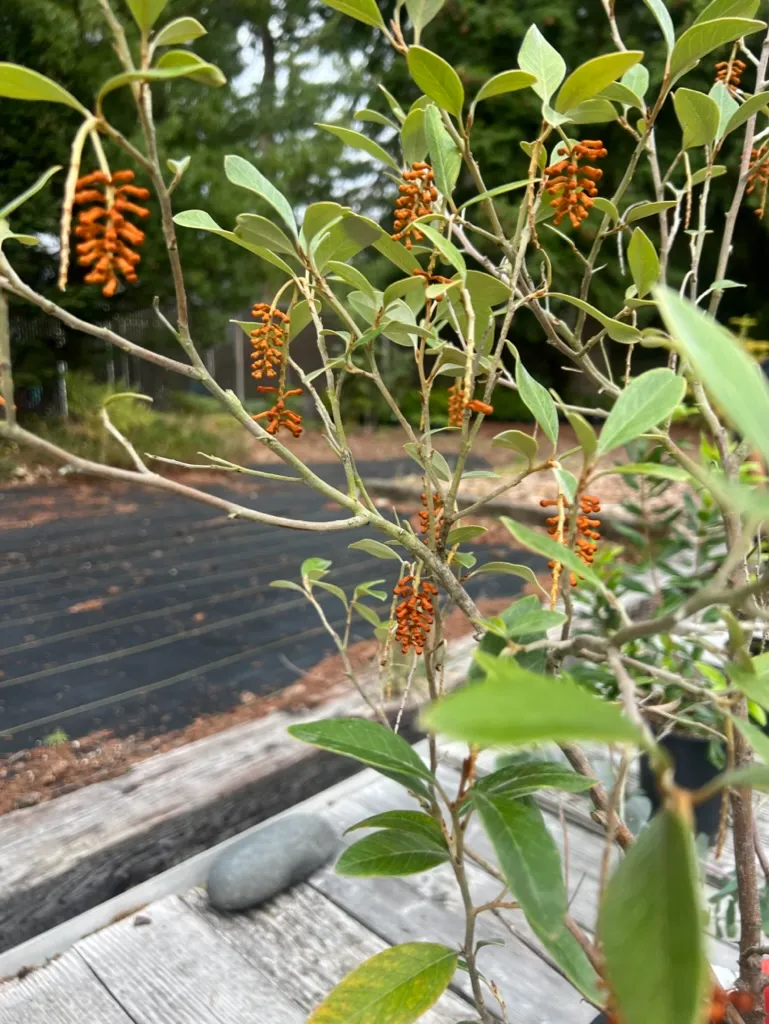
gray-green to olive-green oval leaves 3-6 inches (7-15 cm) long with a slightly leathery texture and silvery undersides from a covering of short soft hairs; evergreen year-round; the silvery underside is visible when wind lifts the foliageGrowing Conditions
Sun Requirements
Requires 6-10 hours of direct sunlight daily
• Full Sun: 6+ hours of direct sunlight
• Partial Shade: 3-6 hours of direct sunlight
• Full Shade: Less than 3 hours of direct sunlight
Care & Maintenance
Care Guide
Site in full sun with 6 or more hours of direct sun per day in sharp-drained sandy or sandy-loam soil with a pH of 5.5–7.0. Sharp drainage is non-negotiable because the species develops root rot in heavy wet soil. Only low-phosphorus or phosphorus-free fertilizers are suitable — standard phosphorus-containing fertilizers burn the proteoid cluster roots and can kill the plant, and this phosphorus sensitivity is shared across the family Proteaceae and applies to all cultivated Grevillea species. The species is the hardiest of the commonly cultivated Grevillea species (brief tolerance to 10 °F / −12 °C) but foliage damage begins at extended temperatures below 15 °F (−9 °C). Drought tolerance develops once the root system is established. Non-toxic and deer-resistant. The nectar-rich spider flowers draw hummingbird visitation. Hardy in USDA zones 8–9.Pruning
Tip-pruning after the main flowering flush (July or August) maintains a compact form and removes spent flower clusters to support a sporadic secondary flush. Hard renovation pruning back into old bare wood is avoided because regeneration from old wood is limited and unreliable, and heavy cutback can produce permanent bare gaps in the canopy. Light annual tip-pruning on young plants shapes the structural framework and supports dense branching.Pruning Schedule
Prune: August
summer
Container Growing
Suitable for container growing
Minimum container size: 10 gallons