Iris, Genus, germanica, Species, 'Beverly Sills', Cultivar,
- Genus & species
- Cultivar
beverly sills reblooming iris
Mediterranean Europe and western Asia (parent species)
Overview
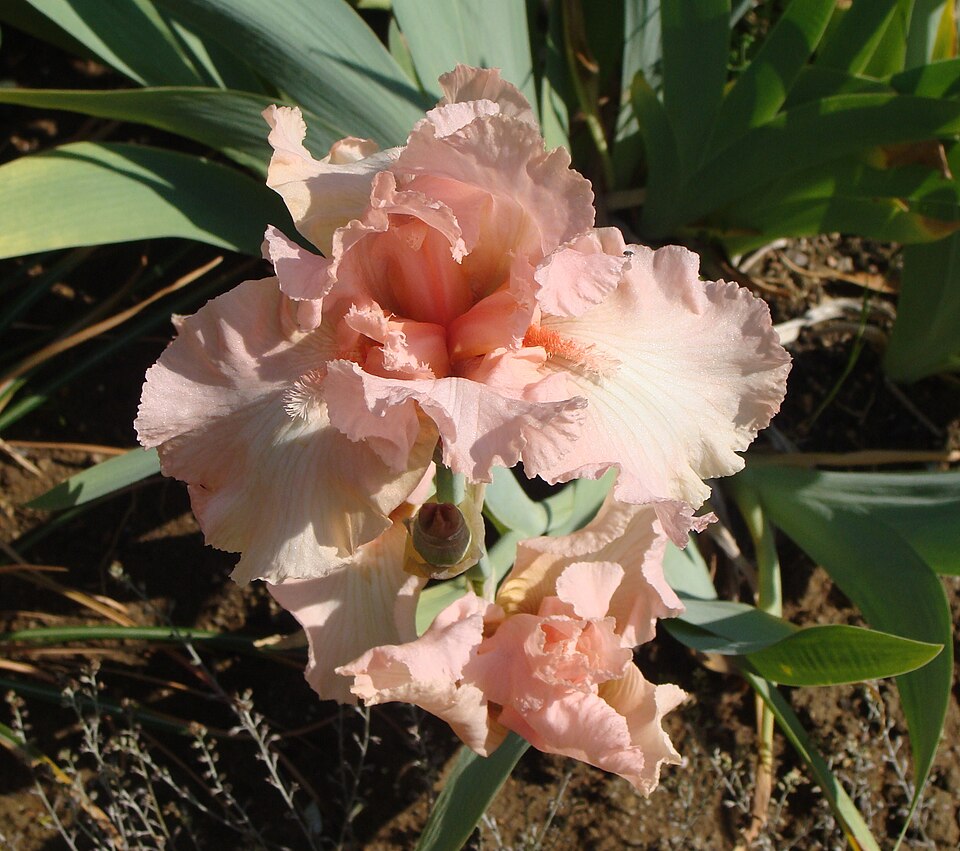
Iris germanica 'Beverly Sills' is a tall bearded iris reaching 35-37 inches (89-94 cm) tall in flower with a foliage clump 18-24 inches (45-60 cm) wide. Sword-shaped leaves grow in upright fans, gray-green, 18-24 inches (45-60 cm) long and 1-1.5 inches (2.5-4 cm) wide. Flowers measure 5.5-6 inches (14-15 cm) across with three upright standards and three drooping falls; both standards and falls are coral-pink with a tangerine-orange beard, and the falls show peach and rose veining at the heart. Each flower lasts 2-3 days; multiple buds per stalk extend bloom on a single stalk to 10-14 days. Stalks carry 7-10 buds with branched flowering. Spring bloom occurs in May-June across most zones; sporadic late-summer rebloom may occur in zones 6-9 on established clumps in favorable seasons but is not reliable. The cultivar was registered in 1979 by Bruce Hager and received the American Iris Society Dykes Medal in 1985. A light sweet fragrance is detectable within 18 inches (45 cm) of an open flower.
Native Range
Iris germanica is naturalized across the Mediterranean basin from Spain through the Balkans into western Asia, on dry, rocky slopes and limestone soils at 1,000-3,500 feet (300-1,070 m) elevation. The species is widely considered an ancient hybrid rather than a true wild taxon. The cultivar 'Beverly Sills' was registered by Bruce Hager of California in 1979.Suggested Uses
Used in perennial borders and cutting gardens, spaced 12-18 inches (30-45 cm) apart so rhizomes have room to expand at the soil surface. The mid-season bloom timing complements early-flowering perennials such as peonies and late-spring poppies. Grows in containers of 5 gallons (19 L) or larger with sharp drainage; flowering may decline after 2 years in containers without division.How to Identify
Appearance
Size & Dimensions
Height2'11" - 3'1"
Width/Spread1'6" - 2'
Bloom Information
Primary bloom occurs from late May through mid-June in zones 4-7 and from mid-April through May in zones 8-9. Each flower lasts 2-3 days; the spring flush extends 10-14 days per clump. Sporadic late-summer rebloom is possible in zones 6-9 in favorable years but not reliable. Bloom timing shifts 7-10 days earlier in unusually warm springs.
Detailed Descriptions
Flower Description
Coral-pink with tangerine-orange beard and peach-rose veining at the heartFoliage Description
Gray-greenGrowing Conditions
Sun Requirements
Requires 6-8 hours of direct sunlight daily
• Full Sun: 6+ hours of direct sunlight
• Partial Shade: 3-6 hours of direct sunlight
• Full Shade: Less than 3 hours of direct sunlight
Care & Maintenance
Care Guide
Plant rhizomes with the upper surface exposed; deeper planting reduces flowering and increases rot. Water weekly for the first growing season; established plants tolerate 3-4 weeks without rain. Apply a balanced low-nitrogen fertilizer in early spring and again after spring bloom; high-nitrogen feeding produces lush foliage and reduces flowering. Iris borer (a moth larva) tunnels into rhizomes in spring, causing soft rot and fan collapse; cut and discard infected fans and remove old foliage in late fall to break the life cycle. Bacterial soft rot develops in poorly drained soil; affected rhizomes turn mushy and foul-smelling. Divide every 3-4 years in July-August when bloom decreases.Pruning
Cut flower stalks to the base after bloom ends to redirect energy into rhizomes; foliage remains intact during bloom and for several weeks after to support rhizome growth. Remove yellowing or brown outer leaves at any time; lift damaged or borer-tunneled fans entirely. Cut all foliage to 4-6 inches (10-15 cm) in late October-November to reduce overwintering pests. Divide congested clumps in late July-August by lifting rhizomes, cutting healthy 3-4 inch (8-10 cm) sections each with a fan of leaves, and replanting at the original soil depth.Pruning Schedule
Prune: October–November
fall
Container Growing
Suitable for container growing
Minimum container size: 5 gallons