Betula, Genus, nigra, Species,
- Genus & species
river birch
Eastern North America (New Hampshire to Minnesota, south to Florida and Texas)
Overview
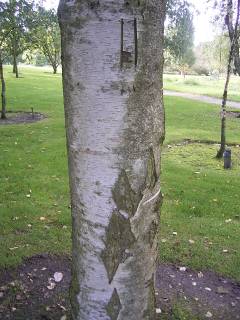
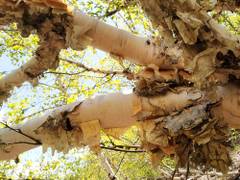
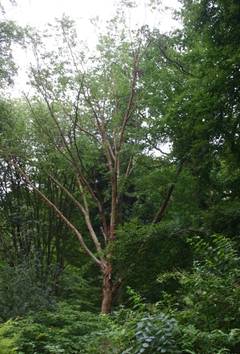
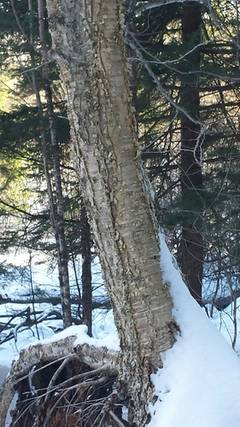
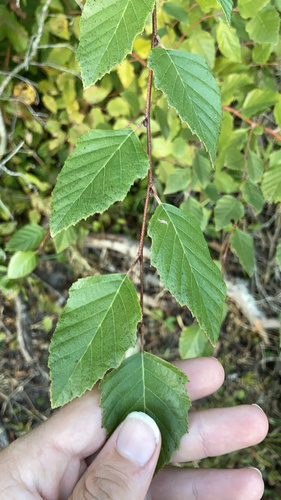
Betula nigra is a medium to large deciduous tree reaching 40–70 feet (12–21 m) tall with a spread of 35–50 feet (10.5–15 m). Frequently multi-stemmed, the species develops a broad, pyramidal to rounded crown. On young trees and upper branches, bark exfoliates in large, papery, curling sheets revealing layers of pinkish-salmon, cinnamon-brown, and cream-white beneath. With age, the lower trunk bark becomes thick, furrowed, and dark reddish-brown to nearly black — the basis for the species name 'nigra'. Leaves are rhombic-ovate, 1.5–3.5 inches (4–9 cm) long, glossy dark green above with silvery-white undersides that flash in the wind. Margins are doubly serrate with 7–9 pairs of lateral veins. Male catkins 2–3 inches (5–8 cm) long are pendant in clusters of 2–3 in March–April. Fall foliage turns yellow, often briefly, and color is inconsistent from year to year. Growth rate is fast at 18–30 inches (45–75 cm) per year. Among North American birches, the species carries the highest documented tolerance to heat and to bronze birch borer (Agrilus anxius), and is hardy into zone 9. It tolerates periodic flooding and also adapts to well-drained upland sites. Leaf drop often begins in late August in hot climates.
Native Range
Betula nigra is native to eastern North America, from New Hampshire west to Minnesota and south to northern Florida and eastern Texas. It occurs naturally along stream banks, floodplains, and swamp margins, typically in seasonally wet soils. Within the genus, it is the only birch native to the lowland southeastern United States.Suggested Uses
Used as a specimen tree, in groves, or along waterways and rain gardens at 20–30 foot (6–9 m) spacing. Multi-stemmed forms display the exfoliating bark across a wider surface. Tolerates wet sites where many other trees fail, which suits it to bioswales, detention basins, and floodplain restoration. Requires adequate space for the 35–50 foot (10.5–15 m) spread and is not grown in containers at mature size.How to Identify
Appearance
Size & Dimensions
Height40' - 70'
Width/Spread35' - 50'
Bloom Information
Male catkins 2–3 inches (5–8 cm) long emerge in March–April, earlier than most North American birches. Female catkins are smaller, upright, and borne on the same tree. Flowers are wind-pollinated. Small cylindrical seed cones 1–1.5 inches (2.5–4 cm) long ripen and disintegrate in late May–June.
Detailed Descriptions
Foliage Description
Glossy dark green above, silvery-white beneathGrowing Conditions
Sun Requirements
Requires 6-10 hours of direct sunlight daily
• Full Sun: 6+ hours of direct sunlight
• Partial Shade: 3-6 hours of direct sunlight
• Full Shade: Less than 3 hours of direct sunlight
Care & Maintenance
Care Guide
Plant in moist to wet, acidic to slightly alkaline soil (pH 4.5–7.0) in full sun. Tolerates periodic flooding, clay soils, heat, and humidity at levels that exceed those tolerated by B. alleghaniensis and B. papyrifera. Adapts to well-drained upland sites once established. Consistent moisture produces the fastest growth and fullest bark development. Among North American birches, this species shows the highest documented resistance to bronze birch borer, extending its viable range into zones 7–9 where other birch species decline. Chlorosis develops in soils above pH 7.5. In hot climates, leaf drop often begins in late August–September. Aphids may produce honeydew.Pruning
Prune in late summer through fall to limit heavy sap bleeding that occurs with winter or spring cuts. Remove dead, crossing, or damaged branches, and leave the naturally irregular multi-stemmed form in place. Canopy raising is done gradually over several years if clearance is needed. Limb-removal wounds heal slowly on birch, so large cuts are minimized.Pruning Schedule
Prune: August–September
summerfall