Asparagus, Genus, setaceus, Species,
- Genus & species
Asparagus plumosa fern
Overview
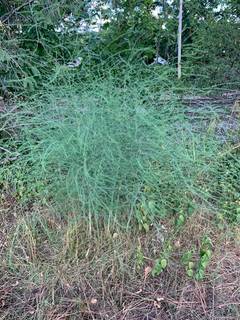
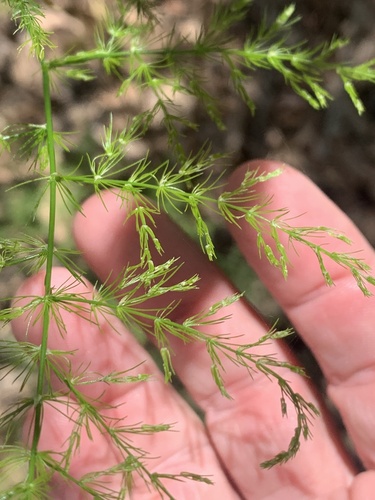
Asparagus setaceus is an evergreen scrambling-to-climbing perennial in the Asparagaceae family grown indoors and in subtropical landscapes for its lacy bright-green sprays of needle-like phylloclades arranged in flat horizontal tiers. Mature plants reach 2–10 feet (60 cm to 3 m) tall depending on support, with young plants growing as bushy mounds 12–24 inches (30–60 cm) tall before sending up climbing stems with tendrils that twine on a trellis or other plants. The lacy 'foliage' is not true leaves but flattened needle-like cladodes (modified stem segments) 0.2–0.6 inch (5–15 mm) long arranged in 2–8 mm clusters along the rachis; true leaves are reduced to small scales at the base of each cluster. The narrow texture of the cladodes is the source of the species' use as a filler in cut-flower arrangements. Tiny white bell-shaped flowers 0.15 inch (4 mm) across appear in summer along older stems, followed by small round green berries that ripen to glossy black 0.2–0.3 inch (5–8 mm) across and hold for several months. The species spreads by underground tuberous rhizomes and is considered invasive in tropical and subtropical regions outside its native range, including Florida, Hawaii, parts of California, and southeastern Australia. The berries and tubers contain saponins and are mildly toxic to pets if ingested, with reports of vomiting and diarrhea.
Native Range
Asparagus setaceus is native to southern Africa, ranging from South Africa (Western Cape, Eastern Cape, KwaZulu-Natal) north through Mozambique and Zimbabwe to southern Tanzania, growing in coastal forest, riverine forest, and rocky habitats at low to mid elevations. The species has naturalized in tropical and subtropical regions worldwide, including Florida, Hawaii, parts of California, eastern Australia, New Zealand, and Pacific island nations, where it is sometimes treated as an invasive species.Suggested Uses
Used as a hanging-basket or trellised houseplant indoors, in shaded covered patios in zones 9–11, and as a foliage filler in cut-flower arrangements (the lacy sprays last 5–7 days in floral water). Pairs in collections with other Asparagus species, ferns, and trailing tropicals at similar humidity needs. Spaced one plant per 6–8 inch (15–20 cm) pot, the species reaches mature trailing or climbing length within 18–24 months from a rooted cutting or tuber division.How to Identify
Appearance
Size & Dimensions
Height2' - 10'
Width/Spread1' - 2'
Colors
Bloom Information
Tiny white bell-shaped flowers 0.15 inch (4 mm) across open along older woody stems from June through September on mature plants in indoor or outdoor conditions; flowers are inconspicuous and many growers do not notice them. Small round green berries develop after pollination and ripen to glossy black 0.2–0.3 inch (5–8 mm) across over 3–4 months. Berries persist on the plant through winter into the following spring and are dispersed by birds in outdoor populations, contributing to the species' invasive spread.
Detailed Descriptions
Foliage Description
bright greenGrowing Conditions
Sun Requirements
Requires 1-4 hours of direct sunlight daily
• Full Sun: 6+ hours of direct sunlight
• Partial Shade: 3-6 hours of direct sunlight
• Full Shade: Less than 3 hours of direct sunlight
Care & Maintenance
Care Guide
Bright indirect light to 1–2 hours of direct morning sun suits this species; under 5,000 lux the cladodes thin and the lacy texture loosens, while direct afternoon sun above 25,000 lux yellows the cladodes. Temperatures of 60–80°F (16–27°C) are required, with cladode drop starting at 50°F (10°C); outdoor mature plants in zones 9–11 tolerate brief drops to 28°F (-2°C). A well-drained mix (3 parts standard houseplant mix to 1 part perlite) with a pH of 6.0–7.0 drains within 30 seconds of watering. Watering occurs when the top 1 inch (2.5 cm) of mix dries; the tuberous root system tolerates short drought but constantly wet medium causes tuber rot. Balanced liquid fertilizer at half strength every 3–4 weeks during active growth (April–September) supports new cladode production; fertilizer is paused during winter. Spider mites and scale are the main pests indoors and are controlled with leaf rinsing and horticultural oil applications.Pruning
Yellowing or browning sprays are cut at the base of the affected stem using a clean blade; entire stems can be removed at the soil line in spring without harming the plant, since new shoots regenerate from the rhizome. Climbing stems can be tip-pruned to control length. The tuberous root system is divided every 3–4 years when the plant outgrows its container.Pruning Schedule
Prune: March–April
early spring
Container Growing
Suitable for container growing
Minimum container size: 1 gallons