Arisaema, Genus, sikokianum, Species,
- Genus & species
Shikoku cobra lily
Overview
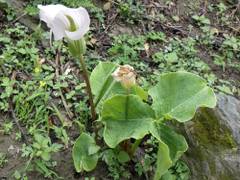
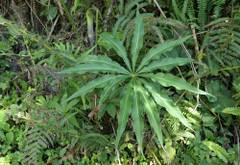
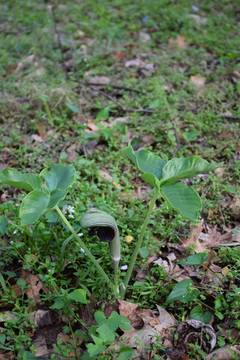
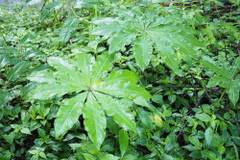
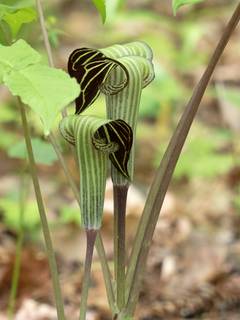
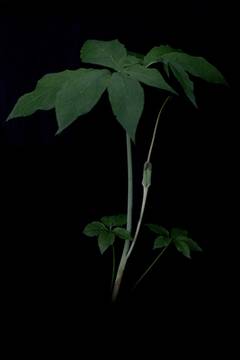
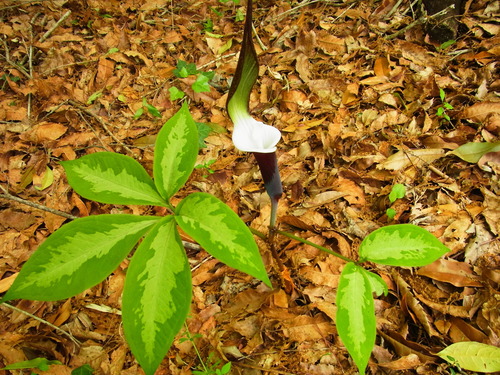
Arisaema sikokianum is a tuberous perennial reaching 12–20 inches (30–50 cm) tall with a spread of 10–15 inches (25–38 cm). One or two leaves emerge on pseudostems, each leaf with 3–5 ovate leaflets, 3–6 inches (8–15 cm) long, often with silvery or pale mottling along the midrib. The spathe is 4–6 inches (10–15 cm) long, deep chocolate-purple to nearly black on the exterior and white on the interior. The hood arches forward and upward, revealing a contrasting bright white, club-shaped spadix that is notably swollen and smooth, terminating in a rounded knob. Clusters of red berries, each 0.3 inch (8 mm) in diameter, develop on female plants by late summer. Growth emerges in mid-spring and the entire above-ground plant disappears by early to mid-fall. Tubers are slow to increase; offsets form infrequently, and plants may remain solitary for many years. This species is considered difficult to maintain long-term in cultivation outside of its native montane conditions. Tubers rot in waterlogged winter soils, and plants decline in hot summer climates above zone 7.
Native Range
Arisaema sikokianum is native to Japan, occurring on the islands of Shikoku and parts of Honshu and Kyushu. It grows in moist, humus-rich deciduous forests at elevations of 1,000–4,000 feet (300–1,200 m) on shaded slopes with consistent moisture and cool summer temperatures.Suggested Uses
Planted in woodland gardens and shaded rock gardens at 10–15 inch (25–38 cm) spacing in humus-rich soil with consistent moisture. Grown in containers of at least 3 gallons (11 L) in a humus-rich, freely draining mix, which allows precise moisture and temperature management. Suitable for underplanting beneath deciduous trees where cool, shaded conditions prevail through summer.How to Identify
Appearance
Size & Dimensions
Height1' - 1'8"
Width/Spread10" - 1'3"
Bloom Information
Flowers appear in April–May in zones 7 and May–June in zones 5–6. The spathe persists for 2–3 weeks before withering. Fruit clusters develop on female plants and ripen to bright red by August–September. Flowering occurs simultaneously with leaf emergence or shortly before the foliage fully expands.
Detailed Descriptions
Flower Description
Deep chocolate-purple exterior, white interior; white spadixFoliage Description
Dark green with silvery mottling along midribGrowing Conditions
Sun Requirements
Requires 2-4 hours of direct sunlight daily
• Full Sun: 6+ hours of direct sunlight
• Partial Shade: 3-6 hours of direct sunlight
• Full Shade: Less than 3 hours of direct sunlight
Care & Maintenance
Care Guide
Plant tubers 3–5 inches (8–13 cm) deep in humus-rich, well-drained soil in fall. Consistent, even moisture during the growing season is critical; this species is less tolerant of dry periods than A. ringens or A. consanguineum. Winter drainage determines survival—tubers rot rapidly in saturated soils. Cool summer temperatures below 85°F (29°C) are necessary for sustained vigor; plants decline over 2–3 years in zones 8–9 without cooling. Slugs feed on emerging shoots in spring. Long-term persistence in cultivation is uncertain; plants frequently decline after 3–5 years even under favorable conditions.Pruning
No pruning required. Spent spathes collapse and decompose naturally. Foliage yellows and senesces in early to mid-fall; dead leaves can be removed once fully brown. Berry clusters can be left for seed collection or removed to prevent self-sowing.Pruning Schedule
Prune: September–October
fall
Container Growing
Suitable for container growing
Minimum container size: 3 gallons