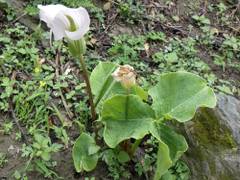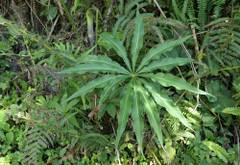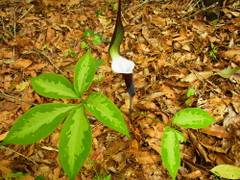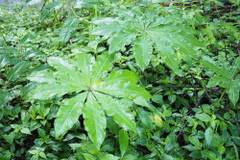
Arisaema, Genus, ringens, Species,
- Genus & species
Japanese cobra plant
Overview
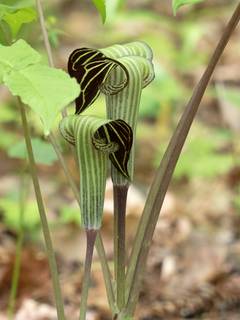
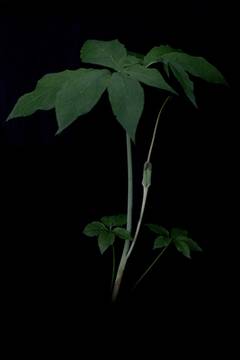
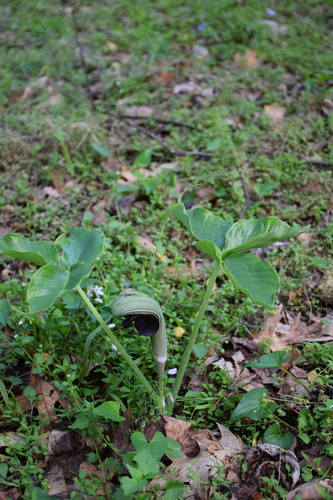
Arisaema ringens is a tuberous perennial reaching 12–20 inches (30–50 cm) tall with a spread of 12–18 inches (30–45 cm). Two leaves emerge on stout pseudostems, each leaf trifoliate with broad, rounded leaflets 4–8 inches (10–20 cm) long and 3–6 inches (8–15 cm) wide. The spathe is 4–6 inches (10–15 cm) long, deep purple-brown to green with white longitudinal striping, held at or below the foliage canopy. The spathe hood curves forward and the lateral margins roll inward, creating a gaping, open-mouthed appearance that distinguishes this species. The spadix is short and club-shaped, concealed within the spathe tube. Clusters of red berries, each 0.3 inch (8 mm) in diameter, develop on female plants by late summer. Growth emerges in mid-spring, earlier than most Arisaema species in the same growing conditions. Foliage is summer-dormant in hot climates, disappearing by July in zones 8–9, and fall-dormant in cooler zones, persisting until September–October. Tubers are susceptible to rot in waterlogged winter soils, and rodents may consume dormant tubers.
Native Range
Arisaema ringens is native to Japan, Korea, and eastern China. It grows in deciduous and mixed forests at low to moderate elevations from near sea level to 3,300 feet (1,000 m) in humus-rich, moist but well-drained soils.Suggested Uses
Planted in woodland gardens and shaded borders at 12–18 inch (30–45 cm) spacing alongside ferns, epimediums, and other shade-tolerant perennials. Grown in containers of at least 3 gallons (11 L) in a humus-rich, freely draining mix; container culture reduces rodent damage to dormant tubers. Suitable for planting beneath deciduous trees where summer shade and winter light reach the ground.How to Identify
Appearance
Size & Dimensions
Height1' - 1'8"
Width/Spread1' - 1'6"
Bloom Information
Flowers appear in April–May in zones 7–9 and May–June in zones 5–6. The spathe persists for 2–3 weeks. Fruit clusters develop on female plants and ripen to bright red by August–September. In hot climates (zones 8–9), flowering may overlap with early foliage senescence.
Detailed Descriptions
Flower Description
Purple-brown to green with white stripingFoliage Description
Dark green, glossyGrowing Conditions
Sun Requirements
Requires 2-4 hours of direct sunlight daily
• Full Sun: 6+ hours of direct sunlight
• Partial Shade: 3-6 hours of direct sunlight
• Full Shade: Less than 3 hours of direct sunlight
Care & Maintenance
Care Guide
Plant tubers 3–5 inches (8–13 cm) deep in humus-rich, well-drained soil in fall. Consistent moisture during the growing season maintains foliage; drought accelerates summer dormancy. Winter drainage is essential—wet, heavy soils cause tuber rot during dormancy. This species tolerates slightly more sun than most Arisaema species but develops leaf scorch with more than 4 hours of direct afternoon sun. Slugs damage emerging growth in spring. Rodents, including voles and chipmunks, may dig and consume dormant tubers. Plants establish slowly, typically requiring 2–3 years to reach full flowering size from a newly planted tuber.Pruning
No pruning required. Spent spathes collapse and decompose in place. Foliage yellows and senesces naturally; spent leaves can be removed once fully brown. Berry clusters can be left for seed collection or removed after ripening to prevent self-sowing.Pruning Schedule
Prune: September–October
fall
Container Growing
Suitable for container growing
Minimum container size: 3 gallons