1 / 9
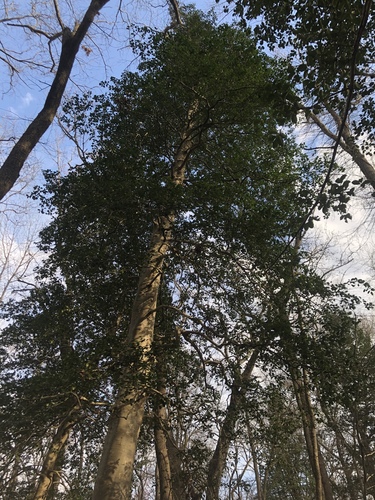
© Milo Pyne, some rights reserved (CC-BY-NC) · iNaturalist
Overview
Ilex opaca is a slow-growing evergreen tree reaching 30-50 feet (9-15 m) tall and 18-25 feet (5.5-7.5 m) wide at maturity, occasionally to 70 feet (21 m) on favorable sites in the southern Appalachians. Habit broadly pyramidal in youth, becoming open and irregular with age. Leaves leathery, dull dark green, 2-4 inches (5-10 cm) long, ovate to elliptic with 5-13 spine-tipped teeth along the wavy margins. Foliage replaces itself over a 2-3 year cycle; older leaves yellow and drop in late spring after new growth pushes. Greenish-white flowers open in May and June, dioecious — male and female on separate trees. Female trees bear red drupes 0.3-0.4 inch (8-10 mm) ripening October to December and persisting through winter unless eaten by birds. Bark light gray, smooth in youth, becoming warty with age. Growth rate slow at 6-12 inches (15-30 cm) per year, with mature size reached in 30-50 years. Fruit set requires a male tree of the same species within 600 feet (180 m). Foliage often shows chlorosis and insect feeding in northern parts of the range; trees grow more rapidly south of zone 6 in acidic soils with summer heat.
Native Range
Native to the eastern United States from coastal Massachusetts south to central Florida and west to eastern Texas and southern Missouri. Found in moist woodlands, sandy coastal forests, and the understory of pine and oak stands at 0-3,000 feet (0-900 m) elevation. The state tree of Delaware.Suggested Uses
Used as a specimen tree, woodland understory planting, or screen at 10-15 foot (3-4.5 m) spacing. Berries feed cedar waxwings, robins, and bluebirds in late winter when other food is scarce. Container culture is impractical due to slow growth and a deep taproot.How to Identify
Appearance
Size & Dimensions
Height30' - 50'
Width/Spread18' - 25'
Reaches mature size in approximately 40 years
Colors
Bloom Information
Inconspicuous greenish-white flowers in May and June across most of the range; April in zones 8-9. Bloom lasts about 2 weeks. Trees are dioecious, requiring a male within 600 feet (180 m) for fruit set on female trees. Native solitary bees, honey bees, and small flies pollinate the flowers.Detailed Descriptions
Foliage Description
Dull dark greenGrowing Conditions
Sun Requirements
Requires 4-8 hours of direct sunlight daily
• Full Sun: 6+ hours of direct sunlight
• Partial Shade: 3-6 hours of direct sunlight
• Full Shade: Less than 3 hours of direct sunlight
Care & Maintenance
Care Guide
Water deeply once a week during the first three growing seasons; established trees tolerate 4-5 weeks without rain in zones 7-9. Apply 2-3 inches (5-7.5 cm) of bark mulch over the root zone, pulled back several inches from the trunk. Soil pH above 6.5 causes iron and manganese chlorosis, with foliage yellowing between leaf veins. Leaf miners cause winding tan trails in leaves but do not affect tree health. Tar spot fungus produces black blotches on leaves in wet springs; affected leaves drop without further damage. Northern populations may suffer winter desiccation in zones 6 and colder when winter winds dry the foliage.Pruning
Prune in late winter to early spring before new growth emerges. Selective thinning of crossing or rubbing branches preserves the natural form. Hard heading cuts produce a flush of weak watersprouts that take 2-3 seasons to integrate into the canopy. Hollies tolerate pruning into older wood but regrowth from bare branches is slow over 1-2 years.Pruning Schedule
J
F
M
A
M
J
J
A
S
O
N
D
early spring
Maintenance Level
lowContainer Growing
Minimum container size: 25 gallons