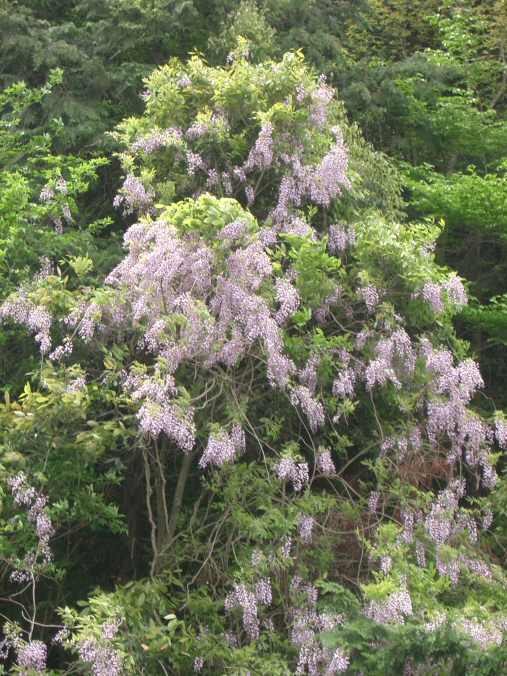
Wisteria, Genus, brachybotrys, Species,
- Genus & species
Silky wisteria
Overview
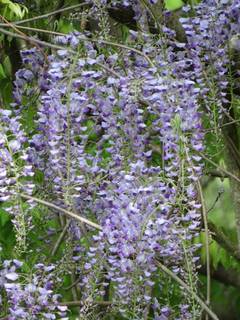
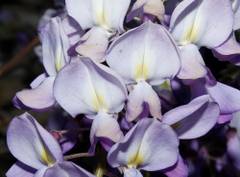
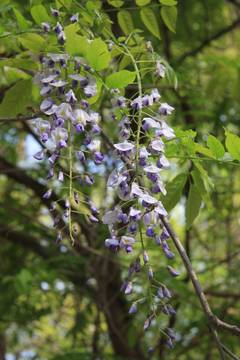
Wisteria brachybotrys is a deciduous twining vine in the Fabaceae, climbing 20–30 feet (6–9 m) and spreading 10–20 feet (3–6 m) on support, with old stems thickening to 6 inches (15 cm) in diameter. Racemes are 4–6 inches (10–15 cm) long and 3–4 inches (7.5–10 cm) wide, shorter and broader than those of W. floribunda, and the flowers open almost simultaneously along the whole raceme rather than progressively from the base. Individual flowers are 1–1.2 inches (25–30 mm) across, violet to lilac with a white blotch and yellow eye on the standard petal, and carry a strong sweet scent. Leaves are pinnate with 9–13 leaflets, each 1.5–3 inches (4–7.5 cm) long and covered on both surfaces with silvery silky hairs when young. Seed pods are 4–8 inches (10–20 cm) long and densely velvety, splitting in autumn to release 1–3 flat brown seeds. Stems twine in the opposite direction to those of W. sinensis. Mature vines weigh 300–500 pounds (135–225 kg) and buckle light trellis, gutters, and timber pergolas, and stems wound around tree trunks girdle them within a few years. Plants raised from seed flower after 10–20 years, while grafted plants flower in 3–5.
Native Range
Wisteria brachybotrys is native to Japan, occurring on western Honshu, Shikoku, and Kyushu. It grows at woodland margins and in riverside thickets from near sea level to about 2,600 feet (800 m), climbing into the canopy of Quercus and Pinus. Selected forms have been raised in Japanese cultivation for several centuries and reached Europe in the 1870s.Suggested Uses
Grown on pergolas, heavy arches, and free-standing timber frames, with a single plant covering 200–300 square feet (18–28 m²) at maturity. Also trained as a standard on a 4–5 foot (1.2–1.5 m) stem staked for the life of the plant, which holds the crown to about 8 feet (2.4 m) across. Planting against house walls, gutters, and downpipes leads to structural damage as the stems thicken.How to Identify
Appearance
Size & Dimensions
Height20' - 30'
Width/Spread10' - 20'
Bloom Information
Flowering runs about two weeks in May, opening with or just before the new leaves in USDA zone 6 and in late April in zone 8. Each raceme is 4–6 inches (10–15 cm) long and holds 20–40 flowers that open almost together, giving a short concentrated period rather than the drawn-out sequence seen in W. floribunda. Flowers are violet to lilac with a white blotch and yellow eye, and the scent carries 10–20 feet (3–6 m) in still air. A light second flush appears in July in some seasons on shoots cut back in summer.
Detailed Descriptions
Flower Description
Violet to lilac with a white blotch and yellow eyeFoliage Description
Silvery-silky when young, mid-green in summer, yellow in autumnGrowing Conditions
Sun Requirements
Requires 6-12 hours of direct sunlight daily
• Full Sun: 6+ hours of direct sunlight
• Partial Shade: 3-6 hours of direct sunlight
• Full Shade: Less than 3 hours of direct sunlight
Care & Maintenance
Care Guide
Six or more hours of direct sun daily supports flower bud formation; vines in under four hours make vegetative growth and few racemes. Free-draining soil with a pH of 6.0 to 7.0 suits the roots, while rich or nitrogen-heavy ground pushes stem extension at the cost of flowering. Weekly watering through the first three growing seasons establishes the root system, after which the vine tolerates 4–6 weeks without rain. The plant is hardy in USDA zones 5–9 and withstands winter lows near -20°F (-29°C), though flower buds are damaged by late frosts below 28°F (-2°C). Supports carry 300–500 pounds (135–225 kg) at maturity, so pergola posts of 4x4 inch (10x10 cm) timber or heavier are used. Nitrogen fertiliser is withheld, and a potash application in early spring at 1 ounce per square yard (35 g per m²) supports bud set.Pruning
Pruning follows a two-stage annual cycle: long whippy shoots are shortened to six leaves in July and August, and those same spurs are cut back to 2–3 buds in January or February. The cycle concentrates growth into short flowering spurs along the main framework. Vines left unpruned build a tangled mass that flowers only at the top of the support and adds 6–10 feet (1.8–3 m) of extension growth a year. Cuts into wood over 2 inches (5 cm) across close slowly and are confined to renovation work in winter.Pruning Schedule
Prune: January–February & July–August
wintersummer