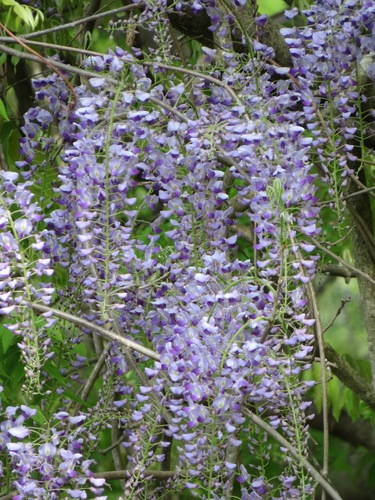
Wisteria, Genus, spp., Multiple species,
- Genus
- Multiple species
wisterias
Eastern Asia and eastern North America
Overview
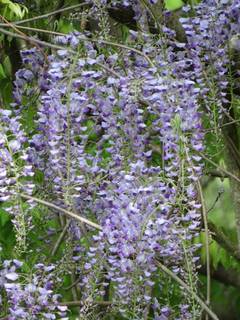
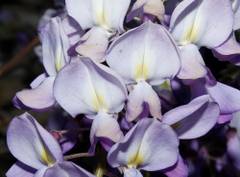
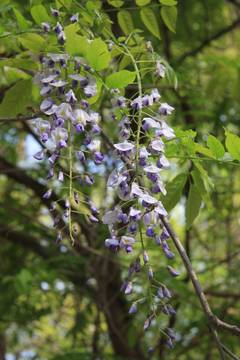
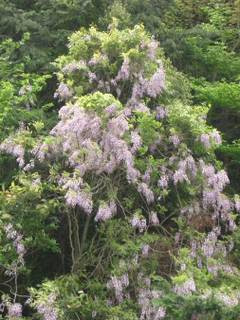
Wisteria is a genus of about 8 to 10 deciduous woody vines in the pea family (Fabaceae) that climb by twining stems wrapping around their supports. Mature plants reach 20 to 65 ft (6 to 20 m) of stem length, with woody trunks thickening to 6 to 15 in (15 to 38 cm) over decades. Leaves are pinnately compound, 4 to 14 in (10 to 35 cm) long, with 7 to 19 oval leaflets that emerge bronze and mature green. Flowers form pendulous racemes 6 to 48 in (15 to 120 cm) long, opening before or with the leaves; each flower follows the pea-flower form with a banner, two wings, and a keel, in blue-violet, lavender, white, or pink. Asian species such as W. sinensis and W. floribunda bloom on bare stems in spring, while the North American W. frutescens flowers after leaf-out on new growth. Seeds develop in velvety legume pods 4 to 8 in (10 to 20 cm) long that split and can eject seeds several feet. All parts, especially seeds and pods, contain wisterin and a lectin that cause vomiting and abdominal pain if eaten by people or pets. The twining stems girdle and can crush trellises and downspouts, and Asian species naturalize across the southeastern United States.
Native Range
The genus is native to eastern Asia, in China, Korea, and Japan, and to the eastern and southern United States. W. frutescens and W. macrostachya grow in North American wetlands and bottomlands, while W. sinensis and W. floribunda originate in temperate East Asian forests and have naturalized across the southeastern United States.Suggested Uses
Wisteria is grown on pergolas, arbors, and house walls where the racemes hang into open space, and it is also trained as a free-standing standard on a stout stake. In the southeastern United States, Asian species spread into woodland edges, where they are classed as invasive.How to Identify
Appearance
Size & Dimensions
Height20' - 65'
Width/Spread8' - 20'
Bloom Information
Most Wisteria bloom in spring, from April to June depending on species and climate. Asian species flower on bare wood before the leaves expand, while W. frutescens blooms in late spring to early summer after foliage emerges and may repeat through summer. Racemes last 2 to 3 weeks, with fragrance ranging from light to strong among species.
Detailed Descriptions
Flower Description
blue-violet, lavender, white, or pinkFoliage Description
green, bronze when youngGrowing Conditions
Sun Requirements
Requires 6-12 hours of direct sunlight daily
• Full Sun: 6+ hours of direct sunlight
• Partial Shade: 3-6 hours of direct sunlight
• Full Shade: Less than 3 hours of direct sunlight
Care & Maintenance
Care Guide
Wisteria grows in full sun to part shade and flowers most heavily with at least 6 hours of direct sun. It tolerates many soils but establishes fastest in moist, well-drained loam at pH 6.0 to 7.0. As a legume it fixes nitrogen and needs little feeding; high-nitrogen soil pushes foliage at the expense of flowers. Mature vines need a support of metal or thick timber, since twining stems exert enough force to bend wood and pull down gutters. Asian species are hardy in USDA zones 5 to 9, and W. frutescens grows in zones 5 to 9 on wetter soils. Flowering can take 3 to 7 years from planting, and longer for seed-grown plants.Pruning
Pruning twice a year controls size and supports flowering: the long summer shoots are cut back to about 6 in (15 cm) in midsummer, then the same spurs are shortened to two or three buds in late winter. Removing seed pods and excess basal growth limits unwanted spread. Hard cuts into old wood are tolerated but may delay flowering for one to two seasons.Pruning Schedule
Prune: February & July
wintersummer