Trifolium, Genus, campestre, Species,
- Genus & species
hop trefoil
Europe, western Asia, and North Africa
SunFull Sun
Overview
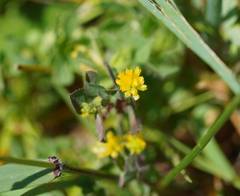
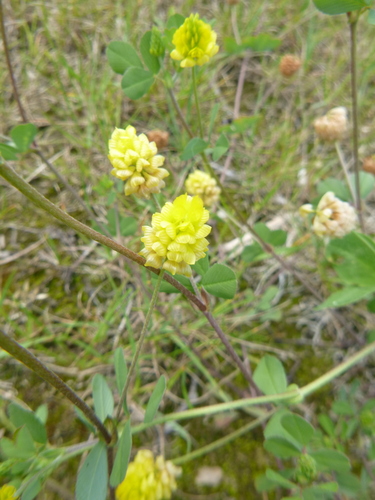
Trifolium campestre is a low annual, occasionally biennial, legume growing 4-14 inches (10-35 cm) tall with slender, branching, ascending to sprawling stems. The leaves are trifoliate, the central leaflet carried on a short stalk that sets it ahead of the two stalkless side leaflets, each leaflet oval and finely toothed toward the tip. Flower heads are rounded to short-cylindrical, 0.3-0.6 inch (8-15 mm) long, and packed with 20 to 40 small pea-type florets in a clear yellow. As the heads age, the dry petals turn pale brown and fold down over the seeds, giving the faded clusters a hop-like look that is the source of the common name. Flowering runs through summer. T. campestre fixes atmospheric nitrogen through root nodules and grows on dry grassland, roadsides, dunes, and disturbed sandy or gravelly ground. It self-seeds readily and is short-lived, dying once seed has set. In rich ground it can be crowded out by taller, leafier vegetation.
Native Range
Trifolium campestre is native to Europe, western Asia, and North Africa. It has naturalized across much of North America, southern Africa, Australia, and other temperate regions, where it grows on roadsides and disturbed open ground.Suggested Uses
Sown in wildflower meadows, pollinator mixes, and on dry banks, verges, and reclaimed ground. It is used as a low-input ground cover and green manure that adds nitrogen to poor soil. The summer-long yellow heads suit naturalistic and conservation plantings.How to Identify
Appearance
Size & Dimensions
Height4" - 1'2"
Width/Spread6" - 1'
Bloom Information
Yellow heads open from May to September, with the heaviest flush in June and July. Each head flowers over one to two weeks before the petals brown and curl over the developing seeds. Plants keep producing new heads through summer in open, sunny sites.
Detailed Descriptions
Foliage Description
greenGrowing Conditions
Sun Requirements
Requires 6-12 hours of direct sunlight daily
• Full Sun: 6+ hours of direct sunlight
• Partial Shade: 3-6 hours of direct sunlight
• Full Shade: Less than 3 hours of direct sunlight
Water & Climate
Water Needs
Drought Tolerance
Drought tolerant when established