Tricyrtis, Genus, hirta, Species,
- Genus & species
Toad lily
Overview
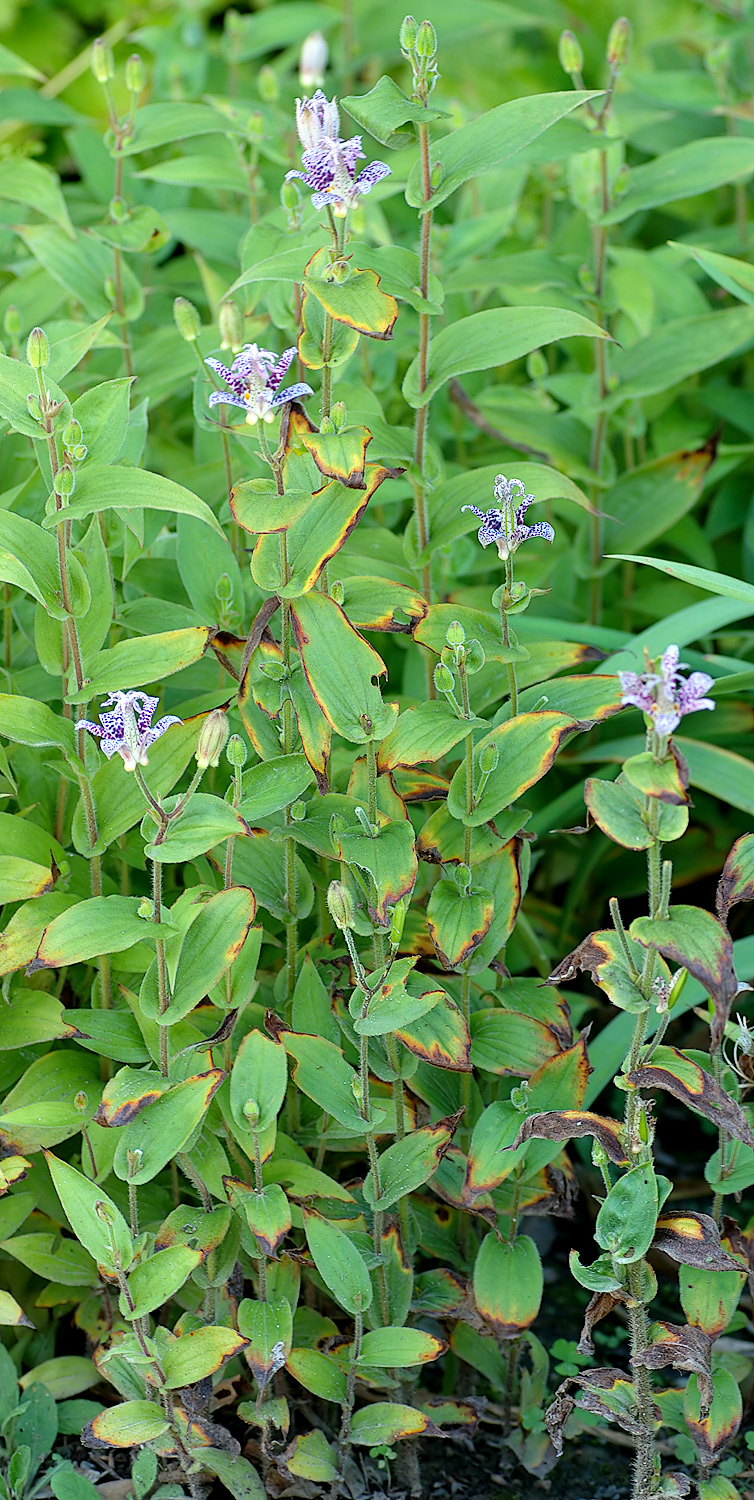
Tricyrtis hirta is a herbaceous perennial with arching, unbranched stems 24-36 inches (60-90 cm) long rising from a slowly spreading rhizome, forming a clump 18-24 inches (45-60 cm) wide. Leaves are alternate, stalkless, and clasp the stem in two ranks, ovate-lanceolate, 3-6 inches (7.5-15 cm) long, covered in short soft hairs on both surfaces and along the stem. Flowers open from early September to late October in the upper leaf axils and at the stem tip, one to three per axil, each 1-1.5 inches (2.5-4 cm) across with six white to pale lilac tepals spotted purple. The outer three tepals carry rounded nectar sacs at the base, and the stamens and styles are fused into a raised central column about 0.6 inch (15 mm) tall tipped with branched, gland-fringed stigmas. Leaf margins brown within a week where the root zone dries, and the damage stays for the rest of the season. Flowering runs late enough that a hard frost before mid-October ends the season with buds unopened in USDA zone 4. Slugs and snails graze emerging shoots in spring. Hardy in USDA zones 4-8.
Native Range
Tricyrtis hirta is native to Japan, on Honshu, Shikoku, and Kyushu. It grows on shaded cliffs, wet rock faces, and stream banks in mountain woodland from near sea level to about 4,900 feet (1,500 m). Plants root into moss and leaf litter over rock, with the arching stems hanging clear of the face.Suggested Uses
Planted along shaded paths and at the front of woodland borders at 15-18 inch (38-45 cm) spacing, where the September and October flowers sit close enough to show their spotting. Grown at the top of low retaining walls and on shaded slopes so the arching stems hang clear. Container culture works in 3 gallons (11 L) or more of a peat-based mix held constantly damp.How to Identify
Appearance
Size & Dimensions
Height2' - 3'
Width/Spread1'6" - 2'
Bloom Information
Flowering runs from early September to late October in USDA zones 5-8, giving five to seven weeks. Buds open in sequence from the base of the stem upward, with three to six flowers open on a stem at any time. Each flower lasts three to five days. In zone 4 the first hard frost in early October ends flowering with the upper buds still closed.
Detailed Descriptions
Flower Description
white to pale lilac, spotted purpleFoliage Description
medium green with soft hairs, turning yellow before dying backGrowing Conditions
Sun Requirements
Requires 2-5 hours of direct sunlight daily
• Full Sun: 6+ hours of direct sunlight
• Partial Shade: 3-6 hours of direct sunlight
• Full Shade: Less than 3 hours of direct sunlight
Care & Maintenance
Care Guide
Two to five hours of filtered or morning sun suits the species; direct afternoon sun scorches the leaf margins even where soil stays damp. Soil is humus-rich loam holding moisture at pH 5.5-7.0, under 2-3 inches (5-8 cm) of leaf mould spread over the root zone. Water use is about 1 inch (2.5 cm) per week from May to October, and a single dry spell marks the foliage for the remainder of the season. A spring application of balanced fertiliser at 0.5 pound per 100 square feet (250 g per 9 sq m) covers the season on average soils. Slugs and snails strip emerging shoots in April and May. Rust and anthracnose spot the leaves in crowded plantings with restricted air movement.Pruning
Stems are cut to ground level after frost blackens the foliage in November, or left through winter and cleared in March before new shoots rise. No summer cutting is done, since flowers form along the length of each stem. Division is done in early spring as shoots emerge, cutting the rhizome into sections that each carry two or three buds.Pruning Schedule
Prune: March & November
fallearly spring
Container Growing
Suitable for container growing
Minimum container size: 3 gallons