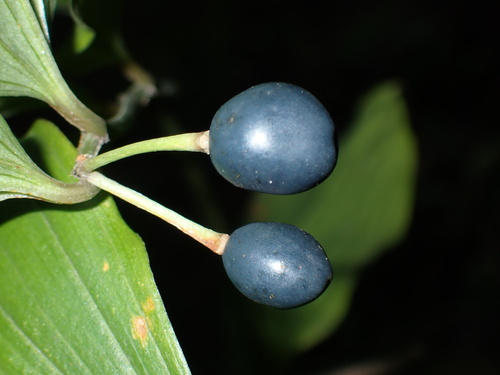
Disporum, Genus, uniflorum, Species,
- Genus & species
yellow fairybells
China, Korea, Japan (moist shaded mountain forests)
Overview
Disporum uniflorum is an upright to arching, rhizomatous, herbaceous perennial reaching 18–30 inches (45–75 cm) tall with a spread of 12–18 inches (30–45 cm). This East Asian species produces the largest and most conspicuous flowers of the fairybells—pendant, tubular-bell-shaped flowers 1–1.5 inches (2.5–4 cm) long in bright lemon-yellow, hanging singly or in pairs at the branch tips in April–May. The specific epithet 'uniflorum' refers to the typically solitary flowers, though 2–3 per cluster also occur. The stems branch in the upper half, carrying alternate, ovate to lance-shaped, medium green leaves 3–5 inches (8–13 cm) long with prominent parallel veins. Glossy black berries follow in fall. Growth rate is moderate, spreading slowly by rhizomes. The bright yellow flowers are substantially larger and more visible than those of D. hookeri or D. longistylum. Hardy to zone 5. Goes dormant in late fall.
Native Range
Disporum uniflorum is native to China, Korea, and Japan, in moist, shaded mountain forests and woodland margins.Suggested Uses
Planted in shade gardens and woodland borders at 12–18 inch (30–45 cm) spacing. The bright yellow flowers are more visible than those of other fairybells and add spring color to shade. The glossy black berries provide fall interest. Pair with ferns, hostas, and blue-flowered shade perennials for color contrast. Functions in containers of at least 3 gallons (11 L). Not suitable for full sun, dry soils, or formal plantings.How to Identify
Appearance
Size & Dimensions
Height1'6" - 2'6"
Width/Spread1' - 1'6"
Bloom Information
Pendant, tubular-bell-shaped flowers 1–1.5 inches (2.5–4 cm) long in bright lemon-yellow hang singly or in pairs at branch tips in April–May. Glossy black berries follow in September–October. Bloom duration is 2–3 weeks.
Detailed Descriptions
Flower Description
Bright lemon-yellow, pendant tubular-bell; glossy black berriesFoliage Description
Medium green, ovate to lance-shaped, prominent parallel veinsGrowing Conditions
Sun Requirements
Requires 2-4 hours of direct sunlight daily
• Full Sun: 6+ hours of direct sunlight
• Partial Shade: 3-6 hours of direct sunlight
• Full Shade: Less than 3 hours of direct sunlight
Care & Maintenance
Care Guide
Plant in partial to full shade in moist, well-drained, humus-rich soil. Consistent moisture. Hardy to zone 5. Spreads slowly by rhizomes. No serious pest or disease problems. Slugs can damage emerging growth.Pruning
Cut back dead stems in late fall or early spring. No other pruning required.Pruning Schedule
Prune: November
fall
Container Growing
Suitable for container growing
Minimum container size: 3 gallons