Stenotaphrum, Genus, secundatum, Species,
- Genus & species
St. Augustine grass
Native to the Gulf of Mexico, Caribbean, and coastal tropical and subtropical regions of the Americas and Africa where the species grows in coastal grasslands and disturbed open ground; the species became the dominant warm-season lawn grass of the Gulf Coast states, Florida, and coastal Southeast through the 20th century, where the salt tolerance and shade tolerance suit the coastal climate; the cultivation range stops at the southern edge of USDA zone 8 since the species has no cold hardiness for northern climates
Overview
Stenotaphrum secundatum is a warm-season perennial stoloniferous grass in the grass family (Poaceae) reaching 6-12 inches (15-30 cm) tall (unmowed) with an aggressive indefinite spread via thick fleshy above-ground stolons and a dense coarse-textured turf habit. Native to the Gulf of Mexico, Caribbean, and coastal tropical and subtropical regions, the species forms a thick spongy medium-to-dark-green lawn with broad flat blades 4-8 mm wide — the coarsest texture among common lawn grasses. Maintained at mowing heights of 3-4 inches (8-10 cm). Established exclusively by sod, plugs, or sprigs since the species does not produce viable seed in commercial quantities. The dominant warm-season lawn grass of the Gulf Coast states, Florida, and coastal Southeast. Among the more shade-tolerant warm-season grasses, maintaining turf in 4-6 hours of sun where bermudagrass and zoysiagrass fail.
Native Range
Stenotaphrum secundatum is native to the Gulf of Mexico, Caribbean, and coastal tropical and subtropical regions of the Americas and Africa.Suggested Uses
Used in home lawns, parks, and commercial landscapes throughout the Gulf Coast, Florida, and coastal Southeast. Among the more shade-tolerant warm-season grasses available. Dense coarse spongy turf form. Thick stolons hold soil in place for erosion control. Salt-tolerant for coastal sites. Warm-season grass for zones 8-10. Not suited to northern climates (no cold tolerance), to gardeners who want narrow-textured lawns (this species is the coarsest), or to high-traffic sports turf (poor wear tolerance). No seed available — establishment is by sod, plugs, or sprigs only.How to Identify
Appearance
Size & Dimensions
Height3" - 1'
Width/Spread1' - 2'
Bloom Information
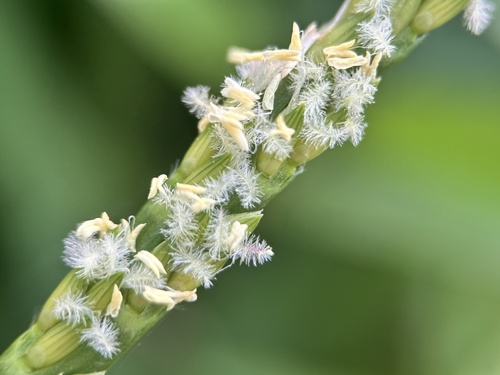
Short branching inflorescences embedded in flattened one-sided racemes appear in summer if plants are unmowed. Visually understated. Produces little viable seed, so propagation is vegetative through sod, plugs, or sprigs.
Detailed Descriptions
Flower Description
Green inconspicuous flattened racemes opening in summer if plants are unmowed; visually understatedFoliage Description
Medium to dark green broad flat coarse blades 4-8 mm wide carried on thick fleshy stolons; the broad blade width is the coarsest of common lawn grassesGrowing Conditions
Sun Requirements
Requires 4-10 hours of direct sunlight daily
• Full Sun: 6+ hours of direct sunlight
• Partial Shade: 3-6 hours of direct sunlight
• Full Shade: Less than 3 hours of direct sunlight
Care & Maintenance
Care Guide
Establish by sod, plugs (12-inch spacing), or sprigs in late spring through summer when soil is warm. Full sun to moderate shade (4-6 hours minimum). Grows in fertile moist well-drained soil at pH 6.0-7.5. Mow at 3-4 inches with a sharp rotary mower. Water 1 inch per week. Fertilize 2-4 lb nitrogen per 1,000 sq ft per year. Warm-season grass that browns in winter dormancy below 55°F (13°C). Susceptible to chinch bugs, gray leaf spot, and SAD virus. Builds thatch — dethatch as the thatch layer reaches 0.5 inch.Pruning
Mow at 3-4 inches (8-10 cm) with a sharp rotary mower since the coarse blades are too wide for reel mowers. Never remove more than one-third of blade height per mowing. Mow higher in shade.Pruning Schedule
Prune: April–October
late springsummerfall