Senega, Genus, lutea, Species,
- Genus & species
orange milkwort
Overview
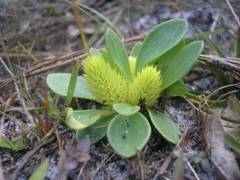
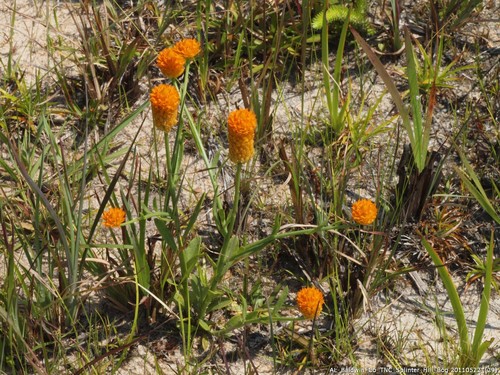
Senega lutea, formerly known as Polygala lutea, is a small biennial or annual herb growing 4-16 in (10-40 cm) tall, forming a basal rosette of spoon-shaped leaves with smaller, alternate leaves up the stems. Its dense, rounded to cylindrical flower heads, 0.5-1.5 in (1.5-4 cm) long, are packed with small bright orange to orange-yellow flowers that dry to a paler yellow. Each stem is topped by one or more of these clover-like heads. The species is native to the southeastern United States, where it grows in wet pine savannas, bogs, ditches, and seepage slopes of the Atlantic and Gulf Coastal Plain. It grows in USDA zones 6 to 9 and depends on consistently moist to saturated, acidic, sandy soils; it does not persist in dry or alkaline ground. As a short-lived plant it relies on regular self-seeding to maintain a population. It flowers in its second year and then declines.
Native Range
Senega lutea is native to the southeastern United States, ranging along the Atlantic and Gulf Coastal Plain from New York and New Jersey south to Florida and west to Texas. It grows in wet pine savannas, bogs, seepage slopes, and ditches.Suggested Uses
Used in bog gardens, wetland restorations, and pine savanna plantings where soils stay moist and acidic, spaced 6-10 in (15-25 cm) apart. The flowers attract small bees and other insects.How to Identify
Appearance
Size & Dimensions
Height4" - 1'4"
Width/Spread3" - 6"
Bloom Information
Flowering occurs over a long warm season, mainly spring through fall, roughly April to October in the Deep South. The orange heads remain colorful for several weeks as new flowers open. In cooler parts of the range bloom is concentrated in summer.
Detailed Descriptions
Flower Description
bright orange to orange-yellowFoliage Description
greenGrowing Conditions
Sun Requirements
Requires 6-10 hours of direct sunlight daily
• Full Sun: 6+ hours of direct sunlight
• Partial Shade: 3-6 hours of direct sunlight
• Full Shade: Less than 3 hours of direct sunlight
Care & Maintenance
Care Guide
Senega lutea grows in full sun to light shade and consistently moist to saturated, acidic, sandy soils with pH from 4.5 to 6.0. It is hardy in USDA zones 6 through 9 and depends on wet, low-nutrient ground typical of pine savannas and bogs. Water needs are high, and the plant fails in dry or alkaline soils. As a biennial or short-lived plant, it persists through self-seeding rather than long-lived individual plants. It is rarely cultivated outside specialized bog or wetland gardens.Pruning
No structural pruning is needed for this small herbaceous plant. Seed heads can be left in place to allow self-seeding, which sustains the population. Spent plants die back naturally after flowering.Container Growing
Suitable for container growing
Minimum container size: 1 gallons
Toxicity: Not assessed
UnknownPlanting Guide
Planting Methods & Timing
Planting Method
direct sow
Plant Spacing
8 inches