Rumex, Genus, sagittatus, Species,
- Genus & species
climbing dock
Overview
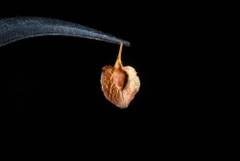
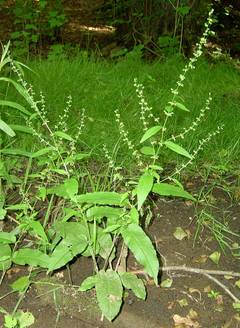
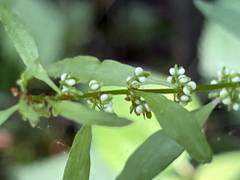
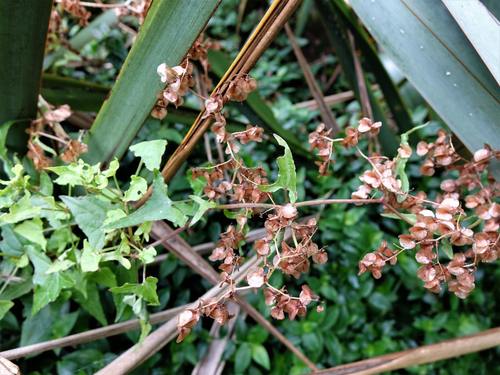
Rumex sagittatus is a climbing or scrambling perennial with slender twining stems that reach 10-16 feet (3-5 m) long, arising from a system of fleshy tubers and rhizomes. The leaves are bright green, thin-textured, and distinctly arrow-shaped, sagittate to hastate, 1-3 inches (2.5-8 cm) long, with two spreading basal lobes. Small greenish-cream to pink-tinged flowers are borne in branched sprays through the warmer months. Each fruit develops three enlarged papery wings about 0.2-0.4 inch (5-10 mm) wide that flush pink before drying to pale brown, a feature shared with the related turkey rhubarb. R. sagittatus is native to southern Africa but has naturalised widely and is regarded as an invasive environmental weed in parts of southern and eastern Australia, where its twining growth forms dense mats that smother shrubs and groundcovers. The plant regrows from its tubers after cutting and also spreads by wind-blown winged seed, so established infestations are persistent. Leaves and stems contain soluble oxalates, and ingestion in quantity can cause poisoning in grazing animals. Stems die back in frost or drought and reshoot from the tubers when conditions improve.
Native Range
Rumex sagittatus is native to southern Africa, including South Africa, Lesotho, and Eswatini. It has naturalised in Australia and several other regions with mild climates.Suggested Uses
R. sagittatus has been grown as a quick-growing climber for screening fences and trellises in mild climates. In parts of Australia where it has naturalised as an environmental weed, it is managed as a plant to control rather than cultivate.How to Identify
Appearance
Size & Dimensions
Height10' - 16'
Width/Spread6' - 13'
Bloom Information
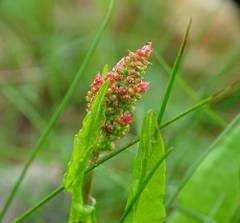
Flowering occurs through spring and summer, roughly September to February in the native and naturalised ranges. Small greenish-cream to pink-tinged flowers are held in branched sprays. The winged fruits that follow turn pink, then dry to pale brown and disperse on the wind.
Detailed Descriptions
Flower Description
greenish-cream to pinkFoliage Description
bright greenGrowing Conditions
Sun Requirements
Requires 4-8 hours of direct sunlight daily
• Full Sun: 6+ hours of direct sunlight
• Partial Shade: 3-6 hours of direct sunlight
• Full Shade: Less than 3 hours of direct sunlight
Care & Maintenance
Care Guide
R. sagittatus grows in full sun to part shade across a wide range of soils, including sandy, loamy, and clay types, and tolerates dry periods once the tubers are established. It twines over any nearby support and spreads from both seed and tuber fragments. Stems die back in frost or extended drought and reshoot from the tubers. It is regarded as an invasive environmental weed in parts of Australia, where its spread into bushland is a recognised problem. Growth is vigorous, and the plant needs strong support if grown on a structure.Pruning
Cutting back the stems controls size but prompts regrowth from the tubers, so repeated cutting is needed for containment. Removing the winged fruits before they dry reduces wind-blown seed. Stems can be cut to ground level in winter.Pruning Schedule
Prune: June–July
winter