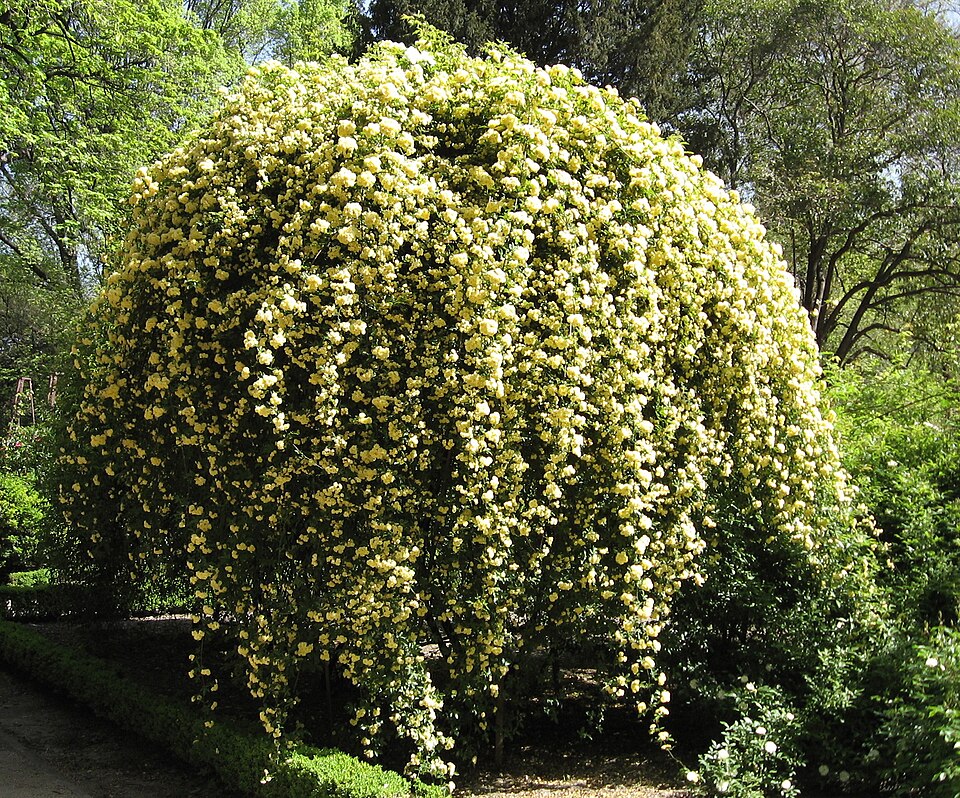
Image 1 of 5
1 / 5
© No machine-readable author provided. Cillas assumed (based on copyright claims)., some rights reserved (CC-BY-SA) · Wikimedia Commons
Rosa, Genus, banksiae, Species, 'Lutea', Cultivar,
- Genus & species
- Cultivar
lady Banks' rose
Overview
Rosa banksiae 'Lutea' is a vigorous, nearly thornless climbing rose growing 20–30 feet (6–9 m) tall and 10–20 feet (3–6 m) wide, with slender, arching canes and small, glossy, semi-evergreen leaves divided into 3–5 narrow leaflets. In mid to late spring it produces dense clusters of many small, fully double, pale yellow flowers, each about 0.75–1 inch (2–2.5 cm) across, in a single heavy flush. The flowers carry little or no scent in this yellow form. The canes are almost without thorns, which makes the plant easier to handle than most climbing roses. It flowers on wood from previous years and blooms only once a season. The rose is frost tender, damaged below about 15°F (−9°C), and is grown outdoors mainly in USDA zones 8–11; in colder areas it needs a warm sheltered wall. Its great size and weight call for sturdy support, and it can outgrow small structures. The foliage stays evergreen in mild winters. It is grown on walls, pergolas, and into large trees in mild and Mediterranean climates.
Native Range
Rosa banksiae is native to central and western China, where it grows in scrub and on woodland margins on mountain slopes. The cultivar 'Lutea' is a long-cultivated double yellow selection raised in gardens rather than found in the wild.Suggested Uses
Rosa banksiae 'Lutea' is grown on large walls, pergolas, arches, and into mature trees in mild and Mediterranean gardens. Its near-thornless canes suit positions near paths and seating. The early spring flush gives colour before most climbing roses bloom.How to Identify
Appearance
Size & Dimensions
Height20' - 30'
Width/Spread10' - 20'
Bloom Information
Flowering is a single heavy flush in mid to late spring, often April to May in the Northern Hemisphere and earlier in warm climates, lasting about 3–4 weeks. The rose blooms on wood formed in previous years and does not repeat. Few or no hips follow the double flowers. After bloom the plant produces long new canes for the next year.
Detailed Descriptions
Foliage Description
Glossy mid-greenGrowing Conditions
Sun Requirements
Requires 6-12 hours of direct sunlight daily
• Full Sun: 6+ hours of direct sunlight
• Partial Shade: 3-6 hours of direct sunlight
• Full Shade: Less than 3 hours of direct sunlight
Care & Maintenance
Care Guide
Grow Rosa banksiae 'Lutea' in full sun in fertile, well-drained soil with a large, sturdy structure or tree to climb. Water during establishment and in drought; mature plants are fairly drought tolerant in mild climates. The rose is frost tender and is grown against a warm wall or under glass where winters fall below about 15°F (−9°C). It is generally healthy, with low black spot and mildew. Feeding in spring supports the heavy spring bloom and vigorous cane growth. Its size needs space, as it can overwhelm small supports.Pruning
Because Rosa banksiae 'Lutea' flowers on older wood, it is pruned right after the spring bloom rather than in winter. Pruning removes spent flowering shoots and thins crowded or dead wood, leaving young canes for next year. Hard winter pruning removes the coming season's flowers, so size is contained gradually after flowering.Pruning Schedule
Prune: May–June
late spring