Rhododendron, Genus, 'Odee Wright', Cultivar,
- Genus
- Cultivar
Odee wright rhododendron
Hybrid of garden origin; bred in the Pacific Northwest; the bicolored yellow face with apricot petal reverse separates this cultivar from the plain-yellow cultivars ('Capistrano', 'Lemon Dream') that carry a single color across the full petal surface
Overview
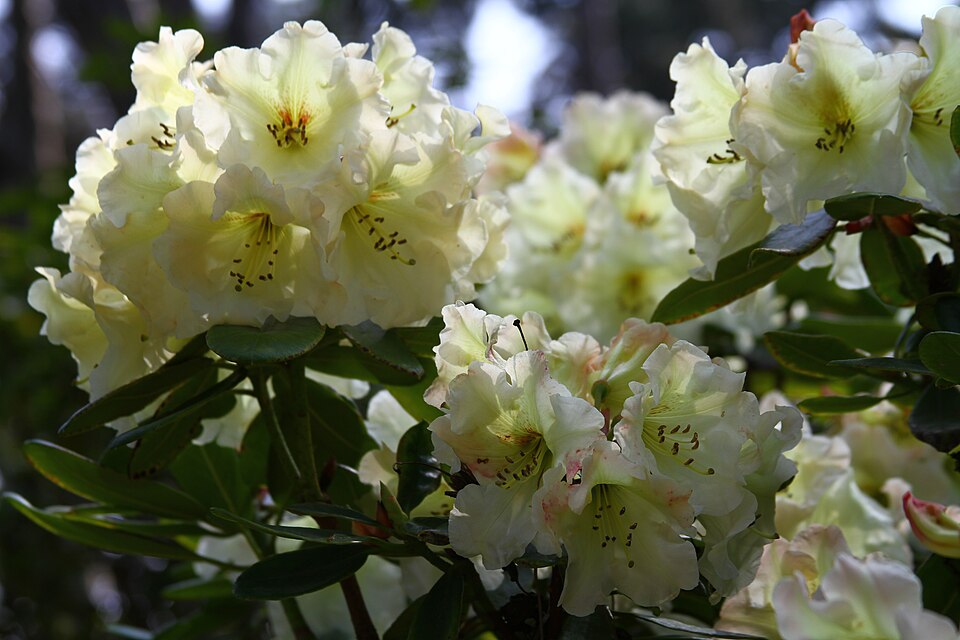
Rhododendron 'Odee Wright' is an evergreen shrub reaching 3-4 feet (0.9-1.2 m) tall with a spread of 4-5 feet (1.2-1.5 m) and a compact, dense, mounding habit wider than tall. An elepidote rhododendron, the cultivar carries dome-shaped trusses of 10-14 funnel-shaped flowers 2-2.5 inches (5-6 cm) wide in bright yellow with a reddish-orange to apricot blush on the petal reverse (the outer surface of each petal). The two-tone effect shows clearly in bud and as the trusses open, then reads as solid yellow once the flowers reach full spread. Bloom duration is 3-4 weeks in May-June. Elliptic leaves 3-5 inches (8-13 cm) long are glossy dark green. Growth rate is slow to moderate. Hardy to USDA zone 6. Toxic to pets and humans if ingested. The compact 3-4 foot (0.9-1.2 m) size fits foundation plantings and mixed borders where the larger yellow cultivars ('Horizon Monarch' at 5-7 feet / 1.5-2.1 m) overwhelm the planting scale, while the apricot-reversed bicolored flower form gives a second visual feature during the bud-to-bloom transition that plain-yellow cultivars such as 'Capistrano' and 'Lemon Dream' cannot match.
Native Range
Rhododendron 'Odee Wright' is a hybrid of garden origin, bred in the Pacific Northwest and propagated vegetatively.Suggested Uses
Used in mixed borders, foundation plantings, and container plantings in zones 6-8 at 4-5 foot (1.2-1.5 m) spacing. The compact 3-4 foot (0.9-1.2 m) size fits scales where 'Horizon Monarch' at 5-7 feet (1.5-2.1 m) overwhelms the planting, while the apricot-reversed bicolored flowers give a color feature that plain-yellow cultivars such as 'Capistrano' and 'Lemon Dream' cannot match. Containers of 5 gallons (19 L) minimum suit the compact habit, and the slow-to-moderate growth rate keeps the same pot appropriate for several years. Also not suited to alkaline soils, full sun in hot climates (yellow bleaches), or dry conditions. Toxic to pets and humans if ingested.How to Identify
Appearance
Size & Dimensions
Height3' - 4'
Width/Spread4' - 5'
Bloom Information
Dome-shaped trusses of 10-14 funnel-shaped bright yellow flowers 2-2.5 inches (5-6 cm) wide carrying a reddish-orange to apricot blush on the petal reverse, May-June. Bloom duration is 3-4 weeks. The two-tone effect reads most clearly in bud and as the trusses open before the flowers reach full spread.
Detailed Descriptions
Flower Description
Bright yellow on the inner face with a reddish-orange to apricot blush on the petal reverse (outer surface) that shows in bud and as the trusses open; funnel-shaped flowers 2-2.5 inches (5-6 cm) wide carried in dome-shaped trusses of 10-14; May-JuneFoliage Description
Glossy dark green leathery leaves; elliptic 3-5 inches (8-13 cm) long; year-round evergreenGrowing Conditions
Sun Requirements
Requires 3-6 hours of direct sunlight daily
• Full Sun: 6+ hours of direct sunlight
• Partial Shade: 3-6 hours of direct sunlight
• Full Shade: Less than 3 hours of direct sunlight
Care & Maintenance
Care Guide
Grows in partial shade in moist, well-drained, acidic soil at pH 4.5-6.0. Hardy to USDA zone 6. Hot afternoon sun bleaches the yellow flowers toward cream, so siting under partial shade with morning sun preserves the yellow color depth. The compact wider-than-tall mounding habit develops naturally and needs no shaping. Mulch the root zone 2-3 inches (5-8 cm) deep with pine bark, pine needles, or oak leaves to hold moisture and protect the shallow root system. Toxic to pets and humans if ingested.Pruning
Deadhead spent trusses after bloom by snapping them off above the growth buds. The compact wider-than-tall form develops naturally and needs no structural pruning. Avoid late-summer cuts, which remove next year's flower buds.Pruning Schedule
Prune: June
summer
Container Growing
Suitable for container growing
Minimum container size: 5 gallons