Pseudotsuga, Genus, menziesii, Species, var., Variety, glauca, Variety,
- Genus & species
- Variety
Rocky Mountain Douglas fir
Interior Rocky Mountain region, British Columbia to Mexico; 2,000–9,000 feet (600–2,700 m)
Overview
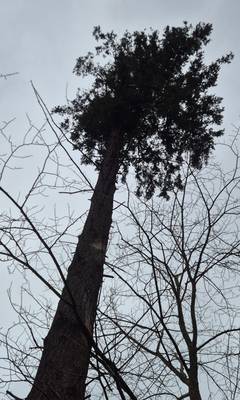
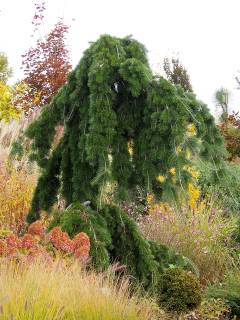
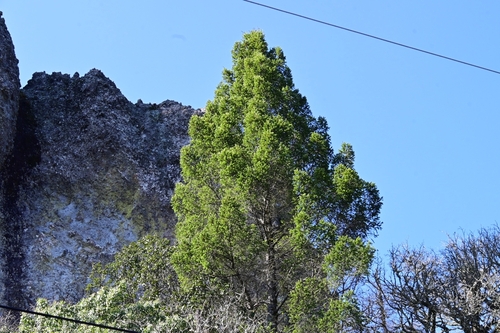
Pseudotsuga menziesii var. glauca is a variety of Douglas fir native to the interior Rocky Mountain region, differing from the coastal variety in needle color, cold hardiness, drought tolerance, and mature size. Trees reach 40–80 feet (12–24 m) tall and 15–25 feet (4.6–7.6 m) wide in cultivation, smaller than coastal var. menziesii; growth rate is 12–24 inches (30–60 cm) per year. The crown is conical to broadly pyramidal, narrower than the coastal variety. Needles are flat, 0.75–1.25 inches (2–3 cm) long, blue-green to gray-green with white stomatal bands below, shorter and often more blue-tinted than the coastal variety. Cones are 2–3.5 inches (5–9 cm) long with three-pronged exserted bracts — the same diagnostic feature as the species. Bark is similar: smooth and gray-brown on young trees, developing thick corky furrows with age. The variety is significantly more cold-hardy (to −30°F/−34°C) and drought-tolerant than the coastal variety, suited to east-side Pacific Northwest conditions. In high-rainfall west-side sites, root disease pressure is higher.
Native Range
Pseudotsuga menziesii var. glauca is native to the interior Rocky Mountain region, from British Columbia and Alberta south through Idaho, Montana, Wyoming, Colorado, and into Mexico, at elevations of 2,000–9,000 feet (600–2,700 m). It is native to eastern Washington and Oregon in the Pacific Northwest.Suggested Uses
Planted as a specimen tree, windbreak, and reforestation tree in dryland east-side Pacific Northwest conditions, spaced 15–20 feet (4.6–6 m) from adjacent plants. The blue-green foliage and more compact size relative to the coastal variety make it useful in medium to large-scale landscapes. The three-pronged cone bracts retain the same diagnostic educational value as the species for conifer identification curricula.How to Identify
Appearance
Size & Dimensions
Height40' - 80'
Width/Spread15' - 25'
Colors
Bloom Information
Male cones are small, orange-red to yellow, releasing pollen in March–May. Female cones ripen over one growing season to pendant cones 2–3.5 inches (5–9 cm) with three-pronged exserted bracts, opening in late summer to fall. Seeds are a food source for crossbills, nuthatches, and Clark's nutcrackers.
Detailed Descriptions
Flower Description
orange-red to yellow (male cones)Foliage Description
blue-green to gray-greenGrowing Conditions
Sun Requirements
Requires 6-12 hours of direct sunlight daily
• Full Sun: 6+ hours of direct sunlight
• Partial Shade: 3-6 hours of direct sunlight
• Full Shade: Less than 3 hours of direct sunlight
Care & Maintenance
Care Guide
Water weekly during the first two growing seasons; established trees are drought tolerant and suited to east-side Pacific Northwest conditions without supplemental irrigation. Prefers well-drained, slightly acidic soils. Grows well in clay, loam, and sandy substrates; does not perform as well as the coastal variety in high-rainfall west-side sites where root disease pressure increases. Cold-hardy to approximately −30°F (−34°C). No fertilization required on adequate sites. Eventual height of 40–80 feet (12–24 m) requires clearance from structures and power lines.Pruning
No pruning required. Allow the natural pyramidal form to develop. Lower branch removal for clearance can be done in late fall or winter. Avoid major pruning cuts; the bark heals slowly. The central leader develops naturally.Pruning Schedule
Prune: November–December
winter