Pittosporum, Genus, spp., Multiple species,
- Genus
- Multiple species
cheesewoods
Australasia, Pacific islands, eastern and southern Asia, and Africa
Overview
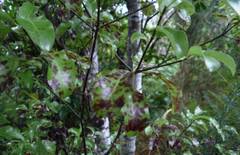
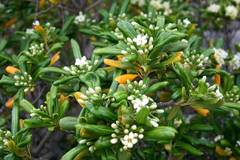
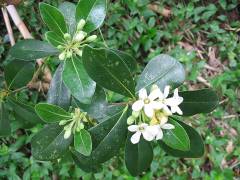
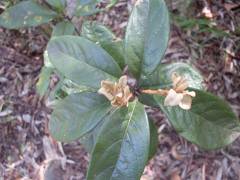
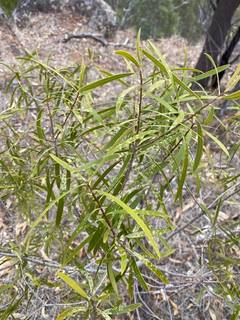
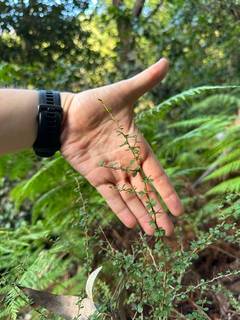
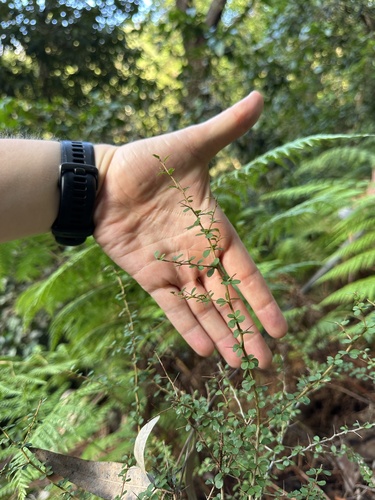
Pittosporum is a genus of about 200 species of evergreen shrubs and small trees in the family Pittosporaceae, native to Australasia, the Pacific islands, southern and eastern Asia, and parts of Africa. Plants range from 3 to 40 feet (0.9 to 12 m) tall depending on species, with a dense, often rounded to upright form. The leaves are alternate or whorled, leathery, and 1 to 6 inches (2.5 to 15 cm) long, with smooth or wavy margins; many species carry glossy dark green foliage, while cultivated forms include silver-grey, variegated cream, and purple-black leaves. Small five-petalled flowers open in spring, cream, yellow, or deep red to purple by species, and many carry a strong orange-blossom scent in the evening. The flowers are followed by woody capsules that split to reveal seeds coated in a sticky, resinous orange pulp, a feature that gives the family its name from the Greek for pitch-seed. Pittosporum grows in coastal scrub, forest margins, and rocky slopes, and tolerates salt spray, wind, and clipping. Several species, especially P. tobira and P. tenuifolium, are grown around the world as hedges, screens, and clipped forms, while P. undulatum has naturalized and become invasive in parts of Australia, the Azores, and the Caribbean. Most species are frost-sensitive and grow outdoors in mild, nearly frost-free climates.
Native Range
Pittosporum is native to Australia, New Zealand, the Pacific islands, southern and eastern Asia, and parts of Africa, including P. tenuifolium from New Zealand and P. tobira from Japan and China. Plants grow in coastal scrub, forest edges, and on rocky slopes. P. undulatum has naturalized beyond its Australian range and is invasive in several mild-climate regions.Suggested Uses
Grown as hedges, windbreaks, screens, and clipped forms, especially in coastal and Mediterranean-climate gardens. Compact and variegated kinds are used in containers and mixed borders, and cut stems are used in floral work. Fragrant-flowered species are planted along paths and seating areas where the evening scent carries.How to Identify
Appearance
Size & Dimensions
Height3' - 40'
Width/Spread3' - 20'
Colors
Bloom Information
Most Pittosporum species flower in spring, roughly March to May, though timing shifts with climate. The small flowers are clustered at the branch tips or in the leaf axils and are often fragrant after dark. Woody capsules develop through summer and ripen into autumn, persisting on the plant and splitting to expose resin-coated seed.
Detailed Descriptions
Flower Description
cream, yellow, or dark red to purpleFoliage Description
dark green, also silver-grey, variegated cream, or purple-black in cultivated formsGrowing Conditions
Sun Requirements
Requires 4-8 hours of direct sunlight daily
• Full Sun: 6+ hours of direct sunlight
• Partial Shade: 3-6 hours of direct sunlight
• Full Shade: Less than 3 hours of direct sunlight
Care & Maintenance
Care Guide
Pittosporum species grow in full sun to partial shade in moist, well-drained soil of moderate fertility. The genus tolerates coastal wind, salt spray, and regular clipping, which makes the dense forms common as hedges and screens. Most species are frost-sensitive and grow outdoors year-round only in USDA zones 8 to 11, with foliage damage below about 15 F (-9 C). Established plants tolerate short dry spells, with denser growth where soil stays moist. Plants in containers are moved under cover where winters are cold. Scale insects and aphids are the main pests, and root rot follows waterlogged soil.Pruning
Pittosporum tolerates hard clipping and is trimmed in late spring or summer to shape hedges and screens. Removing the tips brings dense, leafy regrowth from the lower stems. Old or overgrown plants are cut back into bare wood, from which most species resprout.Pruning Schedule
Prune: May–July
late springsummer
Container Growing
Suitable for container growing
Minimum container size: 5 gallons