Pinus, Genus, jeffreyi, Species,
- Genus & species
jeffrey pine
Western North America: California, southern Oregon, western Nevada, northern Baja California
Overview
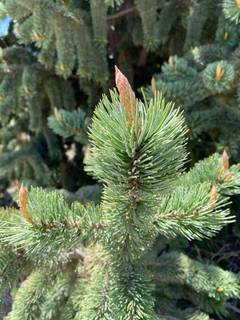
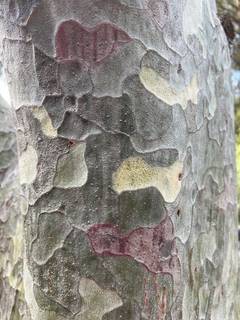
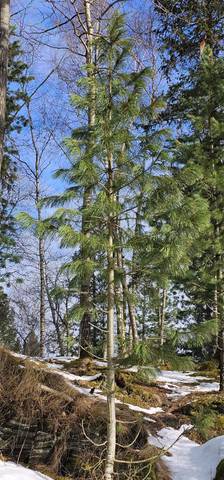
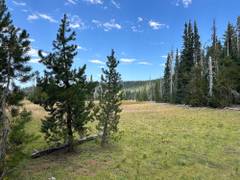
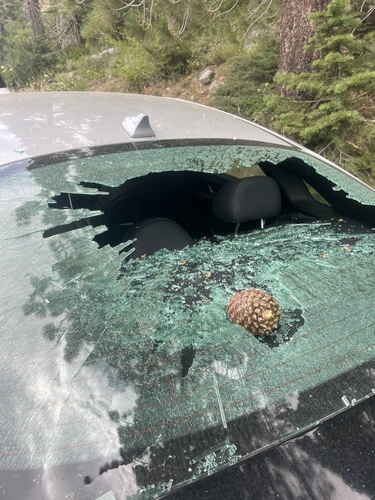
Pinus jeffreyi is a large evergreen conifer reaching 80-130 feet (24-40 m) tall and 25-30 feet (7.5-9 m) wide at maturity, with individual specimens exceeding 170 feet (52 m) on rich sites. The trunk grows to 4-6 feet (1.2-1.8 m) in diameter, sheathed in thick reddish-brown bark divided into elongate plates that emit a vanilla or butterscotch fragrance from the crevices. Needles occur in bundles of three, 5-10 inches (13-25 cm) long, blue-green to grey-green, and persist 5-9 years on the branch. Female cones measure 5-12 inches (13-30 cm) long and ovoid; cone scales bear stout incurved prickles that fold inward against the scale when handled. Cones mature in 24-26 months and release winged seeds in late summer of the second year. The crown is conical on young trees and broadens to rounded or flat-topped on mature specimens. Growth rate is moderate at 12-18 inches (30-45 cm) per year on deep loamy soils and slower on serpentine or shallow rocky slopes; individual trees may live 400-500 years. P. jeffreyi replaces P. ponderosa on serpentine, high-elevation, and cold-pocket sites within their overlapping ranges. The species is sensitive to ozone air pollution, with foliage chlorosis recorded in trees within 30-50 miles (50-80 km) of urban airsheds in California.
Native Range
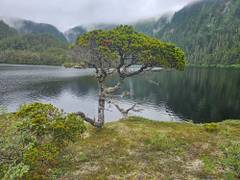
Native to the mountains of western North America from southern Oregon south through California to northern Baja California, with disjunct populations in western Nevada. Grows at 4,000-9,500 feet (1,200-2,900 m) elevation in the Sierra Nevada and Klamath ranges, on serpentine soils, gravelly volcanic substrates, and high-elevation flats.Suggested Uses
Used as a large landscape specimen on properties of 1+ acre and in restoration plantings on serpentine and high-elevation sites within the native range. Spaced 30-40 feet (9-12 m) apart in shelterbelt or grove plantings and 60+ feet (18+ m) apart for solo specimens. Not suited to small urban lots or to lowland heat below 4,000 feet (1,200 m), where summer drought stress accelerates decline.How to Identify
Appearance
Size & Dimensions
Height80' - 130'
Width/Spread25' - 30'
Colors
Bloom Information
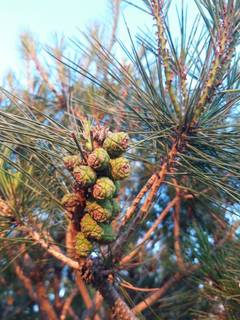
Male strobili release pollen in May and June at low elevations and into July at higher sites. Female cones become receptive at the same time and remain on the tree for 24-26 months before opening to release seed in August and September of the second year. P. jeffreyi reaches reproductive maturity at 30-40 years on most sites.
Detailed Descriptions
Flower Description
Yellow male strobili; reddish-purple young female conesFoliage Description
Blue-green to grey-greenGrowing Conditions
Sun Requirements
Requires 6-12 hours of direct sunlight daily
• Full Sun: 6+ hours of direct sunlight
• Partial Shade: 3-6 hours of direct sunlight
• Full Shade: Less than 3 hours of direct sunlight
Care & Maintenance
Care Guide
Water deeply during the first 2-3 years to establish a deep taproot; established trees survive on natural rainfall in zones 5-9 across most of the native range. Drought tolerance is high in mature specimens but seedlings die back in extended summer dry spells without supplemental water. Mountain pine beetle (Dendroctonus ponderosae) attacks stressed trees and produces pitch tubes on the trunk in mid-summer. Western gall rust forms globular swellings on branches; affected limbs can be removed without harm to the tree. Air pollution sensitivity limits long-term performance within 30-50 miles (50-80 km) of major urban centers in California. Trees grown outside the native elevation band tend to develop crown dieback after 15-20 years.Pruning
Lower branches self-prune as the tree matures, dropping naturally over 30-50 years on forest-grown specimens. Limb-up pruning is performed in late summer or fall after the bark beetle flight period; cuts made in spring attract beetles to the resin wounds. Removal exceeding one-third of live crown in a single season reduces the live crown ratio below 40 percent and produces a top-heavy form.Pruning Schedule
Prune: August–October
summerfall