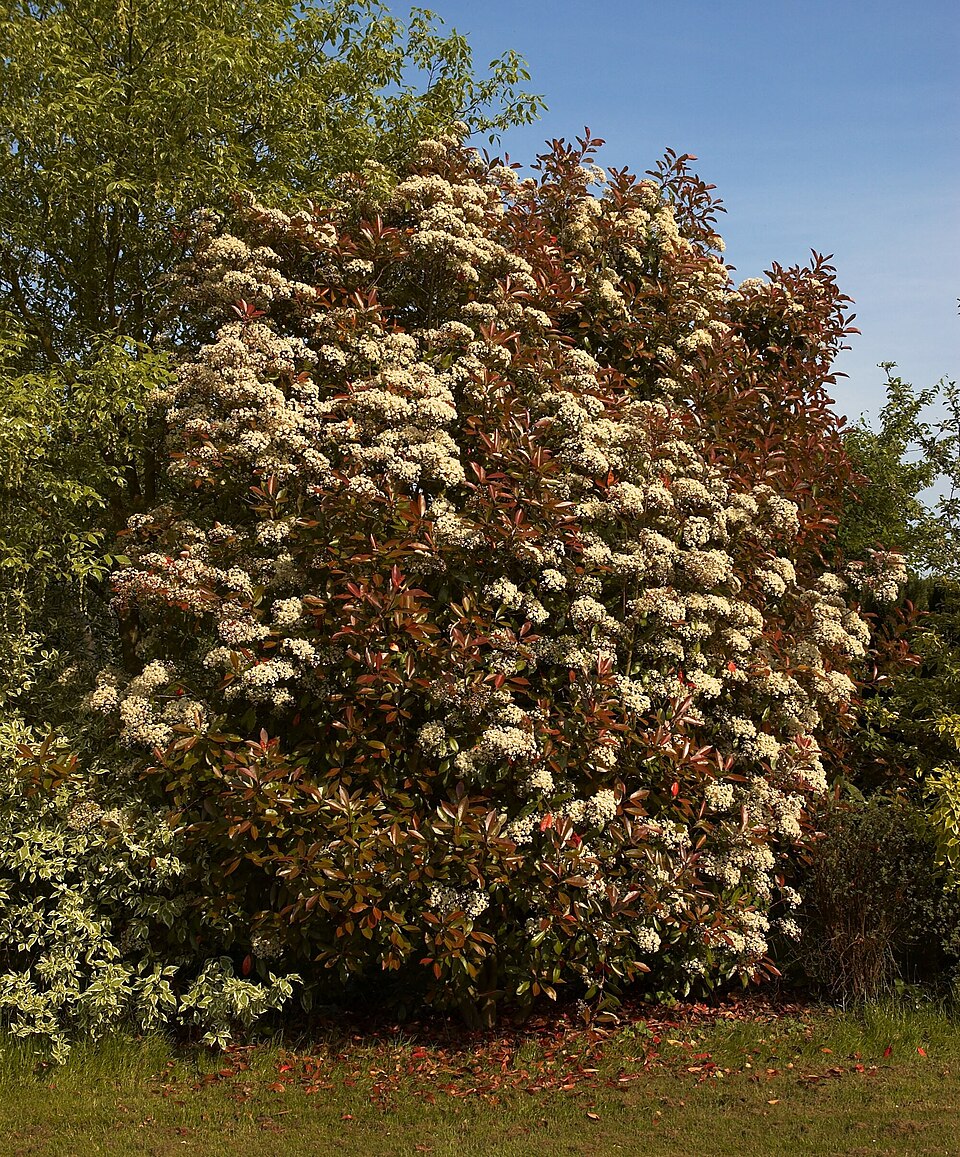
Photinia × fraseri
red tip photinia
Garden origin; parent species from eastern and southeastern Asia
Overview
Photinia x fraseri is an evergreen shrub reaching 10–15 feet (3–4.5 m) tall and 8–12 feet (2.4–3.7 m) wide, a hybrid between Photinia glabra and Photinia serratifolia. New foliage emerges bright red and 2–4 inches (5–10 cm) long, hardening over several weeks to glossy dark green with finely toothed margins. Each flush of growth repeats the red coloring, so trimmed hedges carry red tips through the growing season. Clusters of small white flowers 4–6 inches (10–15 cm) across open in spring, carry a strong sour scent, and are followed sparingly by small red pomes. The shrub forms a dense, upright framework and is planted across mild climates as a screening hedge. It is highly susceptible to Entomosporium leaf spot, a fungal disease that causes red-bordered spots, defoliation, and dieback in humid regions and where overhead irrigation wets the foliage. Growth slows in heavy shade and flowering is reduced. The plant is hardy to about 0°F (−18°C) in USDA zone 7, with foliage damage in colder spells. Leaves and seeds contain cyanogenic compounds that release cyanide when chewed.
Native Range
Photinia x fraseri is a hybrid of garden origin, first raised around 1940 at Fraser Nurseries in Birmingham, Alabama. Its parent species, Photinia glabra and Photinia serratifolia, are native to eastern and southeastern Asia, including Japan and China. The hybrid does not occur in the wild.Suggested Uses
Planted as a screening or boundary hedge, spaced 4–6 feet (1.2–1.8 m) apart, and as a single large specimen in mild-climate gardens. It is also trained as a small multi-stemmed tree or espalier. The red new growth is used for seasonal color in mixed shrub borders.How to Identify
Appearance
Size & Dimensions
Height10' - 15'
Width/Spread8' - 12'
Reaches mature size in approximately 8 years
Bloom Information
White flowers open in spring, typically April to May, in flattened clusters 4–6 inches (10–15 cm) across. The bloom carries a strong sour odor noticeable at close range. Flowering is sparse on sheared hedges, since trimming removes the flower buds. Small red pomes follow on unpruned plants but are often few.
Detailed Descriptions
Foliage Description
red maturing to dark greenGrowing Conditions
Sun Requirements
Requires 6-10 hours of direct sunlight daily
• Full Sun: 6+ hours of direct sunlight
• Partial Shade: 3-6 hours of direct sunlight
• Full Shade: Less than 3 hours of direct sunlight
Care & Maintenance
Care Guide
Full sun produces the most intense red new growth, though the shrub grows in part shade with less color and a looser form. Well-drained soil of average fertility at pH 6.0–7.0 suits it, and established plants tolerate moderate drought. Overhead watering and crowded plantings raise the risk of Entomosporium leaf spot, so drip irrigation and spacing for air movement reduce disease pressure. The plant is hardy in USDA zones 7–9 and damaged by hard freezes below about 0°F (−18°C). A single feeding in early spring supports the seasonal flushes. Fallen diseased leaves harbor fungal spores and are cleared from beneath the plants in wet climates.Pruning
Shearing two to three times during the growing season keeps a formal hedge dense and triggers fresh red growth, with the first cut after the spring flush. Renewal pruning in late winter, cutting stems back by up to one-third, restores overgrown plants. Each cut surface and the humid interior of a sheared plant raise leaf-spot risk in wet climates.Pruning Schedule
J
F
M
A
M
J
J
A
S
O
N
D
winterlate springsummer
Container Growing
✓ Suitable for container growing
Minimum container size: 7 gallons