Image 1 of 4
1 / 4
Plant Reference
Photinia, Genus, davidiana, Species,
- Genus & species
tall stranvaesia
Central and western China — Hubei, Sichuan, and Yunnan provinces, and Vietnam; mountain forests at 3,000-8,000 feet (900-2,400 m) elevation
Overview
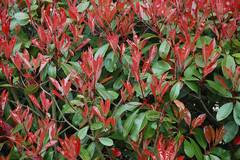
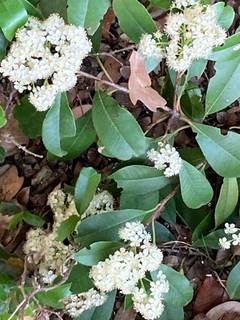
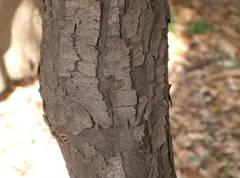
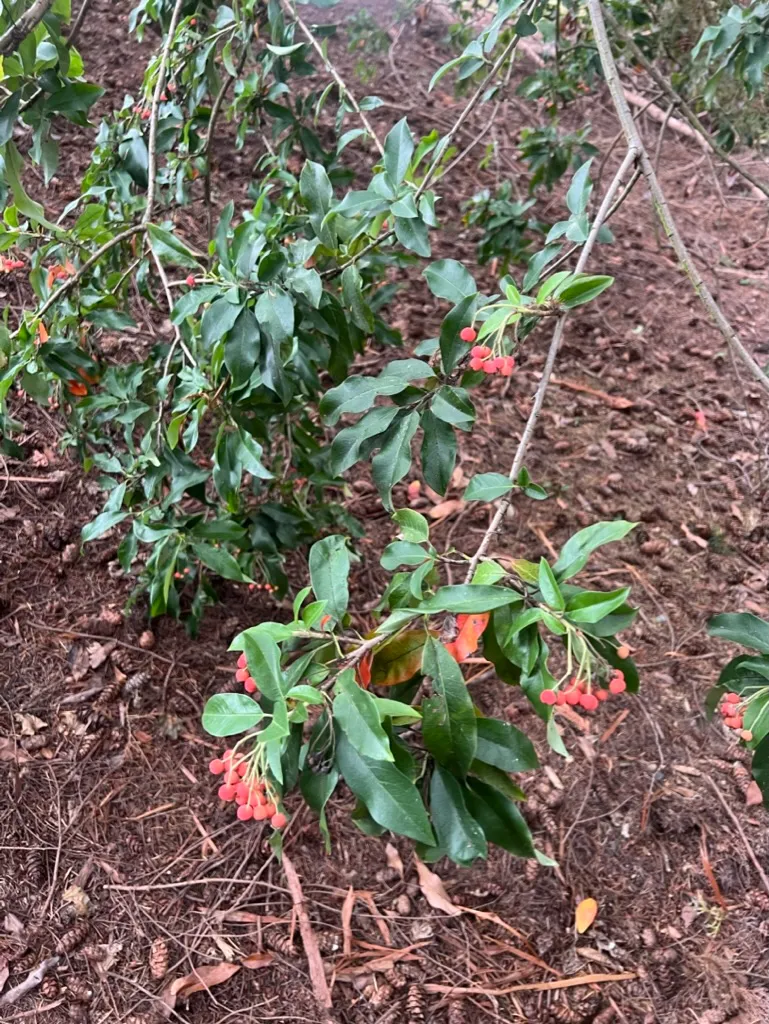
Photinia davidiana is an upright broadleaf evergreen large shrub or small tree in the rose family Rosaceae growing 12–25 feet (3.6–7.5 m) tall and 10–20 feet (3–6 m) wide from a single trunk or multiple stems that develop a rounded canopy with arching outer branches that carry the long pendant berry stalks in fall and winter. The species was formerly classified in the segregate genus Stranvaesia (as Stranvaesia davidiana) and is still encountered under that older name in horticultural literature and in some nursery catalogs, though the current taxonomic placement in Photinia reflects molecular phylogenetic evidence that supports inclusion of the Stranvaesia taxa within the broader Photinia genus. The specific epithet davidiana honors Père Armand David (1826–1900), the French Lazarist (Vincentian) missionary and naturalist who collected extensively across northern, central, and western China during three expeditions between 1862 and 1874 and who introduced many of the Chinese species cultivated in western horticulture, including Davidia involucrata (the dove tree), Buddleja davidii, and Acer davidii. Leaves are bronze-red on the new spring growth flush, glossy dark green and lance-shaped with a leathery texture at maturity, and 2–5 inches (5–13 cm) long. The evergreen foliage carries a singular natural shedding habit in which scattered individual older leaves turn vivid red and drop one at a time through fall and winter while the surrounding foliage remains green — the plant appears to carry random red leaves mixed among the green canopy, and this leaf-replacement pattern is not matched by other commonly cultivated broadleaf evergreen shrubs. The scattered red leaves are a normal natural senescence pattern, not a disease symptom, and gardeners new to the species sometimes mistake the red leaves for fire-blight damage or for cold-injury foliage and remove them unnecessarily. White small 5-petaled flowers 0.3 inch (8 mm) across open in flat-topped corymbs 2–4 inches (5–10 cm) wide in June across a 2–3 week bloom period, and bright red berry clusters 0.3 inch (8 mm) across develop in fall on long pendant stalks that hang downward from the branches and supply the species' primary winter ornamental display. Limitation: the species is susceptible to fire blight (Erwinia amylovora), the same bacterial disease that affects pears, apples, and other rosaceous trees, and infected wood produces blackened scorched-looking shoots and dieback that calls for prompt cut-out at least 12 inches (30 cm) below the visible damage with sterilization of pruning tools between cuts. The large mature size at 12–25 feet calls for ample garden space and excludes the species from small residential lots. Native to central and western China and Vietnam. Drought-tolerant once established. Non-toxic. Not deer-resistant.
Native Range
Native to central and western China — Hubei, Sichuan, and Yunnan provinces — and to northern Vietnam, growing in mountain forests at 3,000–8,000 feet (900–2,400 m) elevation. The species was first collected for western science by Père Armand David (1826–1900), the French Lazarist missionary and naturalist who collected extensively across China between 1862 and 1874 and who introduced many of the Chinese species now cultivated in western gardens. The species was later introduced to British horticulture by E. H. Wilson during his early 20th century expeditions to western China for the Veitch Nurseries.Suggested Uses
Used as an evergreen specimen tree, screening shrub, large hedge, allée tree along driveways and entrance avenues, and small-tree foundation planting at 10–20 foot (3–6 m) spacing between plants in USDA zones 6 through 9. The bronze-red spring growth flush, the white June flower corymbs, the scattered vivid red individual leaves through fall and winter, the bright red pendant berry clusters that persist through winter, and the year-round glossy dark green broadleaf evergreen foliage combine for a four-season ornamental large shrub or small tree on properties with the space to accommodate the 12–25 foot mature height. Sites smaller than approximately 20 by 20 feet (6 by 6 m) are unsuitable because of the large mature size, and gardens with active fire blight pressure (commercial pear or apple orchards nearby, or recent Erwinia amylovora outbreaks in the region) are unsuitable because the species shares the disease susceptibility with the related Rosaceae fruit trees.How to Identify
Appearance
Size & Dimensions
Height12' - 25'
Width/Spread10' - 20'
Bloom Information
White small 5-petaled flowers 0.3 inch (8 mm) across open in flat-topped corymbs 2–4 inches (5–10 cm) wide in June across a 2–3 week bloom period. Honeybees and other early-summer pollinators work the flowers for nectar across the bloom window. Bright red berry clusters 0.3 inch (8 mm) across develop from the spent flowers in fall on long pendant stalks that hang downward from the branches and persist through winter — the long pendant berry display is the species' primary winter ornamental feature, and the berries are dispersed by birds in late winter and early spring after most other red-berried winter shrubs have been stripped.
Detailed Descriptions
Flower Description
white small 5-petaled flowers 0.3 inch (8 mm) across carried in flat-topped corymbs 2-4 inches (5-10 cm) wide in June; followed by bright red berry clusters 0.3 inch (8 mm) across that develop in fall and persist through winter on long pendant stalks that hang downward from the branches and supply the species' primary winter ornamental displayFoliage Description
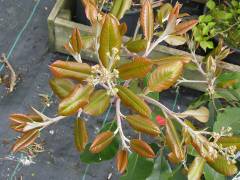
bronze-red on the new spring growth flush; glossy dark green and lance-shaped with a leathery texture at maturity, 2-5 inches (5-13 cm) long; the evergreen foliage carries a singular natural shedding habit in which scattered individual older leaves turn vivid red and drop one at a time through fall and winter while the surrounding foliage remains green — the plant appears to carry random red leaves mixed among the green canopy, a leaf-replacement pattern not matched by other commonly cultivated broadleaf evergreen shrubsGrowing Conditions
Sun Requirements
Requires 4-8 hours of direct sunlight daily
• Full Sun: 6+ hours of direct sunlight
• Partial Shade: 3-6 hours of direct sunlight
• Full Shade: Less than 3 hours of direct sunlight
Care & Maintenance
Care Guide
Site in full sun to partial shade with 4–8 hours of direct sun per day in well-drained loam, clay, or sand soil with a pH of 5.5–7.5. Drought tolerance develops once the root system is established. The species is susceptible to fire blight (Erwinia amylovora) — infected wood produces blackened scorched-looking shoots and dieback, and prompt cut-out at least 12 inches (30 cm) below the visible damage with sterilization of pruning tools between cuts (10% bleach solution or 70% isopropyl alcohol) is the cultural intervention that prevents the disease from spreading through the plant. The large mature size at 12–25 feet (3.6–7.5 m) tall and 10–20 feet (3–6 m) wide calls for ample garden space. The scattered vivid red individual leaves that appear among the green foliage in fall and winter are a normal natural senescence pattern and are not a disease symptom or a sign of plant stress. Not deer-resistant. Non-toxic. Hardy in USDA zones 6–9.Pruning
Pruning is done in early spring (February or March) before new growth emerges to remove dead, damaged, or crossing branches and to maintain the plant's natural form. Fire-blight-infected wood is cut out immediately upon detection regardless of the season — cuts are made at least 12 inches (30 cm) below the visible damage and pruning tools are sterilized between cuts (10% bleach solution or 70% isopropyl alcohol) to prevent the bacterial pathogen from spreading to healthy tissue. The species can be trained as a single-trunk small tree by selecting a dominant leader at planting and removing competing leaders and lower side branches over the first 3–5 years.Pruning Schedule
Prune: February–March
early spring