Pedicularis, Genus, racemosa, Species,
- Genus & species
sickletop lousewort
Overview
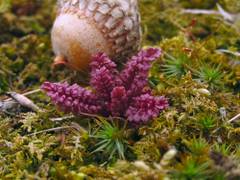
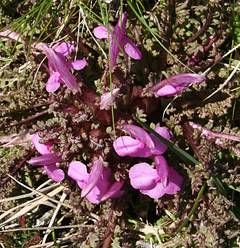
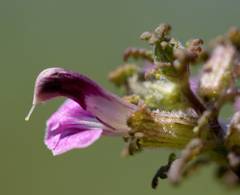
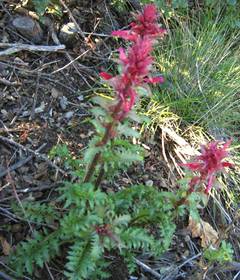
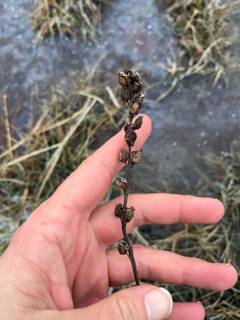
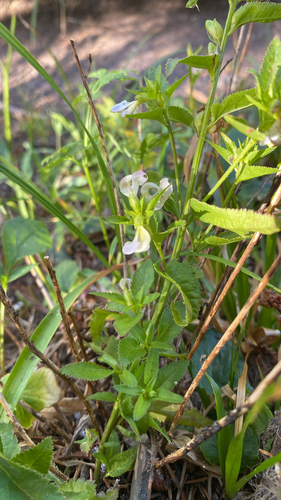
Pedicularis racemosa is a clump-forming herbaceous perennial in the broomrape family, producing several erect, leafy stems 6-20 inches (15-50 cm) tall from a branched crown. Unlike most of its relatives, it carries undivided, lance-shaped leaves with finely toothed margins, often tinged red or purple, arranged along the stems rather than in a basal rosette. The flowers are borne in loose terminal racemes, each bloom white to pale pink, about 0.5 inch (12 mm) long, with the upper lip drawn out into a downward-curving, sickle-shaped beak. Bloom occurs through the summer months. The species is a root hemiparasite, drawing part of its water and nutrients from the roots of nearby conifers and other plants while still producing its own chlorophyll. It grows in montane and subalpine coniferous forests and openings across western North America. The parasitic habit makes it difficult to transplant or cultivate away from host plants. Seeds form in flattened capsules. Bumblebees are the main pollinators.
Native Range
Pedicularis racemosa is native to western North America, from British Columbia and Alberta south through the Rocky Mountains, Cascades, and Sierra Nevada to California, Arizona, and New Mexico. It grows in montane and subalpine coniferous forests, forest openings, and slopes.Suggested Uses
In the wild it forms part of montane and subalpine forest understory communities within its range. It is rarely grown in gardens because of its dependence on conifer host roots. Field observation and native plant study are its main uses.How to Identify
Appearance
Size & Dimensions
Height6" - 1'8"
Width/Spread6" - 1'
Bloom Information
White to pale pink flowers open from June through August, later at higher elevations. Each raceme flowers over two to three weeks. Seed capsules ripen in late summer.
Detailed Descriptions
Flower Description
white to pale pinkFoliage Description
green to red-tingedGrowing Conditions
Sun Requirements
Requires 3-6 hours of direct sunlight daily
• Full Sun: 6+ hours of direct sunlight
• Partial Shade: 3-6 hours of direct sunlight
• Full Shade: Less than 3 hours of direct sunlight
Care & Maintenance
Care Guide
Grows in part shade to dappled light at the edges of conifer forests, with four to six hours of filtered sun. Cool, moist, humus-rich forest soils with good drainage suit it. As a root hemiparasite, it depends on living host roots, mainly conifers, and rarely survives transplanting or pot culture without them. Forest moisture supports growth, and the plant goes dormant in late summer. It is seldom cultivated and persists mainly in native habitat. No fertilizer or routine care applies to wild stands.Pruning
Pruning does not apply to this wild, parasitic perennial. Stems die back to the crown each autumn and regrow the following season. No shaping or trimming is practiced.Pruning Schedule
Prune: October–November
fall