Malva, Genus, parviflora, Species,
- Genus & species
cheeseweed mallow
Mediterranean, North Africa, and western Asia
SunFull Sun – Part Shade
Overview
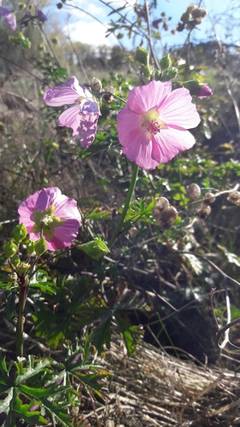
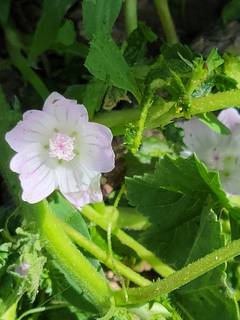
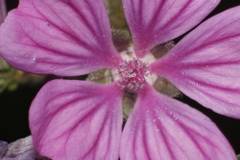
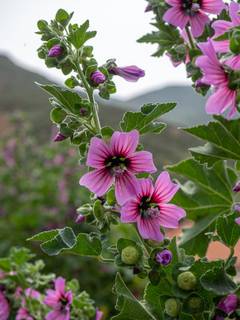
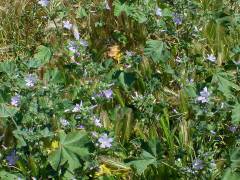
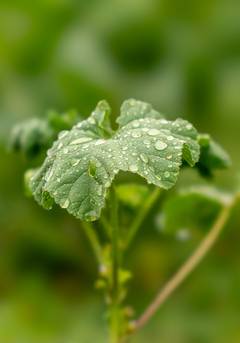
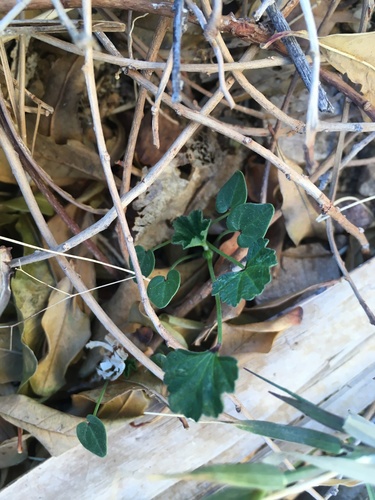
Malva parviflora is an annual to biennial herb in the mallow family reaching 8-32 inches (20-80 cm) tall, with a sprawling to erect habit that branches from a slender taproot. Stems are round, sparsely hairy, and often spread outward before turning upward. Leaves are rounded to kidney-shaped, 1-3 inches (2.5-8 cm) across, with five to seven shallow palmate lobes and crenate margins, carried on long petioles. Flowers form in small clusters at the leaf axils; each measures about 0.2-0.4 inch (5-10 mm) across with five notched petals of white to pale lilac, faintly veined. The fruit is a flattened, disc-shaped schizocarp that breaks into eight to twelve wedge-shaped segments resembling a wheel of cheese, the trait behind the common name. M. parviflora grows quickly in disturbed ground, gardens, and field edges, completing its cycle in a single season under warm conditions. It tolerates poor soil and drought once rooted but becomes coarse and weedy where unmanaged, and it can accumulate nitrates in heavily fertilized soil, a limitation near grazing livestock. The plant self-seeds heavily and persists as a volunteer for several years.
Native Range
Malva parviflora is native to the Mediterranean region, North Africa, and western Asia. It has naturalized across much of North America, Australia, and southern Africa, where it grows in disturbed and cultivated ground.Suggested Uses
Malva parviflora is mostly encountered as a weed of gardens, roadsides, and waste ground rather than a planted ornamental. Young leaves and immature fruits are edible and have a history of use as a pot herb and in traditional remedies. It occasionally appears in informal edible or famine-food plantings.How to Identify
Appearance
Size & Dimensions
Height8" - 2'8"
Width/Spread1' - 2'
Bloom Information
Flowering runs from spring through fall, roughly March to October, and nearly year-round in frost-free climates. Individual blooms are short-lived but appear continuously as the stems extend. Pollination is mainly by small bees and by self-fertilization, and seed set is heavy across the season.
Detailed Descriptions
Flower Description
white to pale lilacFoliage Description
greenGrowing Conditions
Sun Requirements
Requires 6-12 hours of direct sunlight daily
• Full Sun: 6+ hours of direct sunlight
• Partial Shade: 3-6 hours of direct sunlight
• Full Shade: Less than 3 hours of direct sunlight
Water & Climate
Water Needs
Drought Tolerance
Drought tolerant when established
Care & Maintenance
Care Guide
Malva parviflora grows in full sun to partial shade and adapts to most soils, from sandy to clay, where drainage is reasonable. Water needs are low once established, as the taproot reaches moisture deep in the soil profile. The plant germinates readily from seed in warm soil and requires no supplemental feeding; rich soil produces lush growth and higher nitrate levels in the foliage. In cultivated settings it spreads by self-sown seed and can crowd slower-growing plants. Pulling seedlings while young reduces its spread, since mature taproots resist hand removal. No serious pests affect it, though rust fungus can spot the leaves in humid conditions.Pruning
No formal pruning is required. Stems can be cut back or the whole plant removed once seed heads form to reduce volunteer seedlings the following season. Cutting at the base before flowering halts seed production.Toxicity
Non-toxicPlanting Guide
Planting Methods & Timing
Planting Method
direct sow
Direct Sow Timing
spring after last frost
Days to Maturity
60–120 days
Plant Spacing
12 inches