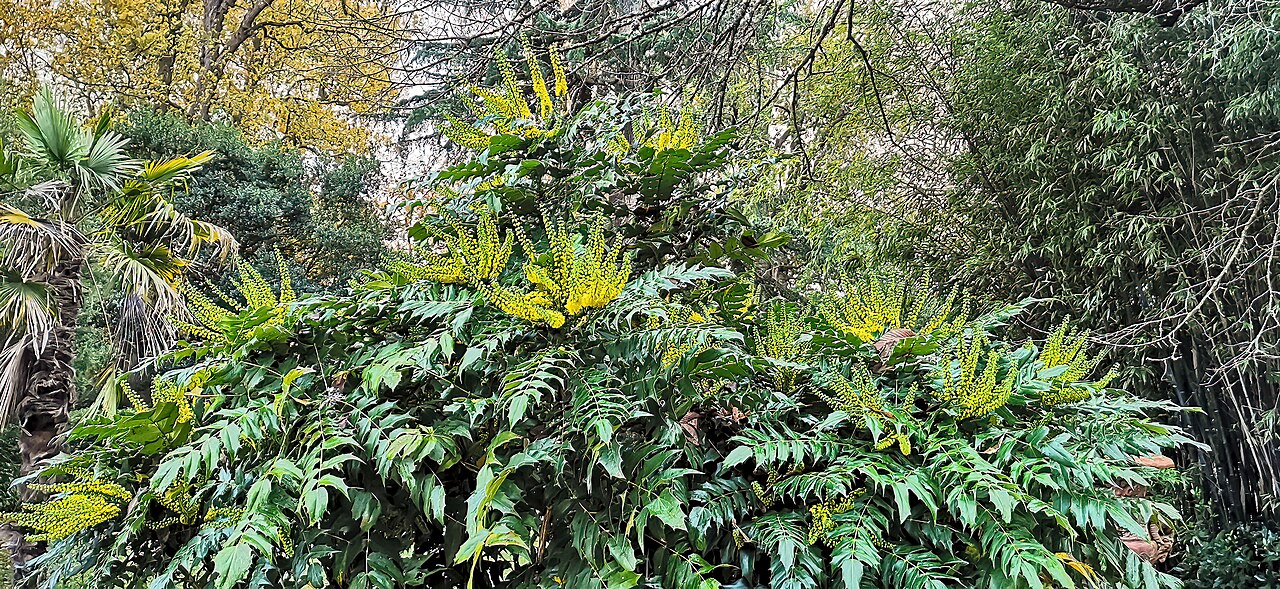
© Didier Descouens, some rights reserved (CC-BY-SA) · Wikimedia Commons
Mahonia bealei
leatherleaf mahonia
Central and western China — Hubei, Sichuan, and Guizhou provinces; mountain forests and shaded rocky slopes at 3,000-7,000 feet (900-2,100 m) elevation
Overview
Mahonia bealei is an upright broadleaf evergreen shrub in the family Berberidaceae growing 4–8 feet (1.2–2.4 m) tall and 3–5 feet (0.9–1.5 m) wide from a multi-stemmed base that produces stout stiff upright stems carrying compound leaves clustered toward the top of each stem and a sparse open canopy below. The species is named in honor of Thomas Beale (1775–1842), an English merchant resident in Macao who maintained an extensive private garden of Chinese plants and through whom the species was introduced to western horticulture by Robert Fortune in the 1840s during Fortune's first plant-collecting expedition to China. Leaves are blue-green to gray-green and pinnately compound with 9–13 broad leathery spiny-margined leaflets 2–4 inches (5–10 cm) long each, and the broad leaflets are wider than the leaflets of any other commonly cultivated Mahonia species — the broad leaflet character supplies the species' coarse architectural foliage texture that is the primary identifying field character and that separates M. bealei from the smaller-leafleted M. aquifolium (Oregon grape) and from the longer-pendant-racemed hybrid M. × media. Bright yellow small flowers open in upright to spreading terminal racemes 3–6 inches (7–15 cm) long from January through March across a 4-week bloom period and carry a light sweet lily-of-the-valley scent that is detectable at close range — the deepest-winter bloom timing supplies a critical early-season nectar source for honeybees and other pollinators that emerge from dormancy on warm winter days. Dusty blue-black berry clusters 0.3 inch (8 mm) across with a powdery glaucous bloom develop from the spent flowers in late spring and are dispersed by birds. Limitation: the species tends to become leggy and top-heavy with age as the lower leaves drop away and bare stems are left below the canopy of compound leaves at the top of each stem, producing a sparse open form that is the primary aesthetic limitation of the species in cultivation — periodic renovation pruning to remove the oldest leggy stems at the base is the cultural intervention that maintains a fuller form. The species is classified as an invasive plant in parts of the southeastern United States — bird-dispersed berries colonize forest understory and disturbed ground, and regional invasive species lists should be consulted before planting in jurisdictions where the species is restricted. Native to central and western China (Hubei, Sichuan, and Guizhou provinces). Drought-tolerant once established. Non-toxic. Deer-resistant.
Native Range
Native to central and western China — Hubei, Sichuan, and Guizhou provinces — growing in mountain forests and on shaded rocky slopes at 3,000–7,000 feet (900–2,100 m) elevation. The species was introduced to western horticulture by the Scottish plant collector Robert Fortune during his 1843–1846 expedition to China, and Fortune named the species in honor of Thomas Beale (1775–1842), an English merchant resident in Macao whose extensive private garden of Chinese plants supplied many of the introductions of Fortune's expeditions. The species has subsequently naturalized in parts of the southeastern United States where bird-dispersed berries colonize forest understory and disturbed ground.Suggested Uses
Used in shade gardens, woodland understory plantings under high deciduous canopy, mixed shade borders, architectural specimen positions where the bold coarse-textured foliage supplies vertical interest, and container specimens in containers of at least 10 gallons (38 L) at 36–60 inch (90–150 cm) spacing between plants in USDA zones 6 through 9. The deepest-winter bloom (January through March) of bright yellow lily-of-the-valley-scented flower racemes, the year-round bold blue-green to gray-green architectural evergreen foliage, and the tolerance of dry shade combine to fill a specific garden niche in shaded positions where most other broadleaf evergreen shrubs decline. Jurisdictions where the species is classified as invasive (parts of the southeastern United States) are unsuitable because of the bird-dispersed seed colonization of native forest understory, and gardeners in those regions should consider native alternatives such as Mahonia aquifolium (Oregon grape, native to the Pacific Northwest of North America) or the related cultivated hybrid Mahonia × media.How to Identify
Appearance
Size & Dimensions
Height4' - 8'
Width/Spread3' - 5'
Reaches mature size in approximately 10 years
Colors
Bloom Information
Bright yellow small flowers open in upright to spreading terminal racemes 3–6 inches (7–15 cm) long from January through March across a 4-week bloom period and carry a light sweet lily-of-the-valley scent that is detectable at close range. The deepest-winter bloom timing supplies a critical early-season nectar source for honeybees and other pollinators that emerge from dormancy on warm winter days, and the species is among the few shrubs in cultivation that supplies pollinator nectar in January and February in temperate gardens. Dusty blue-black berry clusters 0.3 inch (8 mm) across with a powdery glaucous bloom develop from the spent flowers in late spring and are dispersed by birds — the bird-dispersed seed is the mechanism behind the species' invasive spread in the southeastern United States.
Detailed Descriptions
Flower Description
bright yellow small flowers carried in upright to spreading terminal racemes 3-6 inches (7-15 cm) long from January through March; lightly fragrant with a sweet lily-of-the-valley scent that is detectable at close range; followed by dusty blue-black berry clusters 0.3 inch (8 mm) across with a powdery glaucous bloom that develop in late springFoliage Description
blue-green to gray-green pinnately compound leaves with 9-13 broad leathery spiny-margined leaflets 2-4 inches (5-10 cm) long each carried on stout stiff upright stems; the leaflets are broader than the leaflets of any other commonly cultivated Mahonia species and supply a coarse architectural foliage texture that is the species' primary identifying character; evergreen year-roundGrowing Conditions
Sun Requirements
Requires 2-5 hours of direct sunlight daily
• Full Sun: 6+ hours of direct sunlight
• Partial Shade: 3-6 hours of direct sunlight
• Full Shade: Less than 3 hours of direct sunlight
Care & Maintenance
Care Guide
Site in part shade to full shade with 2–5 hours of direct sun per day in well-drained loam or clay soil with a pH of 5.5–7.0. The species tolerates clay soils and develops drought tolerance once the root system is established. The species tends to become leggy and top-heavy with age as the lower leaves drop away — periodic renovation pruning to remove the oldest stems at the base is the cultural intervention that maintains a fuller form, and the species tolerates hard renovation cuts back to 12–18 inches (30–45 cm) above the ground with reliable regrowth from latent buds within 1–2 growing seasons. The species is classified as an invasive plant in parts of the southeastern United States — regional invasive species lists should be consulted before planting in jurisdictions where the species is restricted, and the bird-dispersed berries are the mechanism of the species' invasive spread. Non-toxic. Deer-resistant. Hardy in USDA zones 6–9.Pruning
Pruning is done in early spring (February or March) after the bloom has finished and as the new flush of leaves is emerging, to remove the oldest leggy stems at the base and to encourage fresh basal growth that maintains a full form from top to base. The species tolerates hard renovation pruning back to 12–18 inches (30–45 cm) above the ground when an overgrown plant has lost its lower foliage entirely, and regrowth from latent buds at the base produces a renewed multi-stemmed plant within 1–2 growing seasons. Removal of spent flower racemes before berry set is the practical intervention that limits the bird-dispersed seed spread of the species in regions where the species has naturalized.Pruning Schedule
J
F
M
A
M
J
J
A
S
O
N
D
early spring
Container Growing
Suitable for container growing
Minimum container size: 10 gallons