1 / 5
© lenoradavis, some rights reserved (CC-BY-NC) · iNaturalist
Lonicera involucrata
twinberry honeysuckle
Alaska south through BC, Washington, Oregon to California; east to Rocky Mountains and Great Lakes
Learn more
Overview
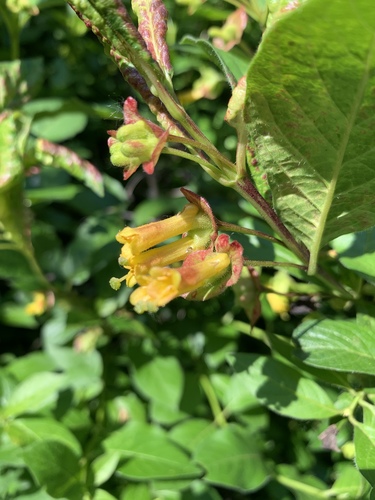
Lonicera involucrata is the twinberry honeysuckle, a native deciduous shrub growing 48–120 inches (120–300 cm / 4–10 feet) tall and 48–96 inches (120–240 cm / 4–8 feet) wide. Pairs of yellow tubular flowers 0.5–0.75 inch (12–18 mm) in late spring to early summer, subtended by green bracts. As the fruit ripens, the bracts turn dark reddish-purple and cup paired glossy black berries — the twin black berries on purple bracts are the species feature (the common name 'twinberry' references the paired fruit). Medium to dark green ovate opposite leaves 2–5 inches (5–13 cm). In the honeysuckle family (Caprifoliaceae). Hummingbird-visited — the yellow tubular flowers are a native nectar source. The berries are consumed by birds (robins, cedar waxwings, thrushes) but are bitter and mildly toxic to humans (purgative). Native to moist stream banks, wetland edges, forest edges, and cool moist thickets from Alaska south through British Columbia, Washington, Oregon, and California, east to the Rocky Mountains and Great Lakes. Tolerates wet soil and seasonal flooding — one of the few native shrubs suited to moist-to-wet sites. Not suited to dry or drought-prone sites. Non-invasive native. Deer-resistant. Part sun to full sun. Zones 3–9. Growth rate is moderate to fast. Native.
Native Range
Native to Alaska south through BC, Washington, Oregon, and California, east to the Rocky Mountains and Great Lakes, growing on moist stream banks, wetland edges, and cool moist thickets.Suggested Uses
Grown in native plantings, riparian buffers, and moist woodland edges in zones 3–9. Tolerates wet soil and seasonal flooding. The twin black berries on purple bracts and the hummingbird attraction are the features. Berries toxic to humans. Deer-resistant. Native.How to Identify
Appearance
Size & Dimensions
Height4' - 10'
Width/Spread4' - 8'
Reaches mature size in approximately 3 years
Bloom Information
Late spring to early summer (May–June), lasting 3–4 weeks. Pairs of yellow tubular flowers. Hummingbird-visited. Twin black berries on purple bracts follow in summer (bird-consumed).Detailed Descriptions
Flower Description
Yellow, tubular, 0.5-0.75 inch (12-18 mm), in pairs, subtended by green bracts that turn dark reddish-purple as the fruit ripensFoliage Description
Medium to dark green, ovate, opposite, 2-5 inches (5-13 cm), with a pointed tipGrowing Conditions
Sun Requirements
Requires 3-8 hours of direct sunlight daily
• Full Sun: 6+ hours of direct sunlight
• Partial Shade: 3-6 hours of direct sunlight
• Full Shade: Less than 3 hours of direct sunlight
Care & Maintenance
Care Guide
Part sun to full sun. Tolerates wet soil and seasonal flooding — one of the few native shrubs for moist-to-wet sites. Not suited to dry sites. Berries mildly toxic to humans. Bird food. Hummingbird-visited. Deer-resistant. Native. Zones 3–9.Pruning
Prune for shape in early spring (March). Remove old or dead stems. Tolerates renovation pruning. The multi-stemmed form develops naturally.Pruning Schedule
J
F
M
A
M
J
J
A
S
O
N
D
early spring