Jasminum, Genus, stephanense, Species,
- Genus & species
pink jasmine
Garden hybrid (parent species from China; Caucasus to western China)
Overview
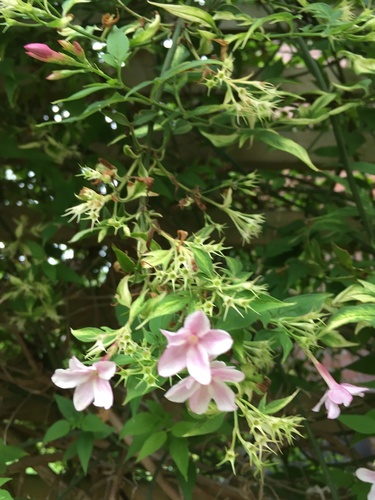
Jasminum × stephanense is a vigorous, twining, semi-evergreen woody climber reaching 15–25 feet (4.5–7.5 m) tall with support and spreading 6–10 feet (1.8–3 m) wide. The interspecific hybrid between J. beesianum (red-purple flowered, Yunnan and Sichuan) and J. officinale (white flowered, Caucasus to western China) was first raised at the Jardin des Plantes in Paris in the early 20th century. Flowers are pale pink fading to near-white, tubular with 5 spreading lobes, 0.75–1 inch (2–2.5 cm) across, borne in terminal cymes of 3–5 from June through July over a 4–6 week bloom window. Fragrance is sweet but lighter than J. officinale, at about 50–60% the olfactory intensity and carrying 5–10 feet (1.5–3 m) from the plant. Leaves are variable on a single plant — some simple (inherited from J. beesianum) and some pinnate with 3–5 leaflets (from J. officinale) — 1.5–3 inches (4–8 cm) long, medium to dark green, with bronze or coppery flush on new growth that persists for 2–3 weeks. Semi-evergreen in mild climates; deciduous in zone 7. Twining stems require support. Growth rate is rapid, reaching mature size in 3 years. Hardy to USDA zone 7. Not known to be toxic to pets or humans.
Native Range
Jasminum × stephanense is a garden hybrid first raised at the Jardin des Plantes, Paris, France, in the early 20th century. The parent species are J. beesianum (native to Yunnan and Sichuan provinces in China) and J. officinale (native from the Caucasus through the Himalayas to western China).Suggested Uses
Used on trellises, arbors, pergolas, and wall wires at 6–10 foot (1.8–3 m) spacing where pink-flowered climbing jasmine fills a color role that white and yellow hardy jasmines do not. The bronze-flushed new growth carries spring interest before bloom. The 4–6 week bloom window is 6–10 weeks shorter than J. officinale, and fragrance is lighter than the white common jasmine; the plant does not climb without support and does not tolerate deep shade or waterlogged soils.How to Identify
Appearance
Size & Dimensions
Height15' - 25'
Width/Spread6' - 10'
Bloom Information
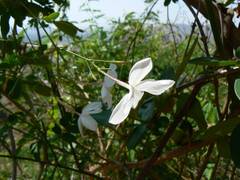
Terminal cymes of 3–5 pale pink, moderately fragrant flowers 0.75–1 inch (2–2.5 cm) across appear from June through July over a 4–6 week bloom window. Flowers fade to near-white as they age, giving mixed pink-and-white effect on each cyme as older and newer flowers coexist. The bloom window is 6–10 weeks shorter than J. officinale.
Detailed Descriptions
Flower Description
Pale pink fading to near-white; tubular 0.75-1 inch with 5 lobes; moderately fragrant; in terminal cymes of 3-5Foliage Description
Medium to dark green; variable on a single plant (some simple, some pinnate with 3-5 leaflets); 1.5-3 inches; bronze-flushed new growthGrowing Conditions
Sun Requirements
Requires 5-10 hours of direct sunlight daily
• Full Sun: 6+ hours of direct sunlight
• Partial Shade: 3-6 hours of direct sunlight
• Full Shade: Less than 3 hours of direct sunlight
Care & Maintenance
Care Guide
Grow in full sun to partial shade with 5–10 hours of direct light in average, well-drained loam, clay, or sandy soil at pH 6.0–7.5. A support structure rated for 20–50 pounds (9–23 kg) is required — trellis, arbor, pergola, or horizontal wall wires. Water deeply once per week during the first two growing seasons, then reduce to supplemental irrigation during extended drought. Apply a balanced fertilizer in early spring at 1 tablespoon per square foot (30 g/m²) of root zone. Hardy to USDA zone 7; exposed cold winter wind in zone 7 causes top dieback with regrowth from the base.Pruning
Prune after flowering in late July–August to manage size and thin congested growth. Flowers form primarily on previous-season wood, so hard spring pruning removes the next year's bloom. Remove up to one-third of oldest stems at the base annually. Renovation pruning to 2 feet (60 cm) in late winter regrows within a season but forfeits the next summer's bloom.Pruning Schedule
Prune: July–August
summer