Iris, Genus, paradoxa, Species,
- Genus & species
paradoxical iris
Native to the Armenian Highlands, occurring in eastern Turkey, Armenia, and northwestern Iran on rocky stony calcareous mountain steppe slopes at 4,000-8,000 feet elevation; native climate carries hot dry summers and cold snowy winters
Overview
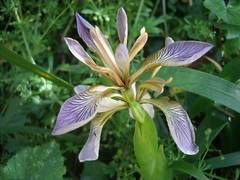
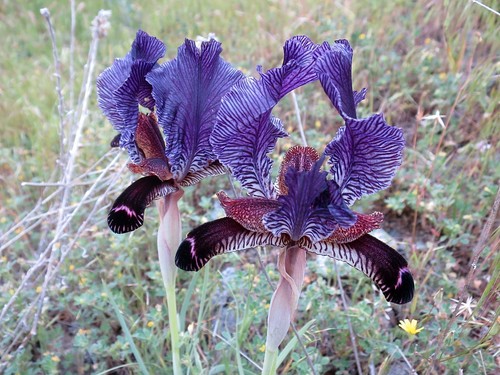
Iris paradoxa is a rhizomatous bearded iris in the family Iridaceae reaching 8–14 inches (20–35 cm) tall — compact relative to most bearded iris species. The species reverses the typical iris flower proportions: the standards (upright petals) are tiny and vestigial at 0.3–0.5 inch (8–12 mm) long, while the falls (drooping petals) are disproportionately large at 2–3 inches (5–8 cm) long and 1.5–2 inches (4–5 cm) wide — the reversed proportions create a flower that appears to be missing its upper half and the configuration gives the species its specific epithet 'paradoxa'. Falls are deep velvety purple-black to dark maroon, heavily veined and signal-marked, with a beard of dark purple to near-black hairs. Leaves are grey-green sword-shaped 0.5–0.75 inch (12–18 mm) wide, emerging from a compact rhizome. The species is native to the Armenian Highlands and adjacent mountain regions at 4,000–8,000 feet (1,200–2,400 m), where the native climate carries hot dry summers and cold snowy winters. In cultivation, the species requires a strict summer-dry dormancy — summer rainfall or supplemental irrigation causes the rhizome to rot, which is the principal cultivation difficulty. In the Pacific Northwest, the species is grown in a bulb frame, alpine house, or under a removable rain shelter to control summer moisture during the dormant period. The species is classified in Section Oncocyclus — a group of iris species that runs difficult to cultivate outside the native Mediterranean-mountain summer-dry winter-wet climate. Toxic to pets through irisin, iridin, and other glycosides in the rhizome.
Native Range
Iris paradoxa is native to the Armenian Highlands, occurring in eastern Turkey, Armenia, and northwestern Iran. The species grows on rocky stony calcareous slopes in mountain steppe habitats at elevations of 4,000–8,000 feet (1,200–2,400 m), where summers are hot and dry and winters are cold with snow cover.Suggested Uses
Grown as a specialist collector's plant in bulb frames, alpine houses, and controlled-environment raised beds where summer rainfall can be excluded. The species is unsuited to open garden borders in the maritime Pacific Northwest due to summer rainfall causing rhizome rot. Display during the brief April–May bloom window. Combines with other Oncocyclus iris in a dedicated frame where the shared cultivation requirements (summer-dry, winter-wet, sharp drainage, lean alkaline soil) are met for the whole collection. The reversed flower proportions and deep purple-black falls make the species a conversation piece at alpine plant society shows and iris society events. The cultivar is unsuitable for general garden use, container culture without seasonal cover, or any position with summer rainfall above approximately 2 inches (50 mm) total across June through September.How to Identify
Appearance
Size & Dimensions
Height8" - 1'2"
Width/Spread6" - 8"
Bloom Information
Flowers appear in April through May, one flower per stem. Each flower lasts 3–5 days. The bloom period runs brief — approximately 10–14 days for an established clump. After flowering, the plant enters a dry summer dormancy lasting from June through September, during which the rhizome stays inactive at or near the soil surface. Pollination in the native range occurs by long-tongued bees foraging on the rocky steppe vegetation; in cultivation, hand-pollination is required for seed production since the appropriate native pollinators are absent.
Detailed Descriptions
Flower Description
Deep velvety purple-black to dark maroon falls 2-3 inches with dark purple to near-black beard; vestigial standards 0.3-0.5 inchFoliage Description
Grey-green; sword-shaped 0.5-0.75 inch wideGrowing Conditions
Sun Requirements
Requires 6-12 hours of direct sunlight daily
• Full Sun: 6+ hours of direct sunlight
• Partial Shade: 3-6 hours of direct sunlight
• Full Shade: Less than 3 hours of direct sunlight
Care & Maintenance
Care Guide
Plant rhizomes in autumn in full sun in sharply drained alkaline gritty soil at pH 7.0–8.5. Position each rhizome horizontally at the soil surface — burying the rhizome causes rot. In the Pacific Northwest, grow in a raised bulb frame or alpine house with a removable rain cover to ensure complete dryness from June through September. Water moderately from October through May to simulate the wet-winter dry-summer cycle of the native habitat. No fertilization is needed — lean soil promotes plant health, while richer soil promotes rot. Sharp drainage in the planting medium reduces winter rot risk — a 50:50 grit-to-soil mix or higher grit ratio works in continually wet maritime climates. The species is a specialist plant requiring controlled conditions outside the native range and runs difficult to maintain long-term in open garden beds in temperate North American climates.Pruning
Remove the spent flower stem at the base after bloom finishes. Allow foliage to yellow and die back naturally by June; do not cut green foliage during the active growth period. During summer dormancy from June through September, the rhizome should remain dry and undisturbed at or near the soil surface.Pruning Schedule
Prune: May–June
springsummer
Container Growing
Minimum container size: 3 gallons