Hibbertia, Genus, virgata, Species,
- Genus & species
twiggy guinea-flower
Overview
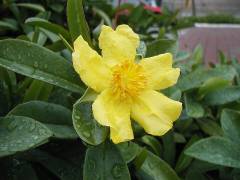
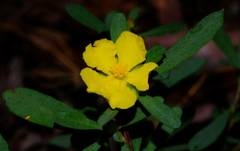
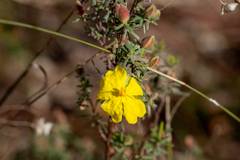
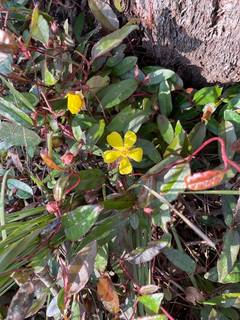
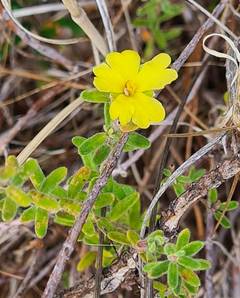
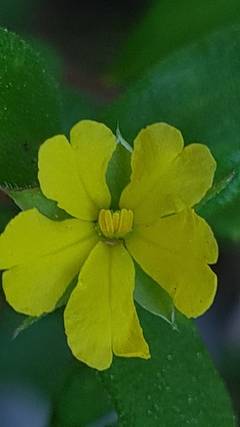
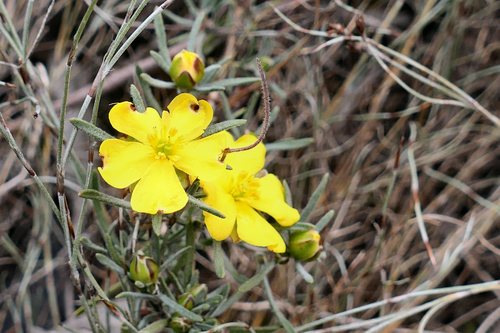
Hibbertia virgata is a small evergreen shrub with slender, erect, twiggy stems reaching 1-3 feet (0.3-0.9 m) tall and 1-2 feet (0.3-0.6 m) wide. The narrow linear to oblong leaves are 0.2-0.5 inch (5-12 mm) long, mid-green, and held close to the wiry stems. Solitary yellow flowers open along the upper stems, each 0.5-0.9 inch (12-22 mm) across with five broad, often shallowly notched petals around a central cluster of stamens. Flowering peaks in spring, with scattered bloom continuing into early summer. The species grows on sandplains and in open heath and woodland on well-drained sandy and gravelly soils, often in full sun. It tolerates extended summer drought once established but is damaged by hard frost. The open twiggy framework gives a see-through habit rather than dense cover, which limits its use as a screen. Like many southwest Australian shrubs, it is sensitive to phosphorus and to prolonged wet soil. Plants are moderately short-lived, lasting roughly 6-12 years in cultivation.
Native Range
Hibbertia virgata is native to the southwest of Western Australia, where it grows on coastal and inland sandplains. It is found in kwongan heath and open woodland on deep sandy and lateritic soils.Suggested Uses
Planted in native, waterwise, and coastal gardens, and in mixed shrub plantings on sandy soil. Suited to rockeries and gravel gardens with sharp drainage. Spaced 18-30 inches (45-75 cm) apart in groups.How to Identify
Appearance
Size & Dimensions
Height1' - 3'
Width/Spread1' - 2'
Bloom Information
Flowering peaks in spring, roughly September to November in the native range, with scattered flowers into early summer. Each flower lasts a day or two, opening in sequence along the stems. Yellow petals surround a tight central group of stamens.
Detailed Descriptions
Foliage Description
Mid-greenGrowing Conditions
Sun Requirements
Requires 6-10 hours of direct sunlight daily
• Full Sun: 6+ hours of direct sunlight
• Partial Shade: 3-6 hours of direct sunlight
• Full Shade: Less than 3 hours of direct sunlight
Care & Maintenance
Care Guide
Hibbertia virgata grows in full sun to light shade in sharply drained sandy or gravelly soil. Established plants tolerate summer drought and need water only in prolonged dry spells. The species is adapted to low-nutrient soils and grows without phosphorus fertilizer, which can injure the roots. Cold hardiness is limited to near-frost-free climates, roughly USDA zones 9-11. Sharp drainage is essential, as the roots rot in soils that stay wet through winter.Pruning
Light tip pruning after flowering keeps the open framework denser and removes spent flower stems. Plants tolerate removal of up to one-third of the season growth but recover slowly from cuts into bare old wood. No routine pruning is otherwise required.Pruning Schedule
Prune: November–December
late springsummer
Container Growing
Suitable for container growing
Minimum container size: 3 gallons