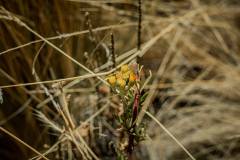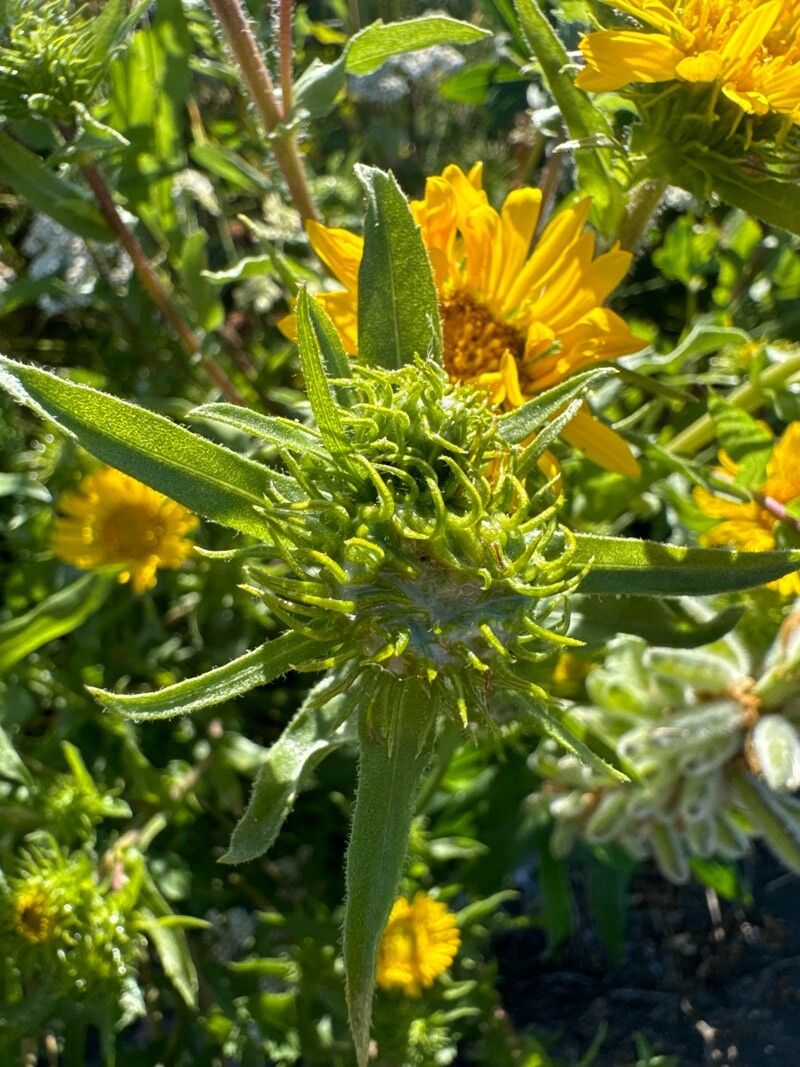
Grindelia, Genus, integrifolia, Species,
- Genus & species
Puget sound gumweed
Pacific coast from British Columbia to northern California
Overview
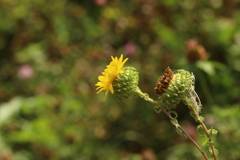
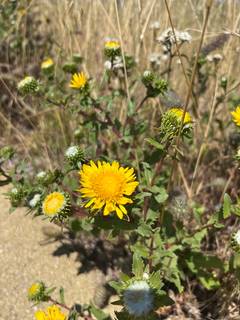
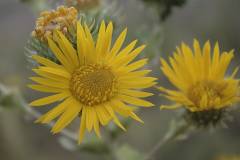
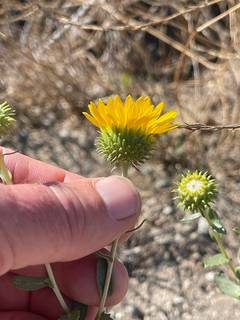
A clump-forming evergreen-to-semi-evergreen perennial reaching 12-32 inches (30-80 cm) tall and 18-24 inches (45-60 cm) wide, growing from a stout taproot and woody basal crown. Leaves alternate, oblanceolate to lanceolate, 1-4 inches (2.5-10 cm) long, leathery, deep green and resinous; lower leaves with finely toothed margins, upper leaves nearly entire. Stems erect, branching above to carry yellow daisy-like flower heads 1-2 inches (2.5-5 cm) across with 25-40 ray florets surrounding a yellow disc. A sticky white gum exudes from the involucre bracts before the flower opens, encasing the bud in a pearly droplet — the source of the common name. Plants flower June through October across their range, with peak flowering July through September. Stands tolerate salt spray and brackish water and persist on wave-affected coastal substrates where most non-native species cannot establish.
Native Range
Native to coastal western North America from southern British Columbia south through Washington and Oregon to northern California, with inland populations along salt-affected waterways in the inland Northwest. Found on coastal bluffs, salt marshes, brackish meadows, dune edges, and beach-fringe gravel from sea level to 200 feet (60 m).Suggested Uses
Planted in coastal restoration plantings, salt-tolerant borders, and bluff plantings within zones 7-10 at 18-24 inch (45-60 cm) spacing. Used in salt-marsh transition plantings and dune stabilization where summer drought combines with salt exposure. Container culture is sustained 2-4 years in pots of at least 3 gallons (11 L) with coarse mineral drainage.How to Identify
Appearance
Size & Dimensions
Height1' - 2'8"
Width/Spread1'6" - 2'
Bloom Information
June through October across the species' coastal range, with peak flowering July through September. Each head lasts 7-10 days; total bloom per stand 16-20 weeks. Cool maritime summers favor extended bloom; hot inland transplants compress flowering into 8-10 weeks.
Detailed Descriptions
Foliage Description
Deep green resinousGrowing Conditions
Sun Requirements
Requires 6-12 hours of direct sunlight daily
• Full Sun: 6+ hours of direct sunlight
• Partial Shade: 3-6 hours of direct sunlight
• Full Shade: Less than 3 hours of direct sunlight
Care & Maintenance
Care Guide
Plants benefit from supplemental water during the first growing season; established stands tolerate 6-8 weeks of drought, salt spray, and brackish soil. Crown rot develops on heavy clay or in pots without sharp drainage. Powdery mildew is rare on dry-grown plants. Aphids and lygus bugs feed on flower buds occasionally. Stands persist 5-8 years in coastal gardens; lifespan drops to 2-3 years on rich loam with summer rainfall above 30 inches (75 cm). Transplanting damages mature plants because the long taproot does not recover from disturbance.Pruning
Spent flower stems are cut at the base in October after seed dispersal. A second light shearing in February removes any winter-killed top growth without affecting bloom. Hard cutback into the woody crown delays flowering by 4-6 weeks the following season.Pruning Schedule
Prune: February & October
fallwinter
Container Growing
Suitable for container growing
Minimum container size: 3 gallons