Grevillea, Genus, 'Robyn Gordon', Cultivar,
- Genus
- Cultivar
grevillea Robyn Gordon
Garden origin; parent species from eastern and southwestern Australia
Overview
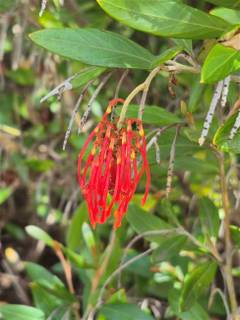
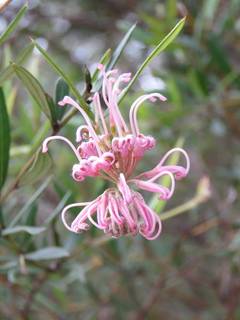
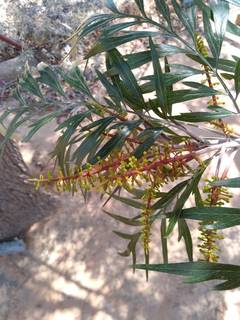
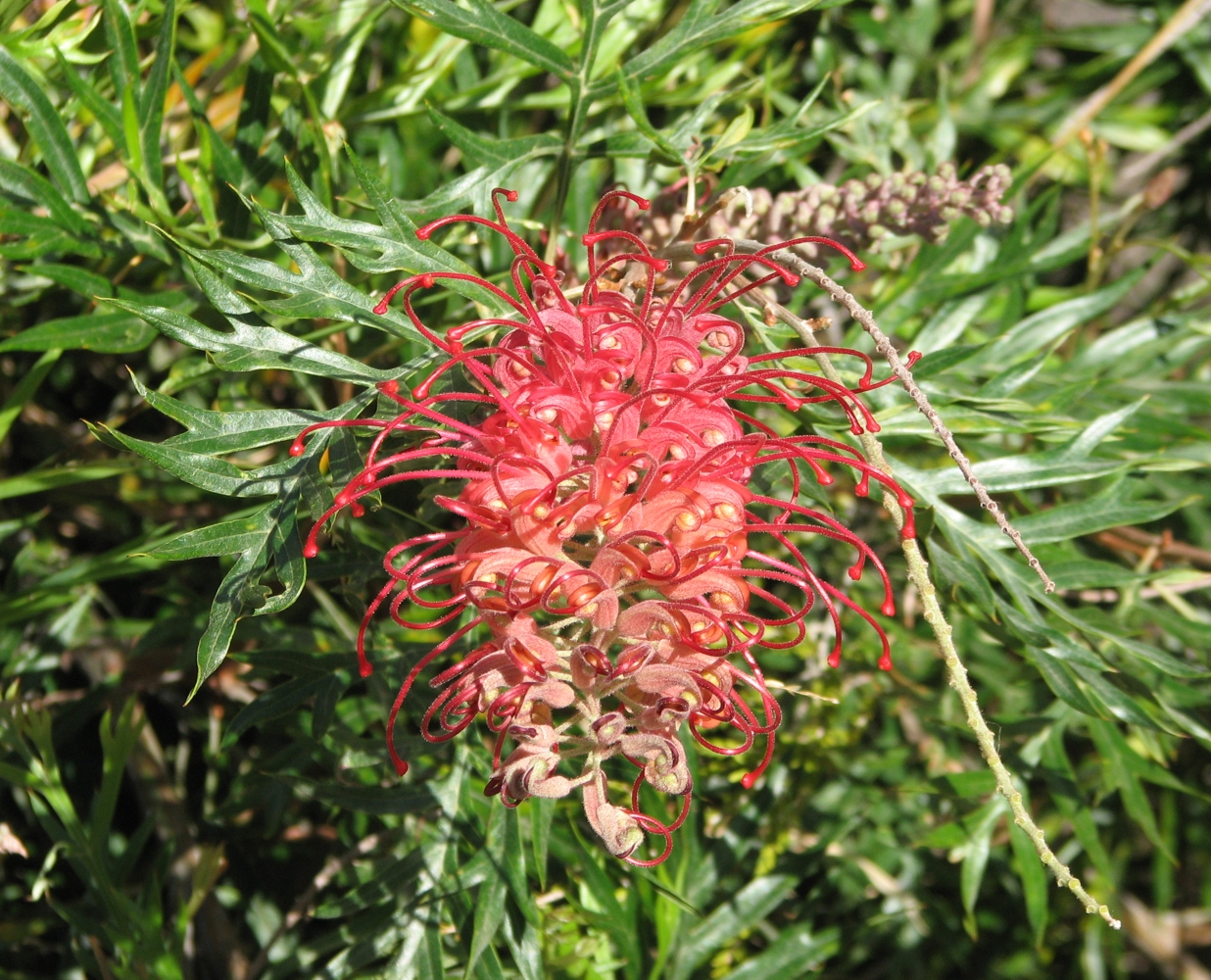
Grevillea 'Robyn Gordon' is an evergreen shrub reaching 3-5 feet (0.9-1.5 m) tall and 6-8 feet (1.8-2.4 m) wide, a hybrid of G. banksii and G. bipinnatifida raised at Myall Park in southern Queensland and released in the 1960s. It holds the low spreading form of G. bipinnatifida rather than the 10-15 foot (3-4.5 m) upright habit of G. banksii. Leaves are divided into 5-11 lobes, 4-10 inches (10-25 cm) long, dark green above and grey-haired beneath. Flower heads are one-sided racemes 4-6 inches (10-15 cm) long, red to deep pink, with styles that curve upward as each flower opens, carried clear of the foliage on stalks 4-8 inches (10-20 cm) long. Flowering occurs in every month in frost-free climates, with 60-80 percent of the heads produced between autumn and spring. The plant sets little viable seed, so stock is grown from cuttings or grafted onto G. robusta rootstock. Plants live 8-15 years on their own roots and under 8 years in summer-rainfall areas on clay, where root rot from Phytophthora cinnamomi kills them over 2-4 weeks. Leaves and flowers contain alkylresorcinols, which cause allergic contact dermatitis on the hands and forearms of people who prune the plant regularly.
Native Range
Grevillea 'Robyn Gordon' is a garden hybrid with no wild distribution, raised at Myall Park Botanic Garden near Glenmorgan, Queensland, from a cross between G. banksii of coastal central and southern Queensland and G. bipinnatifida of southwestern Western Australia. The two parent species are separated by about 2,000 miles (3,200 km) in the wild and meet only in cultivation. The cultivar is grown across mainland Australia and in warm regions of North America, southern Europe, and southern Africa.Suggested Uses
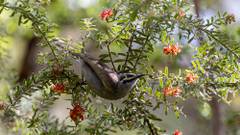
Planted at 6-8 foot (1.8-2.4 m) spacing as a low screen, bank cover, and nectar shrub for honeyeaters in gardens across mainland Australia and in USDA zones 9-11 of North America. Grown in containers of 20 gallons (76 L) or larger in free-draining native potting mix. Skin reactions from repeated contact limit use along paths, play areas, and driveway edges where the foliage is brushed in passing.How to Identify
Appearance
Size & Dimensions
Height3' - 5'
Width/Spread6' - 8'
Colors
Bloom Information
Flower heads open in every month in USDA zones 10-11, with the heaviest flowering between autumn and spring, March to October in the Northern Hemisphere and April to November in Australia. Each head holds 3-5 weeks as flowers open from the base of the raceme outward. Plants past their third year carry 20-60 heads at a time. Flowering thins for 6-8 weeks after hard pruning and in summers with day temperatures above 100F (38C).
Detailed Descriptions
Flower Description
Red to deep pinkFoliage Description
Dark green with grey undersidesGrowing Conditions
Sun Requirements
Requires 6-12 hours of direct sunlight daily
• Full Sun: 6+ hours of direct sunlight
• Partial Shade: 3-6 hours of direct sunlight
• Full Shade: Less than 3 hours of direct sunlight
Care & Maintenance
Care Guide
Water weekly through the first two summers, then every 3-4 weeks; established plants hold their flowering through 6-8 weeks without water. Free-draining sandy or gravelly soil at pH 5.5-7.0 is required, and root rot from Phytophthora cinnamomi kills plants within 2-4 weeks in soil that stays wet above 68F (20C), while plants grafted onto G. robusta rootstock hold in clay and in summer-rainfall climates. Phosphorus above 10 ppm blackens the leaves and kills shoots within one season, so fertilizer formulated for Proteaceae at 1 ounce per square yard (30 g per square meter) after the main flush is the workable option. Contact with foliage and flowers raises an itching rash on the hands and forearms of people who handle the plant repeatedly, appearing 12-48 hours after exposure. Scale insects and stem borers attack plants under drought stress on shallow soils. Frost below 27F (-3C) burns the leaf tips and kills the outer 6-12 inches (15-30 cm) of growth.Pruning
Spent heads and the shoot behind them are cut back by 4-8 inches (10-20 cm) after each flush, which holds the plant at 3-4 feet (0.9-1.2 m) and brings on the next set of heads within 6-8 weeks. Plants cut into leafless wood over three years old reshoot from dormant buds in about 60 percent of cases, and the rest die back to the crown. Sap and leaf hairs released during pruning raise skin reactions in sensitive people 12-48 hours later. Plants left uncut for 3-4 years spread to 8-10 feet (2.4-3 m) wide with flowering confined to the outer canopy.Pruning Schedule
Prune: May–June & November
late springfall
Container Growing
Suitable for container growing
Minimum container size: 20 gallons