Grevillea, Genus, lanigera, Species,
- Genus & species
Woolly grevillea
Southeastern Australia, coastal and montane New South Wales and Victoria
Overview
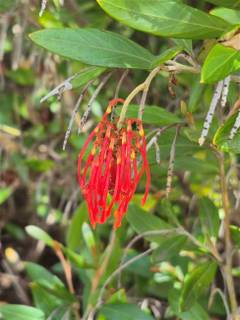
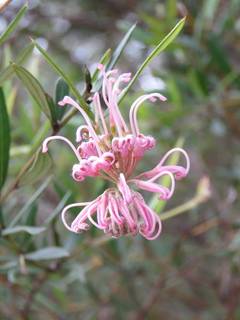
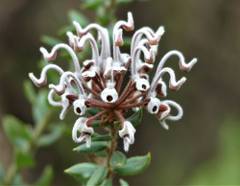
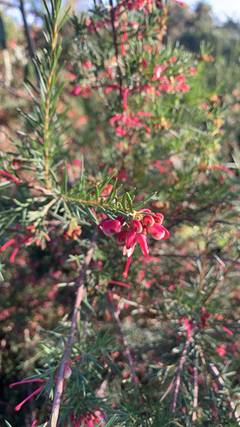
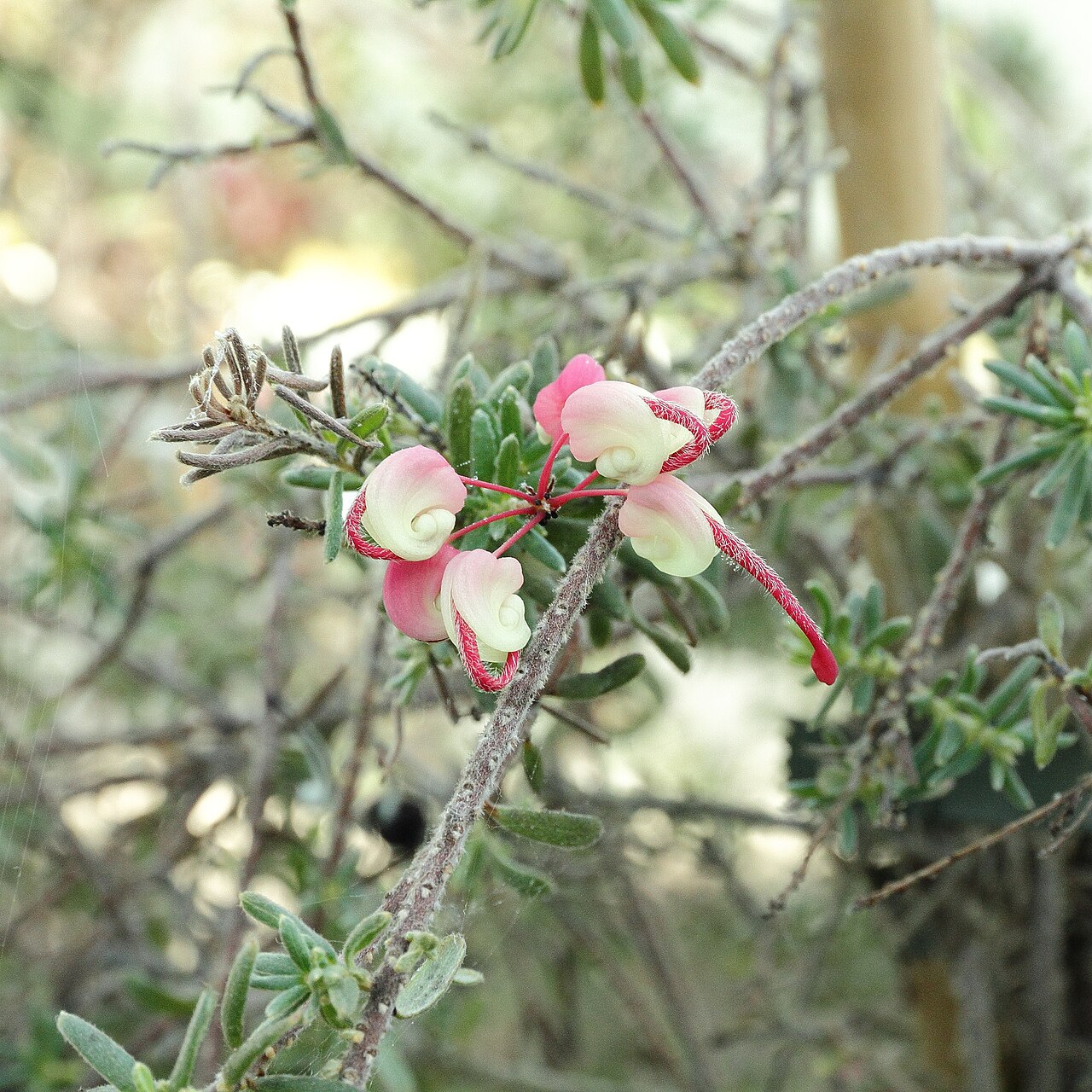
Grevillea lanigera is an evergreen shrub ranging from prostrate mats to rounded bushes, 1-5 feet (30-150 cm) tall and 3-8 feet (0.9-2.4 m) wide depending on the form and where it originated. Stems and leaves are covered in dense soft woolly hairs that give the plant a grey cast and a felted surface. Leaves are crowded along the stems, narrow-oblong to linear, 0.4-1 inch (10-25 mm) long and 0.1-0.2 inch (3-5 mm) wide, with margins rolled under. Flower clusters sit at the branch tips, 1-1.5 inches (2.5-4 cm) across, each holding 8-20 tubular flowers in pink and cream, with a curved style extending about 0.5 inch (13 mm) past the perianth. Flowering is heaviest from late winter through spring and continues in scattered clusters at other times. The species dies quickly from Phytophthora root rot in soil that holds water, which is the usual cause of loss in gardens. Sap and foliage contain resorcinol compounds that bring on contact dermatitis in sensitive people. Coastal and alpine forms differ in habit, frost tolerance, and leaf width. Hardy in USDA zones 8-10.
Native Range
Grevillea lanigera is native to southeastern Australia, in New South Wales and Victoria, from coastal heath and cliff tops to subalpine slopes in the Australian Alps above 4,000 feet (1,200 m). It grows on shallow, gritty, free-draining soils over sandstone and granite, in open woodland and heath. Forms raised from high-elevation populations carry greater frost tolerance than those of coastal origin.Suggested Uses
Grown as groundcover on banks and over retaining walls, in rockeries and gravel gardens, along dry driveway edges, and in coastal plantings, spaced 3-5 feet (90-150 cm) apart. Prostrate forms are planted to spill over walls and the edges of raised beds. Container culture works in pots of 5 gallons (19 L) or larger in a free-draining low-phosphorus native mix.How to Identify
Appearance
Size & Dimensions
Height1' - 5'
Width/Spread3' - 8'
Bloom Information
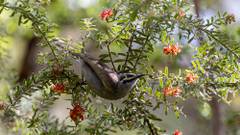
The heaviest flowering runs from June to November in the southern hemisphere and from December to May in northern hemisphere plantings, with scattered clusters outside that window in mild climates. Clusters form on short lateral shoots of the current and previous season, so light tip cutting after the main flush raises the number of flowering points. Each cluster holds colour two to three weeks as its flowers open in sequence. Honeyeaters take nectar from the tubular flowers in Australia, and honeybees work them elsewhere.
Detailed Descriptions
Flower Description
Pink and cream with a curved pink styleFoliage Description
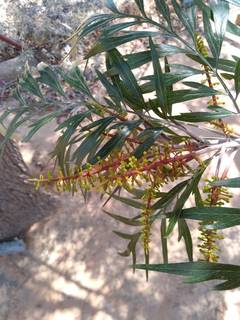
Grey-green, densely woolly, with margins rolled underGrowing Conditions
Sun Requirements
Requires 6-12 hours of direct sunlight daily
• Full Sun: 6+ hours of direct sunlight
• Partial Shade: 3-6 hours of direct sunlight
• Full Shade: Less than 3 hours of direct sunlight
Care & Maintenance
Care Guide
Six or more hours of direct sun gives compact growth and heavy flowering, while part shade opens the plant up and cuts the flower count. Sharp drainage is the controlling factor: the species grows in gritty sand, gravel, or a raised bed at pH 5.5-7.0 and dies within a season in soil that stays wet. Established plants run four to six weeks without water, and summer irrigation on heavy soil raises the risk of Phytophthora root rot. Fertilisers with more than about 2 percent phosphorus damage the proteoid roots of the Proteaceae, so a low-phosphorus native formulation or no feeding at all is what the species takes. A 2-inch (5 cm) gravel or coarse bark mulch held clear of the stem base keeps the crown dry. Plants set on a slope or on a mound 8-12 inches (20-30 cm) above the surrounding grade drain faster than those on flat ground.Pruning
Tip cutting of 2-4 inches (5-10 cm) from each shoot after the main spring flush holds the plant dense and raises the number of flowering laterals. The species reshoots weakly from bare wood, so cuts stay within growth that still carries leaves. A light trim every year from planting holds the plant within its space, since a neglected specimen cannot be reduced later without leaving gaps. Dead and rot-affected stems are taken out at the base at any time of year.Pruning Schedule
Prune: May–June
late spring
Container Growing
Suitable for container growing
Minimum container size: 5 gallons