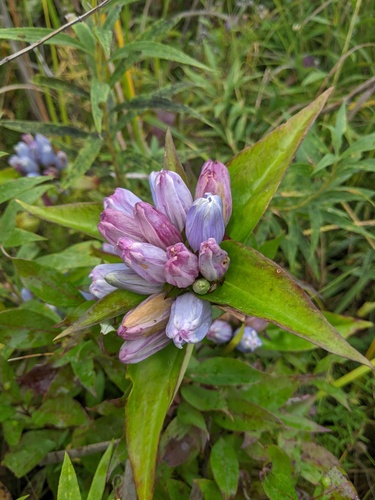
Gentiana, Genus, ×, Hybrid, pallidocyanea, Species,
- Genus & species
- Hybrid
hybrid bottle gentian
Overview
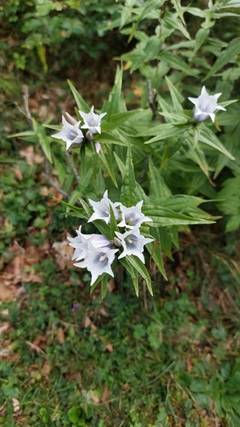
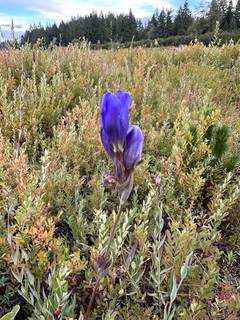
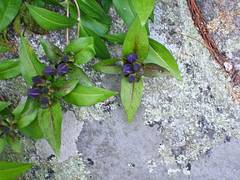
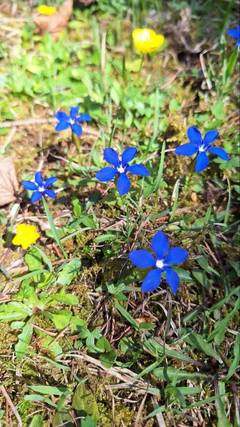
Gentiana × pallidocyanea is a naturally occurring hybrid between G. clausa and G. andrewsii, combining traits of both bottle gentians. It grows as an herbaceous perennial 12–24 inches (30–60 cm) tall, forming upright unbranched stems from a central crown. Leaves are opposite, lance-shaped, 2–4 inches (5–10 cm) long, with smooth margins. Flowers form in tight terminal clusters and in the upper leaf axils, each bloom 1–1.5 inches (2.5–4 cm) long and remaining nearly closed at the tip, a form shared with both parent species. Flower colour ranges from deep blue to pale blue-white, reflecting the intermediate nature of the cross. Bloom occurs in late summer through autumn, from August to October. The closed corolla restricts pollination to large bees able to force the petals apart, which limits seed set where such pollinators are scarce. Plants grow from a perennial rootstock and die back to ground level each winter. This hybrid occurs where the ranges of the two parent species overlap in moist meadows and streambanks of northeastern North America.
Native Range
Gentiana × pallidocyanea occurs in northeastern North America where the ranges of its parent species G. clausa and G. andrewsii overlap. It is found in moist meadows, wet thickets, and streambanks from the Great Lakes region eastward.Suggested Uses
Used in rain gardens, moist meadow plantings, and pond margins where soil stays damp. Combined with other moisture-tolerant perennials in naturalistic borders, spaced 12–18 inches (30–45 cm) apart.How to Identify
Appearance
Size & Dimensions
Height1' - 2'
Width/Spread9" - 1'
Bloom Information
Flowers open from late summer into autumn, roughly August through October. The closed bottle-shaped corollas remain on the plant for several weeks. Pollination depends on large bees forcing entry, so flowering may pass with limited seed set where these bees are absent.
Detailed Descriptions
Flower Description
blue to blue-whiteFoliage Description
greenGrowing Conditions
Sun Requirements
Requires 4-8 hours of direct sunlight daily
• Full Sun: 6+ hours of direct sunlight
• Partial Shade: 3-6 hours of direct sunlight
• Full Shade: Less than 3 hours of direct sunlight
Care & Maintenance
Care Guide
Grows in full sun to part shade in consistently moist, fertile soil. A soil pH near neutral, 5.5–7.0, is suitable, and drainage should retain moisture without standing water. Water needs are medium to high, and plants decline in prolonged drought. Hardy in USDA zones 3–7, withstanding hard winter frost once dormant. Established clumps are slow to reestablish after disturbance, so division rarely succeeds and plants recover slowly when moved. No routine feeding is required in fertile ground.Pruning
Cut spent stems to ground level after they die back in late autumn or early spring. No other pruning is needed. Plants form clumps slowly and do not require thinning.Pruning Schedule
Prune: March & November
fallearly spring