Gahnia, Genus, sieberiana, Species,
- Genus & species
red-fruit saw-sedge
Overview
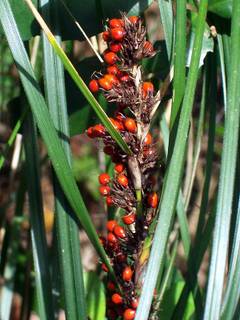
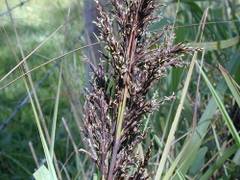
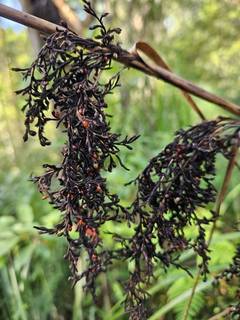
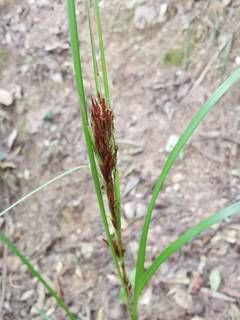
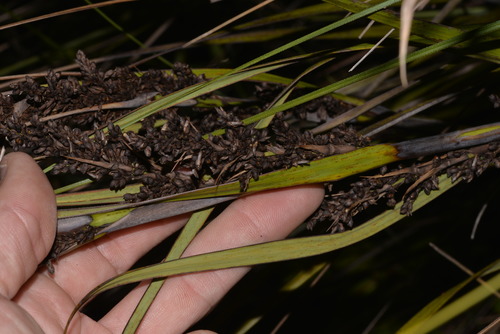
Gahnia sieberiana is an evergreen perennial sedge forming a large dense tussock 3-7 feet (1-2 m) tall and 3-6 feet (0.9-1.8 m) wide, with arching leaves that rise and then bend over at the tips. The leaves are long, narrow, and stiff, up to 6 feet (1.8 m) long and about 0.2-0.4 inch (5-10 mm) wide, dull green, with finely toothed, razor-sharp margins that can cut skin. Tall flowering stems extend above the foliage to 6-10 feet (1.8-3 m), bearing dark brown to blackish branched flower heads in spring and summer. The fruit is a hard, shiny nut about 0.1 inch (3 mm) long, ripening red to red-brown. Growth is moderate, and clumps build slowly over several years into broad tussocks that persist for many years. The species tolerates a range of moist to wet soils and partial shade, but the cutting leaf edges and large size limit where it can be placed.
Native Range
Native to eastern Australia, from Queensland through New South Wales and Victoria to Tasmania. Grows in heath, swamp margins, gullies, and wet forest understorey on moist sandy and peaty soils from near sea level to about 3,300 feet (1,000 m).Suggested Uses
Planted in wetland, bog, and rain-garden plantings, in habitat gardens, and for erosion control on damp banks, spaced 4-6 feet (1.2-1.8 m) apart. It serves as a larval food plant for several native butterflies and shelters small wildlife. The sharp leaf edges and large size limit its use near paths, play areas, and small gardens.How to Identify
Appearance
Size & Dimensions
Height3' - 10'
Width/Spread3' - 6'
Bloom Information
Flowers in spring and summer, September to February in its native range, though flowering can be irregular and is often heavier after fire. The dark heads persist for many weeks as the nuts ripen from green to red-brown. Seed is held on the stems into autumn.
Detailed Descriptions
Flower Description
Dark brown to blackishFoliage Description
Dull greenGrowing Conditions
Sun Requirements
Requires 4-9 hours of direct sunlight daily
• Full Sun: 6+ hours of direct sunlight
• Partial Shade: 3-6 hours of direct sunlight
• Full Shade: Less than 3 hours of direct sunlight
Care & Maintenance
Care Guide
Grows in full sun to part shade in moist to wet sandy or peaty soil and tolerates seasonal waterlogging. Water until established; mature tussocks tolerate short dry spells but stay densest in steady moisture. The leaf margins are sharp enough to cut skin, so the plant is placed away from paths and seating. Old flower stems and dead leaves can be removed once seed has dropped. Few pests affect it, and clumps need little care once settled.Pruning
Remove spent flower stems at the base after the seed drops to tidy the clump. Old or damaged outer leaves can be cut away, though the sharp margins make handling difficult. Clumps do not need regular cutting back and are slow to recover from heavy division.Pruning Schedule
Prune: March–April
fall
Container Growing
Suitable for container growing
Minimum container size: 10 gallons