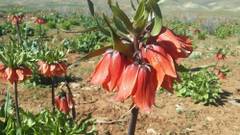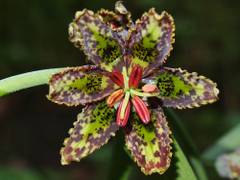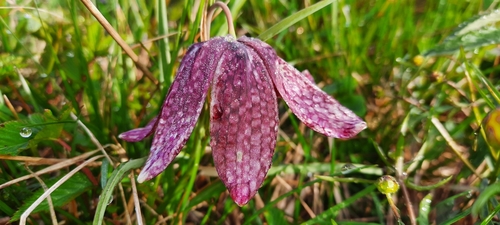
Fritillaria, Genus, meleagris, Species,
- Genus & species
snakes-head fritillary
Europe (Britain, Netherlands east through France, Germany to the Caucasus)
Overview
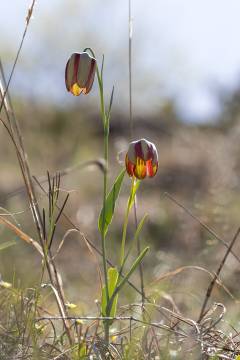
Fritillaria meleagris is the snake's-head fritillary (chequered lily, guinea-hen flower), growing 6–12 inches (15–30 cm) tall and 3–4 inches (8–10 cm) wide. Solitary (occasionally paired) nodding bell-shaped flowers 1.5–2 inches (4–5 cm) with a tessellated (chequered) pattern of contrasting purple-pink and silvery-pink squares on a darker ground — the checkerboard pattern is the species identifier. White-flowered forms (var. alba) lack the chequering but retain the nodding bell shape. Four to six narrow linear gray-green glaucous leaves per stem. In the lily family (Liliaceae). The species name 'meleagris' refers to the guinea fowl (Numida meleagris), whose speckled plumage resembles the flower pattern. Spring ephemeral: emerges in late winter, flowers in mid-spring, and the entire above-ground plant disappears by early summer as the bulb goes dormant. Requires consistently damp to moist soil — the natural habitat is floodplain meadows and water meadows across Europe, from Britain east to the Caucasus. Critically threatened in Britain due to loss of traditionally managed wet meadow habitat — Cricklade North Meadow (Wiltshire) and Magdalen College Meadow (Oxford) are among the remaining sites. Naturalizes in damp turf by self-seeding (slowly, over decades). Plant bulbs promptly — they desiccate rapidly in dry storage. All parts contain steroidal alkaloids — mildly toxic. Zones 3–8.
Native Range
Native to damp meadow and floodplain grasslands across Europe, from Britain and the Netherlands east through France, Germany, Switzerland, Austria, the Balkans, and Romania to the Caucasus.Suggested Uses
Grown in damp meadow, lawns under deciduous trees, and lightly shaded damp borders in zones 3–8. Plant in drifts of 20+ bulbs. Companion to Narcissus pseudonarcissus and Primula veris in spring meadow plantings. Container-suited for early spring display. Mildly toxic.How to Identify
Appearance
Size & Dimensions
Height6" - 1'
Width/Spread3" - 4"
Bloom Information
Mid-spring (March–May), lasting 2–3 weeks per flower. Spring ephemeral — fully dormant by early summer. Naturalizes in damp turf by self-seeding over decades. Do not mow until foliage has yellowed (June–July).
Detailed Descriptions
Flower Description
Tessellated (chequered) purple-pink and pale pink; also pure white formsFoliage Description
Narrow, linear, gray-green with a glaucous bloom, 4-6 per stemGrowing Conditions
Sun Requirements
Requires 3-8 hours of direct sunlight daily
• Full Sun: 6+ hours of direct sunlight
• Partial Shade: 3-6 hours of direct sunlight
• Full Shade: Less than 3 hours of direct sunlight
Care & Maintenance
Care Guide
Part sun to partial shade. Consistently damp to moist soil — intolerant of summer drought while dormant and of waterlogged heavy clay. Plant bulbs 3–4 inches (8–10 cm) deep in autumn — they desiccate rapidly in dry storage. In naturalized grass, delay mowing until foliage has fully yellowed (June–July). Mildly toxic. Zones 3–8.Pruning
No pruning. Allow foliage to yellow and die back naturally — the leaves fuel bulb development. In naturalized settings, delay mowing until July. Mark planting positions — the plant is invisible from midsummer through late winter.Pruning Schedule
Prune: June
late spring
Container Growing
Suitable for container growing
Minimum container size: 3 gallons