Fritillaria, Genus, imperialis, Species,
- Genus & species
crown imperial
Western and central Asia (southeastern Turkey through Iraq, Iran, Afghanistan, into Pakistan and the western Himalayas)
Overview
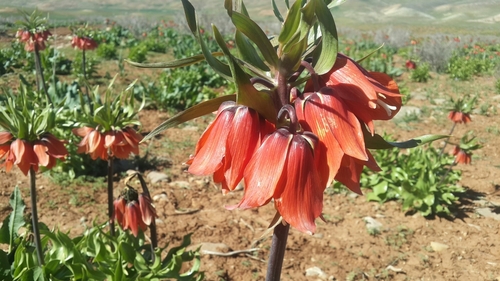
Fritillaria imperialis is a bulbous perennial in the lily family (Liliaceae) reaching 30-48 inches (75-120 cm) tall from a large, fleshy bulb 4-6 inches (10-15 cm) in diameter with a hollow centre that separates the species from related Fritillaria. The stout, erect stem emerges in early spring, clothed in whorls of glossy, lance-shaped leaves 4-6 inches (10-15 cm) long along the lower two-thirds. The inflorescence is a terminal umbel of 3-8 large, pendant, bell-shaped flowers 2-2.5 inches (5-6 cm) long, topped by a crown of erect, leaf-like bracts — the crown that gives the species its common name. Flower colour ranges from orange and burnt orange through red and yellow depending on cultivar. Each tepal carries a large, white, glistening nectary drop at its base that does not fall even when the flower is inverted — a feature that has been recorded in botanical literature since the 16th century. The entire plant carries a strong, musky, fox-like odour (described as skunky by some observers) emanating from the bulb and lower stem, attributed to isopentyl methyl sulfide. This scent is reputed to deter rodents, moles, and deer, though evidence is anecdotal. The species has been cultivated in European gardens since at least 1576, when Clusius received bulbs from Constantinople. The bulb is fragile — unlike most bulbs, it lacks a protective tunic and dries out rapidly if stored improperly, so planting follows immediately upon receipt. All parts are toxic, containing steroidal alkaloids (imperialine).
Native Range
Fritillaria imperialis is native to a wide arc across western and central Asia, from southeastern Turkey through Iraq, Iran, Afghanistan, and into Pakistan and the western Himalayas, where the species grows on rocky mountain slopes, in scrub, and in subalpine meadows at elevations of 3,000-9,000 feet (900-2,700 m).Suggested Uses
Planted as a specimen in spring borders, spaced 10-12 inches (25-30 cm) apart in groups of 3-5 for visual impact. The tall stem and crown-shaped inflorescence rise above lower spring perennials and tulips. Suited to cottage garden borders and formal spring plantings. The musky scent is noticeable at close range, so siting reflects that proximity to seating and paths matters.How to Identify
Appearance
Size & Dimensions
Height2'6" - 4'
Width/Spread10" - 1'
Bloom Information
Flowers open from mid-April through early May in the Pacific Northwest, lasting 2-3 weeks. Each umbel of 3-8 flowers opens nearly simultaneously. Pollination is by large bees and wasps attracted to the copious nectar. After flowering, the stem stays erect as seed capsules develop, then the entire above-ground structure yellows and collapses by late June. Bulbs enter dormancy in summer.
Detailed Descriptions
Flower Description
Orange, red, or yellow depending on cultivarFoliage Description
Glossy bright greenGrowing Conditions
Sun Requirements
Requires 5-8 hours of direct sunlight daily
• Full Sun: 6+ hours of direct sunlight
• Partial Shade: 3-6 hours of direct sunlight
• Full Shade: Less than 3 hours of direct sunlight
Care & Maintenance
Care Guide
Bulbs are planted in September-October, immediately upon receipt — the tunicate-free bulb desiccates rapidly in storage. Bulbs are planted 6-8 inches (15-20 cm) deep on their side (tilted at 45°) so that water does not collect in the hollow centre and cause rot. Bulbs are spaced 10-12 inches (25-30 cm) apart. Plants grow in full sun to light shade in fertile, well-drained soil with a pH of 6.5-7.5. Heavy clay is avoided. A handful of coarse grit below each bulb improves drainage. Watering covers the autumn and spring growing period; soil dries during summer dormancy. Feeding with a potassium-rich fertiliser in early spring as shoots emerge, and again after flowering, supports bulb recovery. Established clumps are not disturbed — the species resents transplanting and may skip a year of flowering after being moved.Pruning
Seed capsules are removed after flowering to redirect energy to the bulb, unless seed is wanted. The stem and leaves stay in place until they have yellowed completely (typically late June) — the foliage photosynthesises to recharge the bulb. The dead stem is then cut at ground level.Pruning Schedule
Prune: June
summer
Container Growing
Suitable for container growing
Minimum container size: 5 gallons