Echinops, Genus, sphaerocephalus, Species,
- Genus & species
great globe thistle
S Europe to Central Asia (dry waste ground, roadsides); naturalized in N America
Overview
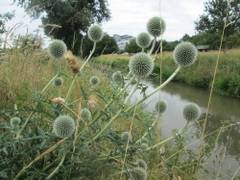
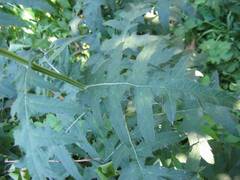
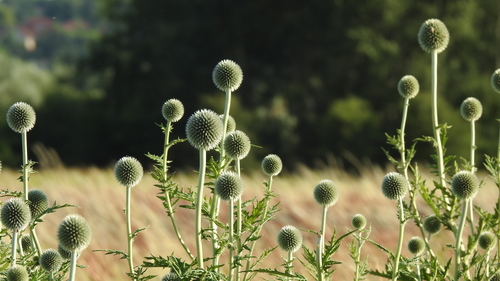
Echinops sphaerocephalus is an upright, clumping, herbaceous perennial reaching 48–72 inches (120–180 cm) tall with a spread of 24–36 inches (60–90 cm). The species is the largest globe thistle in commercial cultivation, carrying spherical flower heads 2–2.5 inches (5–6 cm) across—more than twice the diameter of heads on E. ritro or E. ruthenicus. The globes are silvery-gray to pale grayish-white, bristly, and open from the top of the sphere downward over the 3–4 week bloom period. Flowers are borne on thick, sturdy, grayish-tomentose stems in July–August. The basal leaves are large, 8–16 inches (20–40 cm) long, deeply pinnately lobed with sharp spine-tipped points, dark green above and densely grayish-white tomentose beneath—the coarsest foliage texture in the genus. Growth rate is fast for a globe thistle. The species self-seeds aggressively and has naturalized across parts of North America as a roadside escapee; in some states (Michigan, Wisconsin, Washington) it appears on invasive-plant watch lists. A deep taproot anchors established specimens and makes removal of unwanted plants difficult. Stems and leaves are covered in sticky glandular hairs that can cause mild skin irritation in sensitive individuals on contact—gardeners sensitive to plant saps report this more often than those without sap sensitivities. Hardy to zone 3.
Native Range
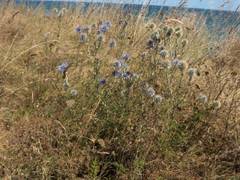
Echinops sphaerocephalus is native to southern Europe, from Spain east through the Balkans and Central Asia to Siberia, growing in dry waste ground, roadsides, hay meadows, and disturbed habitats on calcareous and clay soils. The species has naturalized in parts of North America—particularly the Great Lakes region, the northern Great Plains, and the Pacific Northwest—where it colonizes roadside rights-of-way and abandoned agricultural land. Some state watch lists identify the species as an escape of concern.Suggested Uses
Planted in large-scale naturalistic plantings, prairie gardens, back-of-border positions, and wildflower meadows at 24–36 inch (60–90 cm) spacing. The 2–2.5 inch globes bring bold scale that the smaller Echinops species cannot match—useful where a coarse visual weight is needed to balance other large-scale perennials (Silphium perfoliatum, Vernonia noveboracensis). Functions in dried flower arrangements. The bristly globes attract bumblebees, honey bees, and large native solitary bees intensively during bloom. Small, tidy gardens, regions where the species has naturalized as an escape, and front-of-border positions are poor fits—the aggressive self-seeding, the 6-foot stature, and the glandular sticky foliage all count against those uses.How to Identify
Appearance
Size & Dimensions
Height4' - 6'
Width/Spread2' - 3'
Bloom Information
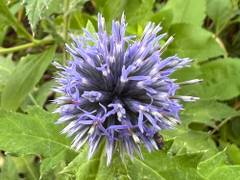
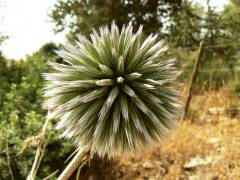
Spherical silvery-gray to pale grayish-white globe flower heads 2–2.5 inches (5–6 cm) across open in July–August—the largest Echinops flower heads in commercial cultivation. Bloom duration is 3–4 weeks. The globe opens progressively from the top of the sphere downward, producing a subtle ring of paler fresh florets around a band of older florets.
Detailed Descriptions
Flower Description
Silvery-gray to pale grayish-white, largest spherical bristly globesFoliage Description
Dark green above, grayish-white tomentose beneath; coarse, deeply lobed, spinyGrowing Conditions
Sun Requirements
Requires 6-12 hours of direct sunlight daily
• Full Sun: 6+ hours of direct sunlight
• Partial Shade: 3-6 hours of direct sunlight
• Full Shade: Less than 3 hours of direct sunlight
Care & Maintenance
Care Guide
Plant in full sun in well-drained, lean soil. The species handles poor, rocky, and calcareous substrates well. Drought-tolerant once established. Hardy to zone 3 (−40°F / −40°C). Self-seeding is aggressive—deadheading before seed capsules split reduces volunteer germination substantially, and the approach is necessary rather than optional in gardens where the species is not wanted to spread. The glandular hairs on stems and leaves exude a sticky resin that causes mild skin irritation in sensitive individuals, so handling during deadheading and cleanup is done with gloves as a practical precaution, and hand-washing after contact reduces any residue transfer. The deep taproot makes established plants difficult to remove, so siting decisions that commit the plant to a long-term position are made deliberately at installation.Pruning
Spent globes are cut back promptly after bloom to prevent self-seeding into adjacent beds and surrounding ground. All foliage is cut back to the ground in late fall or early spring before new growth begins. Gloves are used during cutback because the glandular hairs on the cut stems continue to exude sticky resin for several hours after cutting.Pruning Schedule
Prune: September
fall