Echinops, Genus, bannaticus, Species,
- Genus & species
blue globe thistle
Southeastern Europe (Romania, Bulgaria, Hungary, Balkan states; dry meadows, rocky slopes, steppe habitats)
Overview
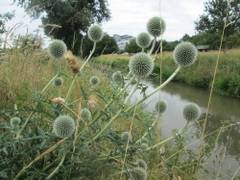
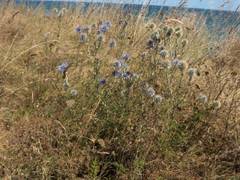
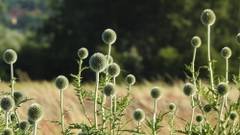
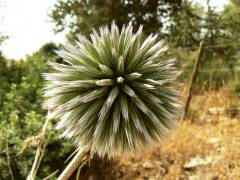
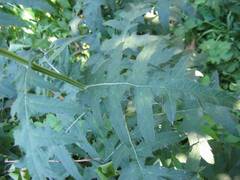
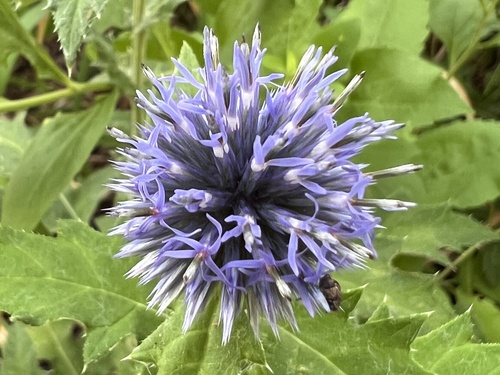
Echinops bannaticus is an upright clumping herbaceous perennial in the aster family (Asteraceae) reaching 36–48 inches (90–120 cm) tall with a spread of 18–24 inches (45–60 cm). This southeastern European species carries perfectly spherical flower heads 1.5–2 inches (4–5 cm) across composed of densely packed individual steel-blue to violet-blue tubular florets — each floret has its own small spiny bract, which gives the globe a bristly texture that reads tactile from close range. Globes are carried singly on sturdy branching grayish-white tomentose stems in July–August. Basal leaves are large, deeply pinnately lobed, 6–12 inches (15–30 cm) long, dark green above and covered with white-gray tomentum beneath, which produces a bicolor foliage effect when wind or movement flips the leaves to reveal the pale undersides. Growth rate is moderate. Flower heads hold their spherical shape when dried, which makes this species a standard choice for dried-arrangement gardens. The deep taproot makes established plants drought-tolerant but resistant to transplanting. Hardy to zone 3.
Native Range
Echinops bannaticus is native to southeastern Europe (Romania, Bulgaria, Hungary, and the Balkan states), where it occurs in dry meadows, rocky slopes, and steppe habitats.Suggested Uses
Grown in borders, meadow gardens, and gravel gardens at 18–24 inch (45–60 cm) spacing. The spherical blue globes carry a geometric form not available from most perennials, which reads especially well against the flat-topped flower architecture of Achillea, Sedum, and upright forms of Monarda. Pairing with ornamental grasses, Echinacea, and Perovskia builds a drought-tolerant summer composition on matching sun and drainage preferences. Cutting globes at the color peak and drying them upside-down holds the spherical form for winter arrangements. The bristly globe surface draws heavy bee visitation during bloom. Shaded sites, wet soils, and rich moist borders where the stems will flop are not suitable given the full-sun and lean-soil requirements.How to Identify
Appearance
Size & Dimensions
Height3' - 4'
Width/Spread1'6" - 2'
Bloom Information
Spherical steel-blue to violet-blue globe flower heads 1.5–2 inches (4–5 cm) across open in July–August. Individual florets open from the top of the globe downward, which extends the full-color display across 10–14 days per globe. Bloom duration is 3–4 weeks. Globes hold spherical form well for drying — the cut-flower harvest point is when florets are fully colored but have not yet opened across the full globe surface.
Detailed Descriptions
Flower Description
Steel-blue to violet-blue; perfectly spherical bristly globes 1.5-2 inches across on gray-white tomentose stemsFoliage Description
Dark green above, white-gray tomentose beneath; deeply pinnately lobed 6-12 inches longGrowing Conditions
Sun Requirements
Requires 6-12 hours of direct sunlight daily
• Full Sun: 6+ hours of direct sunlight
• Partial Shade: 3-6 hours of direct sunlight
• Full Shade: Less than 3 hours of direct sunlight
Care & Maintenance
Care Guide
Grows in full sun in well-drained lean to average soil at pH 6.0–8.0, tolerating loam, sand, and chalk. Hardy to zone 3. Drought-tolerant once established, reflecting the deep-taproot anchoring and the steppe-habitat adaptation. Rich or high-fertility soils produce weak flop-prone stems; lean soils support the self-supporting upright form that this species needs to carry the heavy globe heads without collapse. Established plants are not transplanted — the deep taproot resists moving successfully. Self-sowing occurs at a moderate rate in open soil conditions and can be managed by removing spent globes before seed set. No serious pest or disease problems.Pruning
Spent flower stems are cut back after bloom to tidy the clump, or some stems are left standing for self-seeding and for dried-arrangement harvest. All foliage is cut back to the ground in late fall or early spring as part of the standard perennial dormant-season cleanup.Pruning Schedule
Prune: September
fall