Echinacea, Genus, simulata, Species,
- Genus & species
wavy-leaved purple coneflower
Ozark region and central United States, from Missouri south to Arkansas, Tennessee, and Alabama
Overview
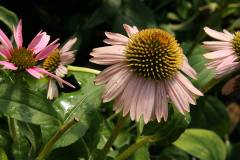
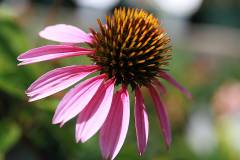
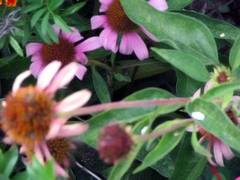
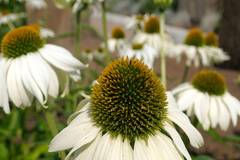
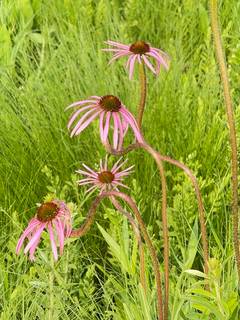
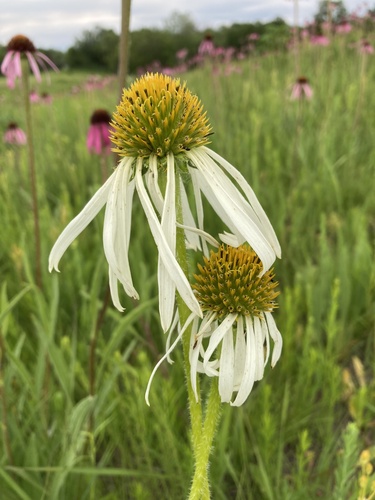
Echinacea simulata is a native coneflower that grows 24–36 inches (60–90 cm) tall and 12–18 inches (30–45 cm) wide. The species name 'simulata' means 'resembling' — it closely mimics E. pallida in flower form, with narrow, drooping pale pink to light rose-pink ray florets hanging below a dark cone. The key difference is botanical rather than visual: E. simulata has yellow pollen (visible on the disc florets), while E. pallida has white pollen. The wavy-margined leaves are the most useful garden-level identification trait, as pollen color requires close inspection. The leaf margins undulate along their length in a way that straight-margined E. pallida does not. The species occurs in the Ozark region and adjacent central states, overlapping in range with E. pallida but generally on different soil types — E. simulata tends toward more acidic, cherty soils while E. pallida favors calcareous ground. In cultivation, the two species behave similarly: deep taproot, drought tolerance, concentrated June–July bloom, and a wild, sparse growth habit. The species is less widely available in the nursery trade than E. pallida or E. purpurea. Deer avoid the foliage.
Native Range
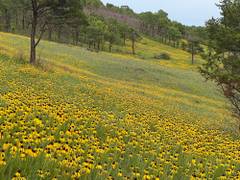
Echinacea simulata is native to the Ozark region and central United States, from Missouri south to Arkansas, Tennessee, and Alabama. It grows in dry, open woodlands, glades, and prairies on acidic, cherty, or sandy soils.Suggested Uses
Used in prairie restorations, native plant collections, and specialist gardens. The close resemblance to E. pallida limits its ornamental separation, but the species has conservation value in its Ozark range. Suited to dry, acidic-soil prairie plantings where E. pallida is less suited.How to Identify
Appearance
Size & Dimensions
Height2' - 3'
Width/Spread1' - 1'6"
Colors
Bloom Information
Flowering in June and July, approximately 4 weeks. Pale pink drooping rays around dark cones. Dark seed cones persist through winter.
Detailed Descriptions
Flower Description
Pale pink to light rose-pink drooping ray florets with a dark coneFoliage Description
Dark green, lance-shaped, wavy-marginedGrowing Conditions
Sun Requirements
Requires 6-12 hours of direct sunlight daily
• Full Sun: 6+ hours of direct sunlight
• Partial Shade: 3-6 hours of direct sunlight
• Full Shade: Less than 3 hours of direct sunlight
Care & Maintenance
Care Guide
Plant in full sun with at least 6 hours of direct light. Well-drained, lean soil; the species tolerates acidic to neutral ground. No fertilization is needed. Watering during establishment only, then drought-tolerant. Established plants resent transplanting due to their deep taproot. Spent seed cones can be left for bird forage.Pruning
All stems and seed cones can be left standing through winter. Stems are cut to ground level in late winter.Pruning Schedule
Prune: March & November
fallearly spring