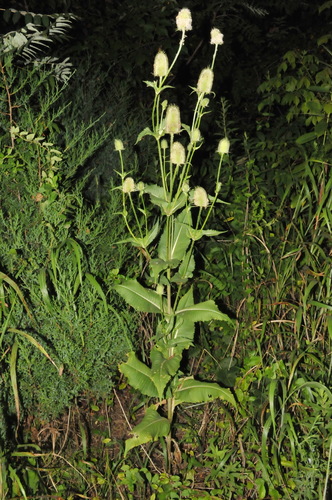
Dipsacus, Genus, laciniatus, Species,
- Genus & species
cutleaf teasel
Overview
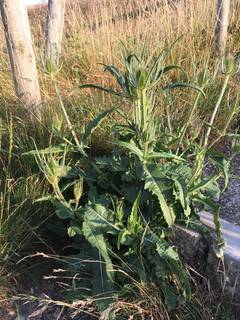
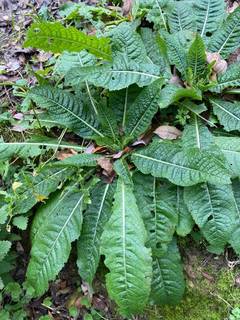
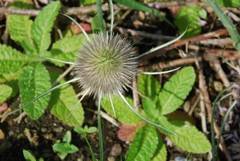
Dipsacus laciniatus is a stout biennial in the teasel family, spending its first year as a low basal rosette and its second sending up a spiny flowering stalk 3-7 feet (0.9-2.1 m) tall before dying. The stem and leaf midribs bear stiff prickles, and the opposite leaves are deeply cut into lobes, with pairs fusing around the stem to form cups that collect rainwater. In summer the branched stems carry egg-shaped flower heads 1.5-4 inches (4-10 cm) long, packed with small white flowers that open in bands moving up and down the head, framed by long spiny bracts. After flowering the dried, spiny seed heads persist into winter, each releasing up to several thousand seeds. The first-year rosette has wrinkled, scalloped leaves pressed to the ground. The species is native to Europe and western Asia and has spread across much of North America, where it colonizes roadsides, ditches, prairies, and disturbed ground. It is listed as a noxious or invasive weed in several US states because dense stands crowd out native vegetation. Its prickly stems and aggressive self-seeding are its defining limitations in any planted setting.
Native Range
Native to Europe and western Asia, and naturalized widely across temperate North America as an invasive weed of disturbed ground.Suggested Uses
The dried spiny seed heads are sometimes cut for floral arrangements, but the plant is rarely grown by choice because of its weedy spread. In managed settings it appears mostly as a volunteer on disturbed ground rather than as an intentional planting.How to Identify
Appearance
Size & Dimensions
Height3' - 7'
Width/Spread1'6" - 3'
Bloom Information
Flower heads open from July through September, with white flowers blooming in shifting bands around each head. Each head flowers over two to three weeks before drying. Seed ripens in fall and persists on the standing stalks through winter.
Detailed Descriptions
Foliage Description
greenGrowing Conditions
Sun Requirements
Requires 6-12 hours of direct sunlight daily
• Full Sun: 6+ hours of direct sunlight
• Partial Shade: 3-6 hours of direct sunlight
• Full Shade: Less than 3 hours of direct sunlight