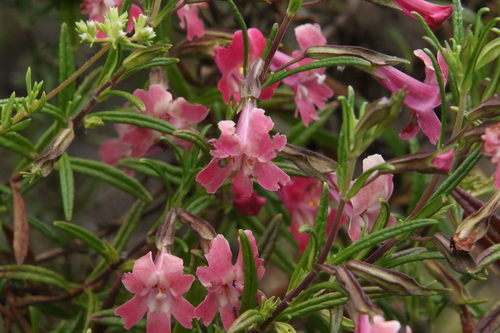
Diplacus, Genus, puniceus, Species,
- Genus & species
red bush monkeyflower
Coastal southern California and Baja California
Overview
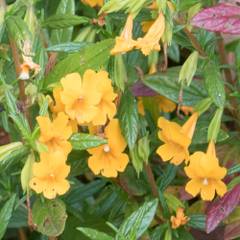
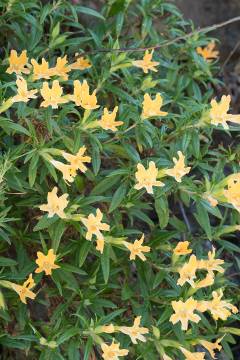
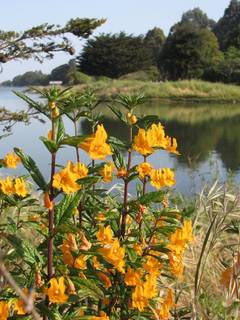
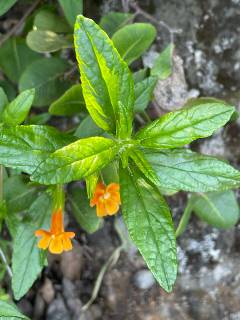
Diplacus puniceus is an evergreen subshrub native to the coastal bluffs and canyons of southern California and northern Baja California, growing 2-4 ft (60-120 cm) tall and wide with woody lower stems. The narrow, lance-shaped leaves are 1-2.5 in (2.5-6 cm) long, dark green, and coated with a sticky resin that gives the foliage a glossy, gummy surface. From spring into summer it produces tubular, two-lipped flowers 1-1.5 in (2.5-4 cm) long in brick-red to orange-red, held in the leaf axils along the stems. The flower tube and color suit pollination by hummingbirds. It grows on dry, sunny slopes, road cuts, and disturbed coastal scrub, often in poor, rocky soils. It is short-lived and can look ragged in late-summer drought, when it may drop leaves. Stems become woody and sparse with age unless cut back. It tolerates heat and drought once established.
Native Range
Native to coastal southern California and northern Baja California, Mexico, mainly in San Diego and Orange counties. It grows on dry coastal bluffs, canyon slopes, chaparral, and disturbed road cuts below about 2,500 ft (760 m).Suggested Uses
Grown in waterwise, native, and coastal gardens of California for its red flowers and drought tolerance. It is planted on dry banks and in rock gardens spaced 2-3 ft (60-90 cm) apart. The tubular flowers draw hummingbirds and native bees.How to Identify
Appearance
Size & Dimensions
Height2' - 4'
Width/Spread2' - 4'
Bloom Information
Detailed Descriptions
Foliage Description
dark greenGrowing Conditions
Sun Requirements
Requires 6-12 hours of direct sunlight daily
• Full Sun: 6+ hours of direct sunlight
• Partial Shade: 3-6 hours of direct sunlight
• Full Shade: Less than 3 hours of direct sunlight
Care & Maintenance
Care Guide
Diplacus puniceus grows in full sun to light shade on sharply drained, rocky or sandy soils at a pH of 6.0-7.5 and tolerates drought once established. Little or no summer water is needed, and overwatering in heat encourages root rot. It withstands coastal wind and salt spray but is damaged by hard frost below about 25F (-4C). Cutting plants back after bloom keeps them compact and can prompt a second flush of flowers. It is short-lived, often persisting only a few years, and self-sows where conditions suit. Powdery mildew and root rot appear mainly in shade or wet soil.Pruning
Cut stems back by about one third after the main bloom in early summer to keep the subshrub dense and to encourage repeat flowering. Remove dead and woody stems in late winter. Hard renewal pruning can revive old, leggy plants but may not always succeed.Pruning Schedule
Prune: June–July
summer
Container Growing
Suitable for container growing
Minimum container size: 3 gallons