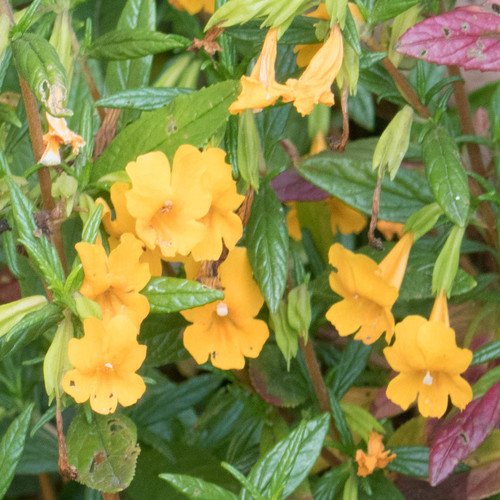
Diplacus, Genus, aurantiacus, Species,
- Genus & species
orange bush monkeyflower
Western North America (California Floristic Province)
Overview
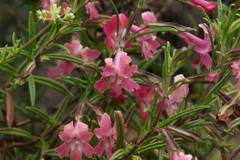
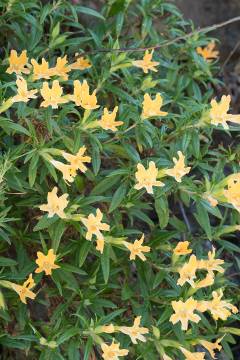
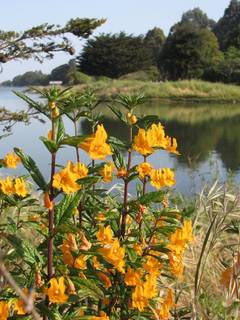
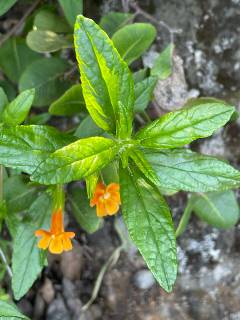
Diplacus aurantiacus is an evergreen subshrub native to the coastal ranges of western North America, growing 2-4 feet (60-120 cm) tall and spreading 2-4 feet (60-120 cm) wide. Stems are woody at the base and branch into a rounded, open framework. The narrow, lance-shaped leaves are 1-3 inches (2.5-7.5 cm) long, dark green above, and coated with a sticky resin that gives the foliage a glossy, varnished surface. From spring into summer the plant carries tubular, two-lipped flowers 1.5-2 inches (4-5 cm) long in shades of orange, apricot, and pale yellow, each flaring into five lobes. The flowers draw hummingbirds and native bees, and the species hybridizes readily with related monkeyflowers where ranges overlap. D. aurantiacus grows on dry slopes, rock outcrops, and chaparral, tolerating drought and lean soils once established. In cultivation it is short-lived, often persisting three to five years before declining, and it can look sparse after summer heat induces partial dormancy. Hard frost damages the evergreen foliage below about 20F (-7C). Growth is rapid in the first seasons, slowing as the woody base matures.
Native Range
Diplacus aurantiacus is native to the Pacific Coast of North America, from southwestern Oregon through California to northern Baja California. It grows in coastal scrub, chaparral, and open woodland below about 5,000 feet (1,500 m).Suggested Uses
D. aurantiacus is used in water-wise and native-plant gardens, on dry banks, and in coastal and chaparral restoration plantings. It suits rock gardens and large containers with fast-draining mix. Plants are spaced 24-36 inches (60-90 cm) apart.How to Identify
Appearance
Size & Dimensions
Height2' - 4'
Width/Spread2' - 4'
Bloom Information
Detailed Descriptions
Flower Description
orange to apricot and pale yellowFoliage Description
dark green, resinousGrowing Conditions
Sun Requirements
Requires 6-10 hours of direct sunlight daily
• Full Sun: 6+ hours of direct sunlight
• Partial Shade: 3-6 hours of direct sunlight
• Full Shade: Less than 3 hours of direct sunlight
Care & Maintenance
Care Guide
D. aurantiacus grows in full sun to part shade and requires sharp drainage, growing on sandy, rocky, or decomposed-granite soils. Water needs are low once established, and the species declines in soils that stay wet, especially in winter. It withstands extended drought by dropping leaves and entering summer dormancy. Hardy in USDA zones 8-10, it suffers foliage damage below about 20F (-7C) and may die to the base in colder spells. Light spring feeding supports bloom, while rich soil produces weak, floppy growth. Plants are short-lived and are often replaced every few years.Pruning
D. aurantiacus responds to light tip pruning after the main bloom to limit legginess and renew branching. Cutting stems back by up to one third in late summer rebuilds the framework. Hard pruning into old wood often fails to resprout.Pruning Schedule
Prune: August
summer
Container Growing
Suitable for container growing
Minimum container size: 3 gallons