Dillwynia, Genus, hispida, Species,
- Genus & species
red parrot-pea
Overview
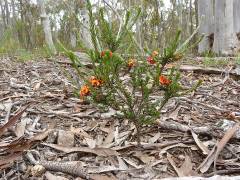
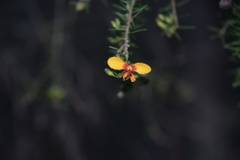
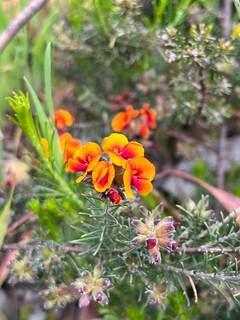
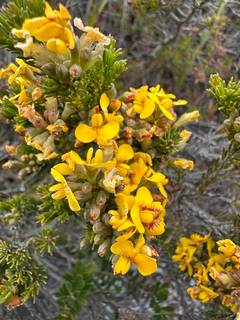
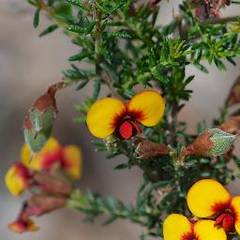
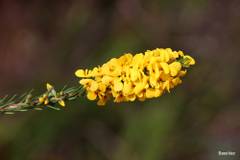
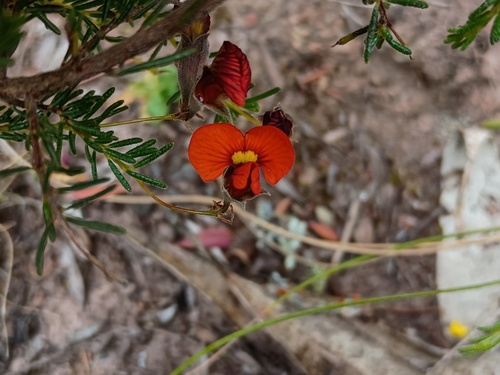
Dillwynia hispida is an evergreen shrub in the Fabaceae reaching 1-3 feet (0.3-0.9 m) tall and 1-2 feet (0.3-0.6 m) wide. The stems are slender, upright to spreading, and covered with short bristly hairs. Leaves are narrow and needle-like, 0.2-0.4 inches (5-10 mm) long, crowded along the stems and slightly rough to the touch. Pea-shaped flowers appear in spring, 0.3-0.4 inches (8-10 mm) across, with red to orange-red standard petals marked yellow at the base and a darker red keel. Flowers are carried in short clusters at the branch tips. Seed pods are short, swollen, and hairy, 0.2-0.3 inches (5-8 mm) long, ripening over summer. The shrub is short-lived, typically persisting 5-8 years, and as a legume it fixes nitrogen through root nodules. Plants regenerate from soil-stored seed after fire. Open, sparse branching gives the shrub a wiry form, and lower stems become bare with age.
Native Range
Native to southern Australia, including South Australia, western Victoria, and southern New South Wales. Grows in mallee scrub, heathland, and dry open woodland on sandy and loamy soils, often in semi-arid inland regions.Suggested Uses
Planted in native cottage gardens, low-water borders, and habitat plantings, spaced 18-24 inches (45-60 cm) apart. Used on sandy or rocky banks for low erosion control. Grows in containers of at least 5 gallons (19 L) with a free-draining mix.How to Identify
Appearance
Size & Dimensions
Height1' - 3'
Width/Spread1' - 2'
Bloom Information
Flowers from August to November, with peak bloom in September and October. The main display lasts 4-6 weeks. Flowering is heavier in seasons following good winter rainfall and is reduced in deep shade.
Detailed Descriptions
Flower Description
Red to orange-redFoliage Description
GreenGrowing Conditions
Sun Requirements
Requires 6-10 hours of direct sunlight daily
• Full Sun: 6+ hours of direct sunlight
• Partial Shade: 3-6 hours of direct sunlight
• Full Shade: Less than 3 hours of direct sunlight
Care & Maintenance
Care Guide
Grows in full sun to part shade in sandy or loamy soil with sharp drainage. Water occasionally through the first summer to establish; established plants tolerate extended dry periods and need little supplementary water. As a legume it grows in low-fertility soil without added nitrogen. Waterlogged soils cause root rot. Heavy fertiliser is not required and can promote soft, sappy growth. The species is short-lived and may need replacement after 5-8 years.Pruning
Tip-prune after flowering to slow the development of bare lower stems. The species reshoots poorly from old leafless wood, so cutting back into bare stems can kill branches. Light annual trimming maintains a denser habit.Pruning Schedule
Prune: November–December
late springsummer
Container Growing
Suitable for container growing
Minimum container size: 5 gallons