Dillwynia, Genus, spp., Multiple species,
- Genus
- Multiple species
egg and bacon peas
Overview
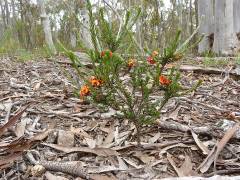
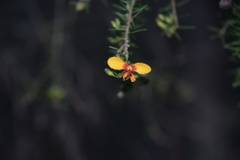
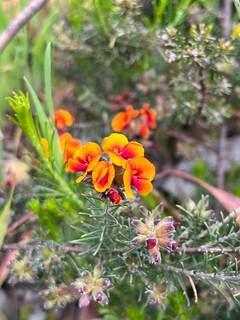
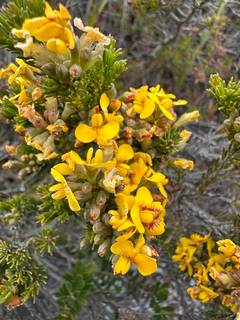
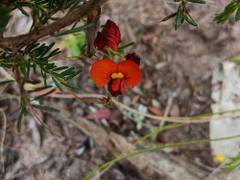
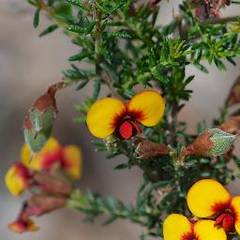
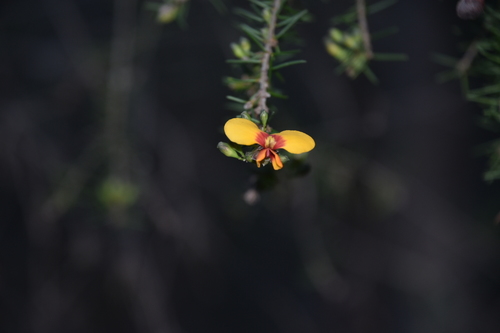
Dillwynia is a genus of about 50 species of small evergreen shrubs in the pea family, endemic to Australia. Most species grow 0.3-2 m (1-6.5 ft) tall with a wiry, upright to spreading habit and crowded, narrow, often terete (cylindrical) leaves 3-15 mm (0.1-0.6 in) long. The pea-shaped flowers are yellow to orange with red markings, the colour pairing that gives the common name egg and bacon peas; they are carried singly or in short clusters near the branch tips. Flowering is followed by small inflated pods 4-8 mm (0.2-0.3 in) long holding one or two seeds. Species occur in heathland, dry sclerophyll woodland, and coastal scrub across eastern and southern Australia, usually on nutrient-poor sandy or rocky soils. Like many Australian legumes, the roots host nitrogen-fixing bacteria. The genus is sensitive to humid summers, root disturbance, and poorly drained soil, which limits its use outside open, free-draining sites. Species such as D. retorta and D. juniperina are grown in native gardens.
Native Range
Dillwynia is endemic to Australia, occurring across New South Wales, Victoria, Queensland, South Australia, Western Australia, and Tasmania. Species are most diverse in the heathlands and sclerophyll woodlands of the temperate south and east.Suggested Uses
Dillwynia is planted in native and water-wise gardens, on embankments, and in mixed shrub borders on free-draining soil. The low species suit rockeries and container culture, while taller forms fill informal screens. The winter and spring flowers support native bees and other insects.How to Identify
Appearance
Size & Dimensions
Height1' - 6'6"
Width/Spread1' - 5'
Bloom Information
Detailed Descriptions
Flower Description
yellow with red markingsFoliage Description
greenGrowing Conditions
Sun Requirements
Requires 6-10 hours of direct sunlight daily
• Full Sun: 6+ hours of direct sunlight
• Partial Shade: 3-6 hours of direct sunlight
• Full Shade: Less than 3 hours of direct sunlight
Care & Maintenance
Care Guide
Dillwynia grows in full sun to light shade on sharply drained sandy, gravelly, or rocky soils that are low in phosphorus. Established plants tolerate drought and short dry spells but decline in heavy, wet, or fertile soil. A soil pH of about 5.0-6.5 suits the genus, and phosphorus-rich fertiliser damages the roots. Plants are frost-hardy in temperate zones but struggle in humid subtropical summers. Light watering through the first season aids establishment, after which little is needed. Lifespan is often short, around 5-10 years.Pruning
A light trim after flowering keeps plants compact and encourages branching. Cutting into old leafless wood is unproductive, as the shrubs reshoot poorly from bare stems. Spent flower clusters need no removal.Container Growing
Suitable for container growing
Minimum container size: 3 gallons