Cylindropuntia, Genus, spp., Multiple species,
- Genus
- Multiple species
chollas
Overview
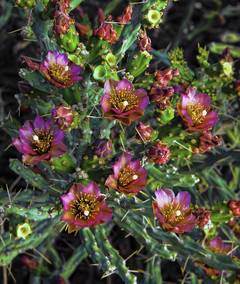
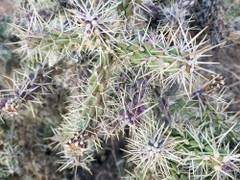
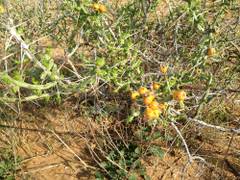
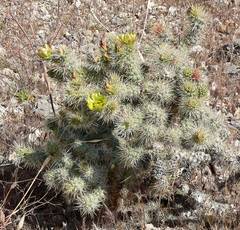
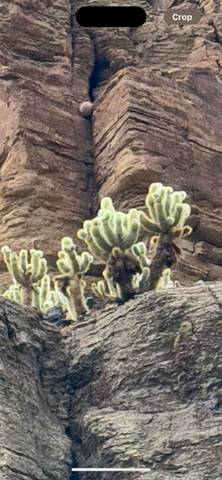
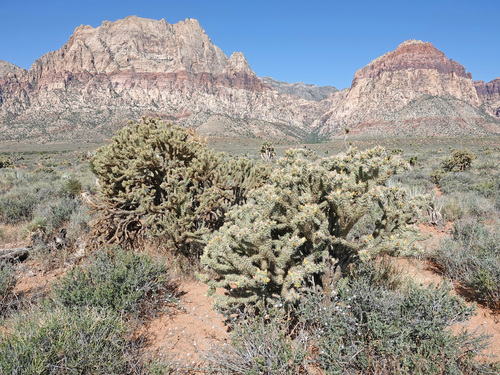
Cylindropuntia is a genus of about 35 species of cacti, the chollas, native to the deserts and dry scrub of southwestern North America, from the United States through Mexico. Unlike the flat-padded prickly pears, chollas have cylindrical, segmented stems built from a series of joints, and the plants range from low shrubs 1-3 feet (0.3-0.9 m) tall to tree-like forms 6-15 feet (1.8-4.6 m) tall with a woody trunk. The green stems carry raised tubercles and clusters of barbed spines, most sheathed in a thin papery covering that catches the light. In several species, including the jumping chollas, the stem joints detach at the lightest touch and cling to skin, fur, and clothing by their barbs, which is how the plants spread vegetatively. Cup-shaped flowers 1-3 inches (2.5-7.5 cm) across open in spring and early summer in yellow, green, bronze, pink, red, and magenta, followed by fleshy or dry spiny fruit. Like other cacti, chollas store water in their stems and carry out photosynthesis there, the leaves being reduced to small early-shed structures. The plants are drought- and heat-tolerant and grow in zones 8 to 11. The barbed, sheathed spines make handling hazardous.
Native Range
Cylindropuntia species are native to the arid and semi-arid regions of southwestern North America, including the deserts of the southwestern United States and much of Mexico. They grow on dry slopes, flats, and desert scrub, often forming open stands locally called cholla gardens.Suggested Uses
Cylindropuntia is grown in desert, rock, and xeriscape gardens and in containers in dry-climate regions, set well back from paths and seating because of the barbed joints. Tree-like species are used as living sculpture and habitat, and several serve as nesting sites for desert birds. The genus is also planted as a barrier and boundary marker.How to Identify
Appearance
Size & Dimensions
Height1' - 15'
Width/Spread1' - 8'
Bloom Information
Chollas flower mainly in spring and early summer, generally April to June, with the timing shifting later at higher elevations. The cup-shaped flowers open by day over a period of two to four weeks across a stand. Flower color ranges widely by species, from yellow and green to pink, red, and magenta.
Detailed Descriptions
Flower Description
yellow, green, pink, red, or magentaFoliage Description
green stems (leaves vestigial)Growing Conditions
Sun Requirements
Requires 6-12 hours of direct sunlight daily
• Full Sun: 6+ hours of direct sunlight
• Partial Shade: 3-6 hours of direct sunlight
• Full Shade: Less than 3 hours of direct sunlight
Care & Maintenance
Care Guide
These cacti grow in full sun and fast-draining, gritty, sandy, or rocky soil with a pH from neutral to alkaline, and rot quickly in heavy, wet, or poorly drained ground. Established plants need no irrigation in their native range and only occasional deep watering in cultivation, mainly during the warm growing season. They withstand intense heat, drought, and wind, and most tolerate cold to about 10-20 F (-12 to -7 C), with hardiness varying by species. Overwatering, shade, and high humidity are the main causes of failure. Propagation is simple from detached joints, which root where they fall. The barbed spines and glochids embed in skin and are difficult to remove.Pruning
Pruning is rarely needed and is done with long-handled tools to keep clear of the barbed joints. Whole joints are removed at the narrow point where segments meet to shape the plant or take cuttings. Removed joints root readily and are easily moved by wind and animals.Container Growing
Suitable for container growing
Minimum container size: 3 gallons