Crocosmia, Genus, ×, Hybrid, crocosmiiflora, Species,
- Genus & species
- Hybrid
Montbretia
Garden origin (parent species from southern Africa)
Overview
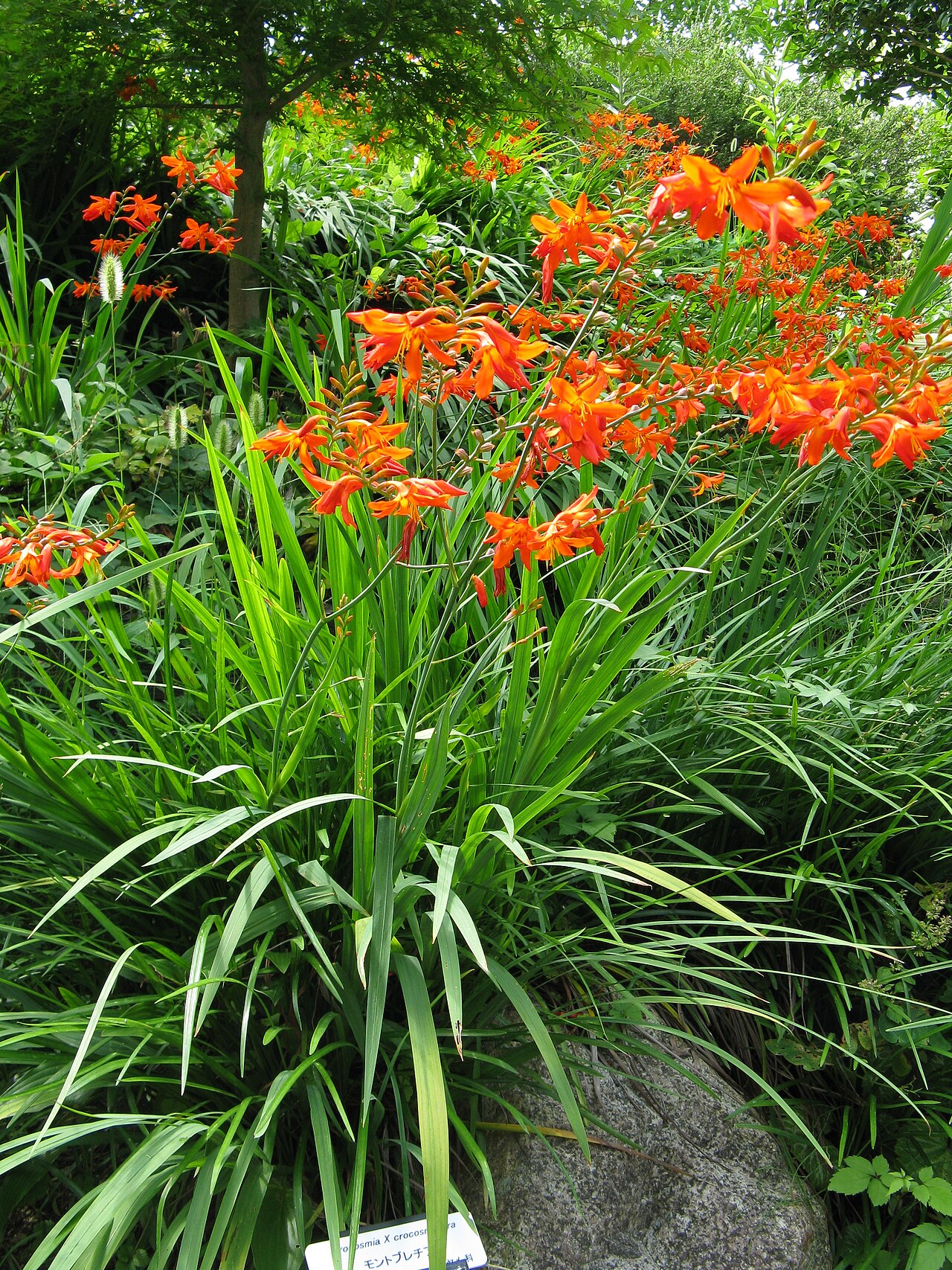
Crocosmia × crocosmiiflora is a cormous perennial in the family Iridaceae, a hybrid of C. aurea and C. pottsii, both native to southern Africa; the hybrid originated in cultivation in France around 1880. Plants form clumps 2–3 feet (60–90 cm) tall and 1–2 feet (30–60 cm) wide from corms that multiply by stolons into chains. Leaves are sword-shaped, pleated, 1.5–2.5 feet (45–75 cm) long and 0.5–1 inch (1.2–2.5 cm) wide, and arranged in flat fans. Flowers are funnel-shaped, orange to orange-red, 1–2 inches (2.5–5 cm) long, and borne in arching, one-sided spikes from July to September. Fruit is a round capsule holding rounded orange-red seeds. Plants are hardy in USDA zones 6–9, and corms in zones 6–7 are protected by winter mulch. The hybrid has naturalized in parts of western Europe, Australia, New Zealand, and the Pacific coast of North America, where it spreads by corms and forms dense stands. Foliage browns in dry summers and after frost.
Native Range
A garden hybrid of two species native to southern Africa, raised in France around 1880. Naturalized in parts of western Europe, Australia, New Zealand, and the Pacific coast of North America.Suggested Uses
Used in mixed borders, cottage gardens, and as a cut flower, planted in groups of five to nine corms. Flowers attract hummingbirds. Spread by corms and seed limits use near natural areas in regions where the hybrid has naturalized.How to Identify
Appearance
Size & Dimensions
Height2' - 3'
Width/Spread1' - 2'
Bloom Information
Flowers open from July to September, with buds opening in succession from the base of each spike. Individual flowers last 3–5 days, and each spike remains in flower for 2–3 weeks. Flowers are visited by hummingbirds and bees. Plants flower in the first or second year after planting.
Detailed Descriptions
Flower Description
Orange to orange-redFoliage Description
Medium greenGrowing Conditions
Sun Requirements
Requires 5-8 hours of direct sunlight daily
• Full Sun: 6+ hours of direct sunlight
• Partial Shade: 3-6 hours of direct sunlight
• Full Shade: Less than 3 hours of direct sunlight
Care & Maintenance
Care Guide
Growth and flowering are heaviest in full sun to light shade in moist, well-drained soil of pH 6.0–7.0. Corms are planted 3–4 inches (8–10 cm) deep in spring, spaced 6–9 inches (15–23 cm) apart. Water is applied at 1 inch (2.5 cm) per week during growth, and plants wilt in prolonged drought. Cold hardiness is USDA zones 6–9, and a 3–4 inch (8–10 cm) layer of mulch protects corms in zones 6–7. Overcrowded clumps flower less and are divided every 3–4 years.Pruning
Spent flower spikes are cut back to the foliage after blooming to prevent seed formation. Foliage is cut to 2–3 inches (5–8 cm) above ground in late autumn or early spring after it browns. Clumps are lifted and divided in early spring every 3–4 years. Divisions are replanted at the original depth.Pruning Schedule
Prune: March & November
fallearly spring
Container Growing
Suitable for container growing
Minimum container size: 3 gallons