Overview
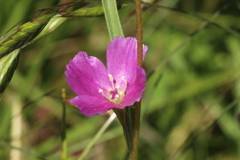
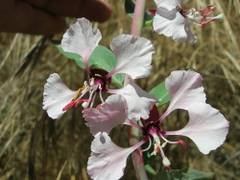
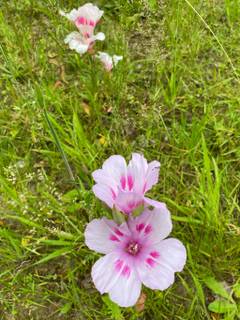
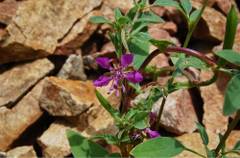
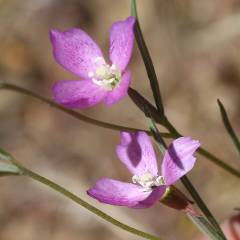
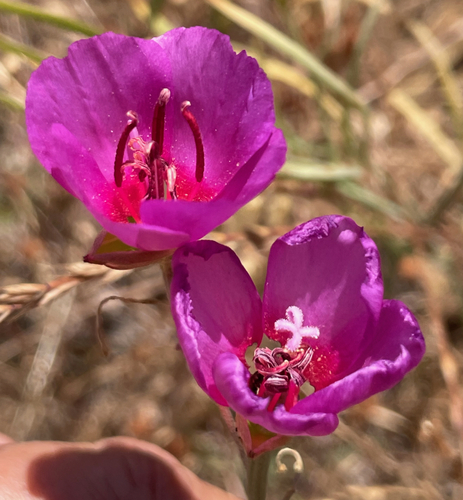
Clarkia rubicunda is an annual in the evening-primrose family, growing 1-3 feet (30-90 cm) tall on slender, often reddish stems that may stand erect or sprawl. The alternate leaves are narrow, lance-shaped, 1-2.5 inches (2.5-6 cm) long, and sparsely set along the stem. Nodding buds open into bowl- to cup-shaped flowers 1-2 inches (2.5-5 cm) across, each with four fan-shaped petals in pink to lavender, marked with a deeper red to purple spot or flush toward the base that forms a ring in the cup. Flowering comes late in the season, from late spring into summer, as the annual grasses around it dry, giving the plant its farewell-to-spring name. It grows on open slopes, coastal bluffs, grassland, and disturbed ground and depends on winter and spring rain, finishing its life cycle as the soil dries. It self-sows freely on bare ground and reappears from seed each year. In rich, moist, or shaded sites it grows leggy and flowers less.
Native Range
Clarkia rubicunda is native to the central California coast, including the San Francisco Bay Area and adjacent Coast Ranges. It grows on coastal bluffs, open slopes, grassland, and disturbed ground, mostly at low elevations near the coast.Suggested Uses
Ruby chalice clarkia is used in wildflower meadows, native annual plantings, and dry sunny borders for late spring and summer color. It suits open, well-drained ground sown with other California annuals. It self-sows to form drifts where soil is left bare between plants.How to Identify
Appearance
Size & Dimensions
Height1' - 3'
Width/Spread6" - 1'6"
Bloom Information
Flowering occurs late in the season, generally May through July, after many spring wildflowers have finished. The cup-shaped flowers open a few at a time over several weeks as the soil dries. Slender seed capsules follow and split to release small seed.
Detailed Descriptions
Flower Description
pink to lavender with a red basal spotFoliage Description
greenGrowing Conditions
Sun Requirements
Requires 6-12 hours of direct sunlight daily
• Full Sun: 6+ hours of direct sunlight
• Partial Shade: 3-6 hours of direct sunlight
• Full Shade: Less than 3 hours of direct sunlight
Water & Climate
Water Needs
Drought Tolerance
Drought tolerant when established
Care & Maintenance
Care Guide
Ruby chalice clarkia grows in full sun on dry, well-drained sandy, rocky, or loamy soils and lives on winter and spring rainfall. It needs little or no summer water and finishes its cycle as the ground dries. Rich, moist, or shaded soil makes it grow tall and floppy with fewer flowers. As an annual, it has no winter-hardy structure and survives only as seed in the soil. It self-sows readily on open ground, returning each year where soil stays bare. Sowing seed in fall or early spring suits its natural rhythm.Pruning
As an annual, the plant is not pruned. Spent plants can be left to scatter seed or pulled once they dry and finish flowering. Removing plants before seed set reduces self-sowing for the next year.Toxicity
Non-toxicPlanting Guide
Planting Methods & Timing
Planting Method
direct sow
Direct Sow Timing
fall or early spring
Days to Maturity
100–130 days
Plant Spacing
12 inches